
Market Position and Market Share
Disco Corporation holds an undisputed global leadership position in semiconductor backend precision processing equipment, operating with near-monopoly economics in its core niches. The company specializes in the “Kiru, Kezuru, Migaku” (Cut, Grind, Polish) domains.
- Dicing Saws:Disco commands approximately 70% to 80% of the worldwide market for semiconductor dicing equipment, ranking #1 globally.
- Grinders and Polishers: In wafer edge and surface grinders/polishers, Disco controls roughly 65% to 70% of the global market, ranking #1 globally.
- Consumables (Dicing Blades & Grinding Wheels): Disco maintains an estimated 50%+ market share globally in precision dicing blades and abrasive grinding wheels. This razor-and-blade model contributes roughly one-third of company revenue and provides countercyclical stability.
Driven by the surge in High Bandwidth Memory (HBM), advanced packaging (CoWoS/2.5D/3D), and silicon carbide (SiC) power semiconductors, Disco’s critical positioning at ultra-thin wafer grinding (down to sub-5 micrometers) has reinforced its monopolistic moat.
Supply Chain Analysis and Key Suppliers
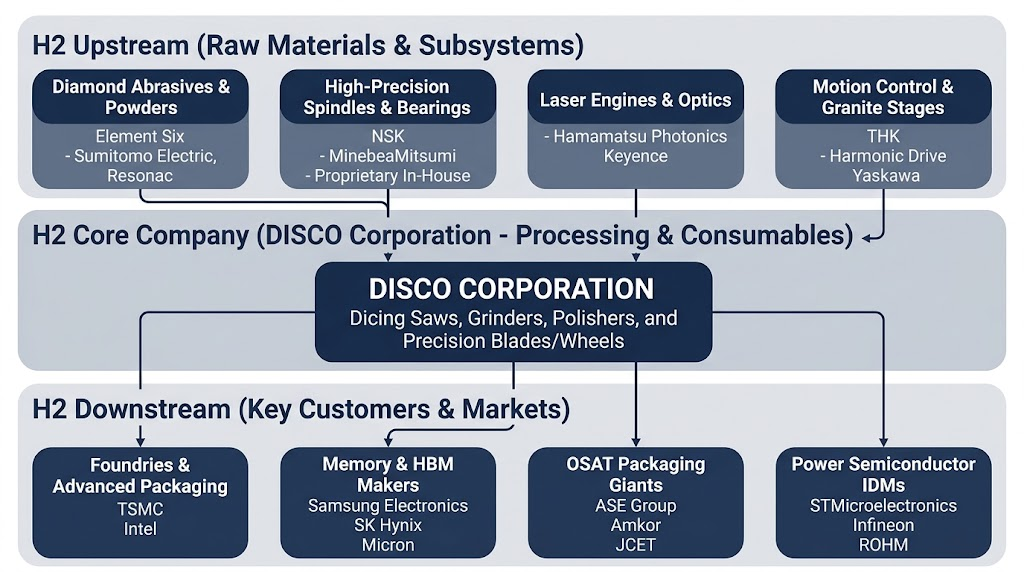
Disco operates a tightly integrated, highly centralized manufacturing structure centered in Japan, ensuring high precision and proprietary process control.
Upstream Supply Chain (Key Inputs & Suppliers):
- Abrasives and Diamond Powder: Crucial for manufacturing high-precision dicing blades and grinding wheels. Synthetic industrial diamond micro-powders and silicon carbide abrasive materials are sourced from advanced material specialists such as Element Six, Sumitomo Electric Industries, and Resonac (formerly Showa Denko).
- Precision Spindles and Air Bearings: Spindle units rotating at ultra-high speeds (up to 60,000–80,000 RPM) with minimal runout are vital for mechanical dicing. Disco insources the assembly and design of proprietary air-bearing high-frequency spindles to protect trade secrets, procuring high-grade bearings and specialized steel from suppliers like NSK Ltd. and MinebeaMitsumi.
- Laser Sources and Optical Engines: For stealth dicing (SD) and laser grooving tools, laser engines and precision optics are supplied by laser specialists such as Hamamatsu Photonics (co-developed stealth dicing engine IP) and optical component makers including Keyence and Olympus/Evident.
- Motion Control and Subsystems: Ultra-precise linear encoders, granite stages, motion controllers, and precision servomotors are sourced from Japanese mechatronics specialists, including Harmonic Drive Systems, Yaskawa Electric, and THK Co., Ltd.
Manufacturing and Operational Architecture:
- Disco concentrates 100% of its equipment and precision tooling manufacturing inside Japan (primarily at its Kure and Kuwabata plants in Hiroshima Prefecture, alongside the Chino plant in Nagano).
- Over 80% of Disco’s revenue originates overseas (predominantly Taiwan, China, South Korea, and the United States), creating a currency dynamic where a weaker Yen expands operating margins.
Downstream Supply Chain (Customers & Applications):
- Foundries & IDMs:TSMC, Intel, Samsung Electronics, SK Hynix, and Micron Technology. In HBM production, Disco’s ultra-precision grinding tools thin DRAM dies before Through-Silicon Via (TSV) stacking.
- Outsourced Semiconductor Assembly and Test (OSAT):ASE Technology Holding, Amkor Technology, JCET, and SPIL, which deploy high-volume mechanical dicing lines for logic, memory, and analog devices.
- Power Semiconductor Manufacturers:STMicroelectronics, Infineon Technologies, Wolfspeed, and ROHM, which utilize Disco’s KABRA laser slicing and specialized dicing tools for brittle SiC and GaN substrates.
Competitor Analysis: Technical and Financial Comparison
Disco’s primary direct competitor is Tokyo Seimitsu (Accretech), with additional presence from ASMPT and regional niche toolmakers.
Key Competitors:
- Tokyo Seimitsu (Accretech – 7729.T):The primary competitor in dicing saws and wafer polishers/grinders. Also operates a large metrology instruments business.
- ASMPT Limited (0522.HK): Competes in downstream packaging and surface mount technology (SMT), offering laser singulation and saw dicing solutions mainly for mid-to-entry OSAT lines.
- Advanced Dicing Technologies (ADT): A specialized dicing equipment provider (acquired by China’s CETC) targeting cost-sensitive dicing segments.
Technical Comparison:
- Mechanical Dicing & Grinding: Disco holds a technical advantage in vibration dampening, automated alignment optics, and proprietary spindle stability. While Tokyo Seimitsu produces capable dual-spindle dicing saws, Disco’s machines achieve tighter kerf widths and minimize die chipping on sensitive ultra-low-k dielectric layers.
- Consumables Lock-in: Unlike Tokyo Seimitsu, Disco formulates and manufactures tens of thousands of custom-tailored dicing blade specifications (resin, metal, and vitrified bonds). Machines are calibrated to perform optimally with Disco blades, creating a self-reinforcing technical lock-in.
- Laser Processing & Slicing: Disco developed KABRA (Keying Applied Brilliance), an ingots-to-wafer laser slicing method that drastically reduces kerf loss when slicing SiC ingots compared to diamond wire saws. While Tokyo Seimitsu licenses Hamamatsu’s stealth dicing technology, Disco holds comprehensive end-to-end integration covering surface prep, laser modification, and subsequent mechanical separation.
Financial Comparison:
- Gross Margin & Operating Margin:Disco consistently outperforms Tokyo Seimitsu.Disco’s gross margin operates in the 65% to 70% range, and operating margin regularly reaches 35% to 40%+, supported by high-margin consumables and proprietary pricing power.In contrast, Tokyo Seimitsu’s corporate operating margin typically ranges between 18% and 23%, roughly one-third lower than Disco’s.
- Return on Invested Capital (ROIC) & ROE: Disco maintains an average ROIC exceeding 20% to 25% across cycles (compared to Tokyo Seimitsu’s 12% to 16%).
- Balance Sheet Strength:Disco carries zero interest-bearing debt and maintains a massive net-cash reserve representing over 1.5x of its annual EBITDA, shielding it from semiconductor downcycles. Tokyo Seimitsu also maintains a healthy balance sheet, but with smaller overall cash generation capacity.
- Valuation Multiples: Disco consistently commands premium valuation multiples (EV/EBITDA of 22x–28x, forward P/E often above 30x–40x) reflecting its monopolistic pricing power in advanced packaging, compared to Tokyo Seimitsu’s more traditional cyclical equipment multiples (forward P/E typically 14x–18x).
Sources
- https://www.disco.co.jp/
- https://sifterfund.com/en/disco-corporation-a-japanese-leader-in-a-niche/
- https://www.digitimes.com/news/a20240110PD201/disco-semiconductors-equipment-hbm-sic.html
- https://gabelli.com/research/gabelli-japan-research-finding-technology-leaders/
- https://uk.advfn.com/stock-market/USOTC/DSCSY/competitors
- https://www.mordorintelligence.com/industry-reports/dicing-equipment-market
back to Disco