
According to the Wells Fargo Fourth Quarter 2025 earnings report, the most critical changes this quarter lie in the major breakthrough regarding regulatory restrictions and the upward revision of financial targets:
Major Operational and Regulatory Changes
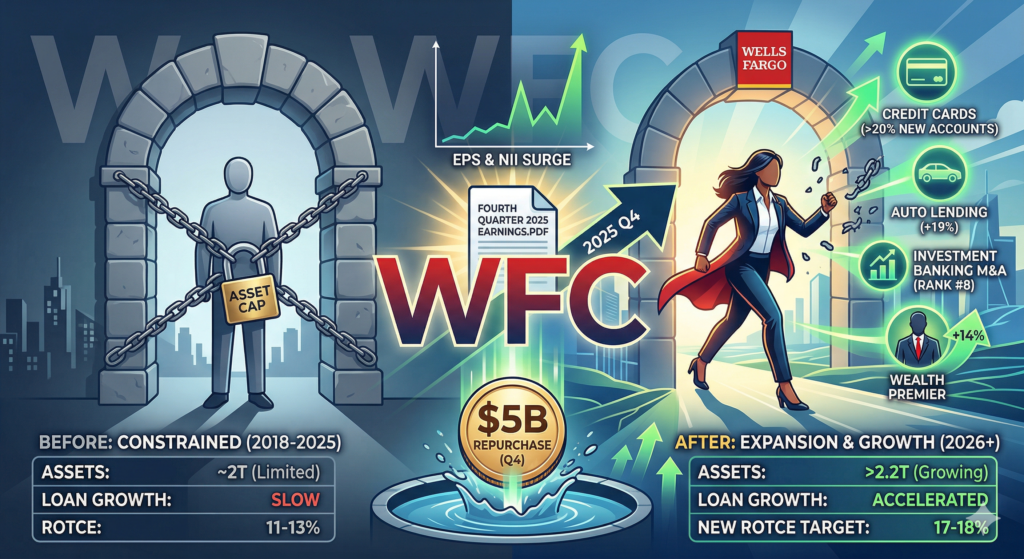
- Removal of the Asset Cap: The Federal Reserve has formally removed the asset growth restriction imposed on Wells Fargo since 2018. This means the bank is no longer limited to an asset size of approximately $2T and can now freely expand its balance sheet to pursue more business opportunities.
- Termination of Multiple Consent Orders: In addition to the asset cap, several regulatory consent orders related to past sales practices have been terminated, signaling that the company’s transformation in compliance and risk management has gained regulatory recognition.
- Upward Revision of Financial Targets: Due to the lifting of operational constraints and improved efficiency, the company has raised its medium-term Return on Average Tangible Common Equity (ROTCE) target from 15% to 17-18%.
Business Performance Changes
- Accelerated Loan Growth: Benefiting from the lifting of restrictions, average loans in the Corporate and Investment Banking (CIB) segment grew 14% YoY. In consumer lending, credit card spending and auto loan balances grew 20% and 19% respectively.
- Investment Banking Ranking Improvement: Investment banking fees increased 14%, and the company’s M&A market ranking climbed from 12th to 8th.
- Significant Improvement in Efficiency Ratio: The efficiency ratio dropped to 64% this quarter (compared to 68% in the same period last year), demonstrating effective expense control alongside revenue growth.
Credit and Capital Changes
- Substantial Capital Returns: The company returned $23B to shareholders in full-year 2025, including $18B in share repurchases. In Q4 alone, $5B of common stock was repurchased.
- Stable Credit Performance: Although Commercial Real Estate (CRE), particularly the office portfolio, remains under pressure (with a slight increase in nonaccrual loans), total net charge-offs decreased 13% compared to the previous year.
According to the Wells Fargo Fourth Quarter 2025 earnings report and comments from CEO Charlie Scharf, the company’s growth momentum for 2026 (starting next quarter) will primarily stem from several core areas:
1. Balance Sheet Expansion Following Asset Cap Removal
With the Federal Reserve officially lifting the asset cap, Wells Fargo can finally compete on a level playing field. The company has explicitly stated it will dedicate more resources to balance sheet growth, particularly in commercial lending and corporate credit, which will serve as a direct revenue driver in the coming quarters.
2. Strong Momentum in Consumer Banking
- Credit Cards: New account growth exceeded 20% year-over-year, and card spending continues to show robust growth.
- Auto Lending: This business has returned to a growth trajectory, with balances increasing 19% compared to the previous year.
- Wealth Management Penetration: Deposits and investment balances for the affluent offering, Wells Fargo Premier, grew 14% year-over-year, indicating that cross-selling strategies are gaining traction.
3. Market Share Gains in Investment Banking and Markets
The company continues to expand its market share in investment banking, with its M&A ranking improving from 12th to 8th. As the market environment improves and operational constraints are removed, investment banking fees and market trading revenue are expected to be key contributors to non-interest income growth.
4. Continued Optimization of Operating Efficiency
The new ROTCE target of 17-18% is fueled by the financial flexibility gained from $15B in cumulative expense reductions over the past five years. The company will continue to leverage automation and process simplification to reinvest cost savings into infrastructure and business expansion.
5. Monetization of Digital and Technology Investments
Continuous investment in technology and equipment aims to enhance the digital customer experience and reduce service costs. As new platforms and digital tools gain adoption, the company expects to attract a younger demographic and increase the stickiness of its existing customer base.
Based on the latest analyst projections and the 2026 annual outlook released by Wells Fargo in January, the EPS for the coming year is expected to show steady growth, benefiting from scale expansion following the removal of the asset cap.
The following is the projected trend and range for EPS over the next year:
2026 EPS Forecast Range
According to consensus estimates from various brokerage analysts (including Zacks, Simply Wall St, and MarketBeat), the market consensus range for full-year 2026 EPS is as follows:
- Market Consensus Target: 6.87 to 6.99 USD
- Optimistic Estimate (High): Approximately 7.15 to 7.25 USD
- Conservative Estimate (Low): Approximately 6.50 to 6.60 USD
Compared to the reported 2025 annual EPS of 6.26 USD, this represents a projected growth potential of 6.6% to over 10%.
Key Drivers Impacting EPS Trends
- Expansion of Net Interest Income (NII): The company expects 2026 NII to be approximately 50B. With the asset cap removed, Wells Fargo can expand its loan portfolio (especially in credit cards and auto loans, which showed strong momentum in 2025), directly contributing to earnings.
- Capital Return Program: The company repurchased a substantial 18B in stock during 2025. Analysts expect a continued aggressive repurchase pace in 2026, which will boost EPS by reducing the number of shares outstanding.
- Decline in Efficiency Ratio: Market expectations suggest the efficiency ratio will further improve to the 62-63% range in 2026, down from 64-66% in 2025. This increased operating leverage will translate into higher per-share earnings.
- Upward Revision of ROTCE Targets: Management has set a medium-term return target of 17-18%, signaling strong confidence in profitability over the coming quarters.
Potential Risk Factors
- Credit Costs: If default rates in Commercial Real Estate (CRE), particularly the office sector, exceed expectations in 2026, increased provisions could erode EPS growth.
- Interest Rate Environment: NII performance remains highly dependent on the Federal Reserve’s interest rate policy; a faster-than-expected decline in rates could pressure net interest margins.
In summary, most analysts believe Wells Fargo has entered a “harvest period” in the post-regulatory era, with a high probability of EPS stabilizing above 6.80 USD over the next year.
Based on the Q4 2025 financial data (released in January 2026) and market analysis, Wells Fargo has demonstrated a clear “catch-up and rebound” posture within the competitive landscape of major U.S. banks. Following the removal of the asset cap, its competitive relationship with JPMorgan (JPM), Bank of America (BAC), and Citigroup (C) has seen the following shifts:
1. Competition in Asset Size and Market Share
- From Restricted to Full Competition: For the past eight years, Wells Fargo was constrained by a $2T asset cap, forcing it to forfeit many low-margin but scale-building businesses. With the removal of restrictions in early 2026, Wells Fargo’s assets grew by 11% YoY, showing stronger “catch-up” momentum than JPM or BAC.
- Leap in Investment Banking Rankings: In the investment banking sector, Wells Fargo’s U.S. M&A ranking rose from 12th to 8th. While a gap remains with JPM’s top position (8.4% wallet share), Wells Fargo has begun capturing market share from second-tier banks.
2. Profitability and Efficiency Ratio
- Most Significant Efficiency Improvement: Wells Fargo’s efficiency ratio dropped rapidly from 68% at the end of 2024 to 64% by the end of 2025 (analysts even project it could reach 62.9% in 2026).
- Peer Comparison:
- JPMorgan: Maintains a lead in scale and diversification, but its NII momentum is expected to normalize as the interest rate environment shifts in 2026.
- Bank of America: Despite consumer strength, its NIM improvement is slower than Wells Fargo’s due to a large portfolio of low-rate long-term bonds.
- Citigroup: Still undergoing a multi-year transformation and simplification plan; while EPS growth is notable, overall efficiency and earnings stability remain under testing.
3. Competitive Landscape by Business Line
| Business Line | Wells Fargo Competitive Shifts | Performance Relative to Peers |
| Credit Cards | New accounts up >20% YoY; extremely fast growth. | Starting to directly challenge the dominance of JPM and Citi in the high-end card segment. |
| Auto Lending | Balances up 19% YoY; return to growth. | Actively reclaiming lost market share while peers maintain more conservative strategies. |
| Wealth Management | Premier service deposits/investments grew 14%. | While smaller than Morgan Stanley or JPM, its growth rate is leading the pack. |
| Investment Banking | Entered the Top 8; fees grew 14%. | Beginning to compete directly with Goldman Sachs and Morgan Stanley in M&A advisory. |
4. The 2026 Battlefield
- Net Interest Income (NII): As the Fed paused rate cuts in early 2026 (holding at 3.50-3.75%), the competition among banks has shifted from “who has the largest spread” to “who can expand loan volumes most effectively.” Due to its lower base and recent deregulation, Wells Fargo is viewed as having the highest NII growth potential in 2026.
- Capital Returns: Wells Fargo returned 23B in 2025, representing a very high percentage of its market cap. This aggressive capital deployment makes it more competitive than BAC in attracting value investors.
Summary
Wells Fargo is transitioning from a “sanctioned entity” to an “aggressive expander.” In the 2026 competitive environment, it is no longer just defending profits but is leveraging its massive branch network and post-restriction funding advantages to go on the offensive across credit cards, auto loans, and mid-sized corporate lending, threatening the market shares of JPM and BAC.
Source:
- https://www.wellsfargo.com/assets/pdf/about/investor-relations/earnings/fourth-quarter-2025-earnings.pdf
- Morningstar/MarketWatch – Wells Fargo 2026 Outlook
- MarketBeat – WFC Earnings Date and Reports 2026
- Simply Wall St – WFC Forecast
Back to Wells Fargo page