
Corporate History
Origins and Expansion (1968–2006)
Unibail was founded in France in 1968 as a finance-leasing entity under Worms & Cie. By the early 1990s, the company pivoted entirely away from financial leasing to specialize directly in commercial property investment. It rapidly acquired prime assets in the Paris region, including the Forum des Halles, key office towers in La Défense, and major convention properties. In parallel, Rodamco Europe grew as a major Dutch retail property fund established in 1999 following the split of the original Rodamco group.
European Consolidation: The Unibail-Rodamco Merger (2007–2016)
In 2007, Unibail merged with Rodamco Europe in a multi-billion euro transaction, creating Unibail-Rodamco, the undisputed market leader in continental European retail real estate. Over the next decade, the combined entity streamlined its holdings, focusing strictly on high-performing flagship assets in wealthy urban centers and divesting secondary properties.
The Westfield Mega-Acquisition and Restructuring Crisis (2017–2020)
In December 2017, Unibail-Rodamco announced the acquisition of Westfield Corporation for approximately $25 billion, closing the transaction in 2018 to establish Unibail-Rodamco-Westfield. The purchase brought premier UK and US shopping centers under one brand but saddled the group with substantial debt. When pandemic lockdowns hit retail real estate in 2020, URW faced severe solvency challenges. An activist investor rebellion led by Xavier Niel and Léon Bressler rejected a planned €3.5 billion capital increase, ousted the legacy leadership, and mandated aggressive debt reduction via large-scale property disposals.
Deleveraging and Strategic Realignment (2021–Present)
URW initiated multi-billion euro divestment programs to shed non-core US and European assets while retaining its most lucrative flagship locations. Under its 2025–2028 “Platform for Growth” business plan, the company executed over €2.2 billion in disposals, simplified corporate overhead, and expanded into asset-light licensing and retail media monetization.
Business Model and Strategy
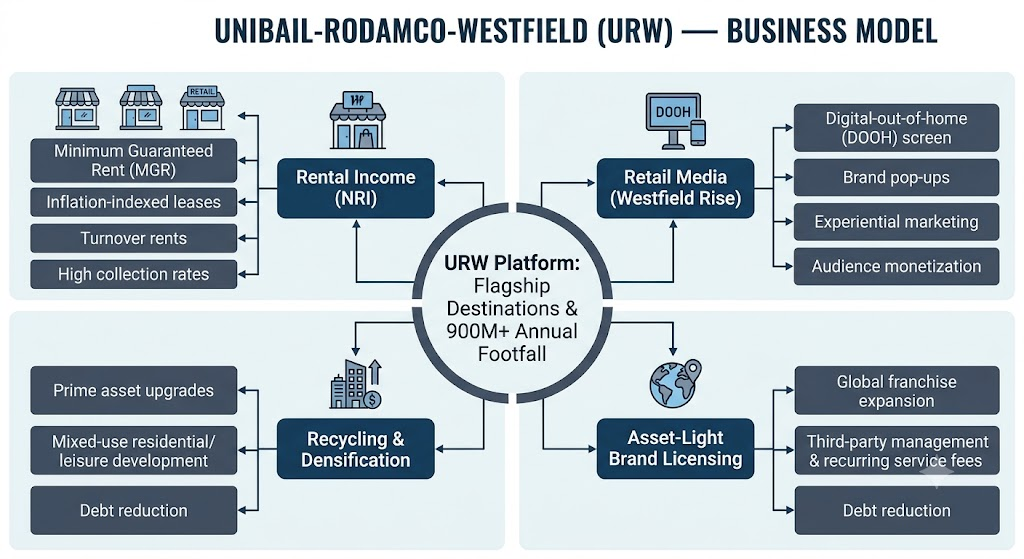
URW generates revenue primarily through long-term real estate rental contracts, high-margin retail media, and capital-light brand licensing:
- Gross and Net Rental Income (NRI): The foundation of URW’s revenue is Minimum Guaranteed Rent (MGR), typically structured with multi-year leases (over 80% long-term contracts) indexed to inflation, plus turnover-linked rents. The group generates over €2 billion in annual shopping center Net Rental Income, maintaining an EBITDA margin of around 65% and high collection rates. Its European retail vacancy sits at a tight 3.3% to 4.6% overall.
- Retail Media and In-House Agency (Westfield Rise): URW monetizes its 900+ million annual footfall through Westfield Rise, an in-house media and brand experience agency. Operating digital-out-of-home (DOOH) screens, experiential pop-ups, and customer data monetization, Westfield Rise produced €112 million in net income in 2025, with a target of reaching €180 million by 2028.
- Brand Licensing and Third-Party Management: To scale without capital-heavy development, URW licenses the “Westfield” brand internationally. For example, it secured a multi-asset deal with Saudi Arabia’s Cenomi Centers, generating recurring service and franchise revenues projected to add €25 million to €35 million in annual EBITDA by 2028.
- Balance Sheet Optimization & Capital Recycling: URW uses selective capital recycling, selling mature or non-core assets to reduce net debt (from €21.9 billion to under €20 billion) and pushing Loan-to-Value (LTV) toward its 40% target, while reinvesting into prime asset densification (residential, leisure, mixed-use).
Sources for Business Model Information
- https://assets.eu.ctfassets.net/1e76kztii87u/3EgtykFET5bONGbtbLLBAP/9b87b4f87155a1cc1ba611d80112116b/01-URW_presents__A_Platform_for_Growth__2025-28_business_plan.pdf
- https://ml-eu.globenewswire.com/Resource/Download/83364e11-34ae-4e59-ab65-d03408674f0e
- https://www.globenewswire.com/news-release/2025/02/13/3025589/0/en/unibail-rodamco-westfield-reports-fy-2024-earnings.html
- https://www.investing.com/news/company-news/unibailrodamcowestfield-h1-2026-slides-vacancy-hits-multiyear-low-93CH-4823206
AI Strategy, Budget, and Partnerships
URW’s technology and AI roadmap focuses on customer journey monetization, smart building operations, and operational administrative automation rather than proprietary fundamental research:
- Audience Measurement and Predictive Analytics (Digeiz Partnership): URW partnered with French AI computer-vision startup Digeiz to deploy AI-based foot-traffic analysis across more than 24 European shopping malls. Using neural network video processing with over 95% accuracy, the system tracks customer paths, dwell times, and storefront conversion rates without storing personal biometric data. This algorithmic data feeds Westfield Rise and helps retail tenants calibrate window displays and merchandising layouts.
- Customer Sentiment and Real-Time Feedback (Goodays): Implemented across more than 50 centers in 11 countries, URW uses Goodays Connect’s NLP-driven platform to aggregate thousands of real-time customer feedback points across QR codes, Google reviews, and digital channels, boosting customer retention by 54% among previously dissatisfied visitors.
- Building Operations and Digital Twins: To meet strict environmental ESG and cost reduction goals, URW invested in cloud-based Digital Twin and predictive modeling systems for high-consumption complexes such as Westfield Stratford City. The predictive energy optimization software resulted in a 35.62% drop in operational energy consumption with a rapid capital payback period under 11 months.
- Back-Office Automation and Tech Spending: The group maintains an annual ICT and digital budget running in the tens of millions of euros, managed as part of its recurring ~€600 million annual capital and maintenance expenditure envelope. Priority deployments include automated AI contract processing for leasing agreements, invoice processing, and property data consolidation, contributing to ongoing overhead reductions and corporate simplification.
Back to URW