
The history of Union Pacific Corporation can be divided into several key development stages:
Phase 1: Foundation and the Transcontinental Link (1862–1869)
In 1862, President Abraham Lincoln signed the Pacific Railroad Act, chartering the company to build the eastern leg of the first transcontinental railroad. In 1869, Union Pacific met the Central Pacific Railroad at Promontory Summit, Utah, completing the project. This feat revolutionized westward expansion and established a new era for American logistics.
Phase 2: Expansion and Restructuring (1870–1980s)
Following rapid late-19th-century expansion and subsequent bankruptcies, the company entered a long period of consolidation. During this era, Union Pacific focused on acquiring smaller branch lines, refining its western rail network, and investing in technological advancements to improve operational capacity and efficiency.
Phase 3: Major Mergers and Network Consolidation (1990s–Early 2000s)
This period marked a significant transformation into a modern logistics giant. In 1995, Union Pacific acquired the Chicago and North Western Railway for approximately 5.4B USD. This was followed in 1996 by the acquisition of the Southern Pacific Railroad for approximately 3.9B USD. These mergers solidified the company’s dominance in the western U.S. market, providing control over critical ports and industrial corridors.
Phase 4: Precision Railroading and Technical Optimization (2010s–Present)
In recent years, the company has focused on implementing Precision Scheduled Railroading (PSR) strategies to optimize transit times while reducing fuel and labor costs. Simultaneously, Union Pacific continues to invest heavily in automation, digital tracking systems, and infrastructure upgrades to meet stricter environmental regulations and enhance freight efficiency, maintaining its position as a central pillar of the North American supply chain.
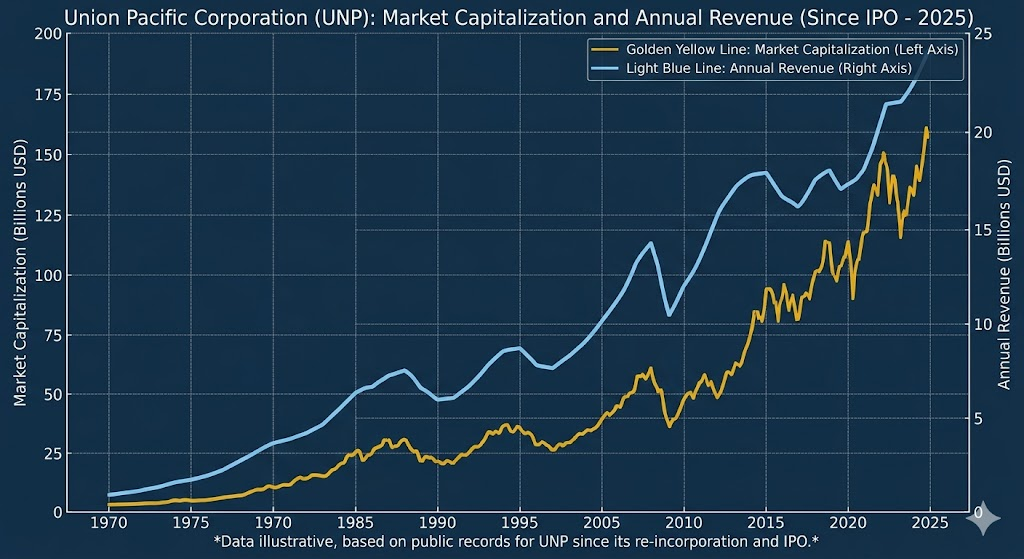
Union Pacific (UP) maintains a leadership position in the North American freight rail market, which is characterized by a high degree of oligopoly. Key competitive aspects are analyzed below:
1. Primary Competitors
- BNSF Railway (a Berkshire Hathaway subsidiary): The most direct competitor to UP in the U.S. West. BNSF possesses immense resources and strong capital backing, leading to intense competition in transcontinental freight, coal, and agricultural product transportation.
- Other Class I Railroads: Such as CSX, Canadian National (CNI), and Canadian Pacific Kansas City (CPKC). While their primary operating regions differ (e.g., CSX dominates the East), they compete dynamically with UP in long-haul logistics and cross-border trade (such as U.S.-Mexico trade) through interline and transfer agreements.
- Logistical Alternatives: Freight rail also faces competitive pressure from trucking, particularly for short-haul and high-value cargo that requires the flexibility and speed of door-to-door delivery.
2. Core Competition: Service and Efficiency
- Precision Scheduled Railroading (PSR): This is the core operational strategy for major North American railroads. By optimizing schedules, increasing asset turnover, and reducing idle time, UP aims to maintain high operating margins.
- Pricing and Service Advantages: Due to the economies of scale inherent in rail transport, a company that provides more stable and reliable service can capture market share from trucking and maintain stronger leverage in pricing negotiations.
3. Current Focus: Norfolk Southern (NSC) Merger Pursuit
UP has been pursuing a potential merger with Norfolk Southern to create a rail network spanning the entire U.S. This move has drawn significant opposition and regulatory scrutiny from other major railroads (such as BNSF, CSX, and CPKC):
- Market Concerns: Competitors argue that the merger could reduce inter-railroad competition and negatively impact freight rates and market access.
- Regulatory Hurdles: The proposed merger is currently under strict review by the U.S. Surface Transportation Board (STB), which remains the primary variable determining UP’s future ability to expand market share and enhance its comprehensive competitiveness.
4. Financial Valuation Comparison
The market typically values UP at a premium compared to the industry median, reflecting investor confidence in its economies of scale, operational efficiency, and robust cash flow. Compared to its peers, UP has demonstrated resilience in navigating industrial cyclicality and fuel cost fluctuations.
Source:
- https://uk.investing.com/news/swot-analysis/union-pacifics-swot-analysis-railroad-stock-navigates-merger-path-93CH-4693404
- https://www.marketbeat.com/stocks/NYSE/UNP/competitors-and-alternatives/
- https://www.supplychaindive.com/news/up-ns-merger-what-other-railroads-are-saying/820011/
Back to Union Pacific page