
Unicredit (UniCredit S.p.A.) is one of Europe’s leading pan-regional banking groups, maintaining a central systemic presence across Western, Central, and Eastern Europe.
Market Position and Market Share
- Overall Regional Position: UniCredit is ranked as the 2nd largest bank in Italy by total assets (behind Intesa Sanpaolo) and holds top-3 market positions in several Central and Eastern European (CEE) countries, as well as Germany (via HypoVereinsbank/UniCredit Bank GmbH) and Austria (via Bank Austria).
- Italian Market Share: Holds approximately 11%(estimated) to 12%(estimated) market share in total domestic customer loans and roughly 10%(estimated) to 11%(estimated) in retail deposits, positioning it directly behind Intesa Sanpaolo (which holds ~18%-20% market share).
- German Market Share: Operates as a top-5 commercial bank in Germany through HypoVereinsbank, accounting for roughly 3%(estimated) to 4%(estimated) of total German corporate and retail lending.
- CEE Dominance: Occupies a top-3 market position across Austria, Austria-adjacent CEE markets, Croatia, Bulgaria, and Bosnia and Herzegovina. In Bulgaria and Croatia, its market share in total assets exceeds 18%(estimated) to 20%(estimated).
- Global Ranking: Ranked among the top 40 largest global banks by total assets, with total consolidated assets exceeding €850 billion(estimated).
Supply Chain, Value Chain, and Key Vendors
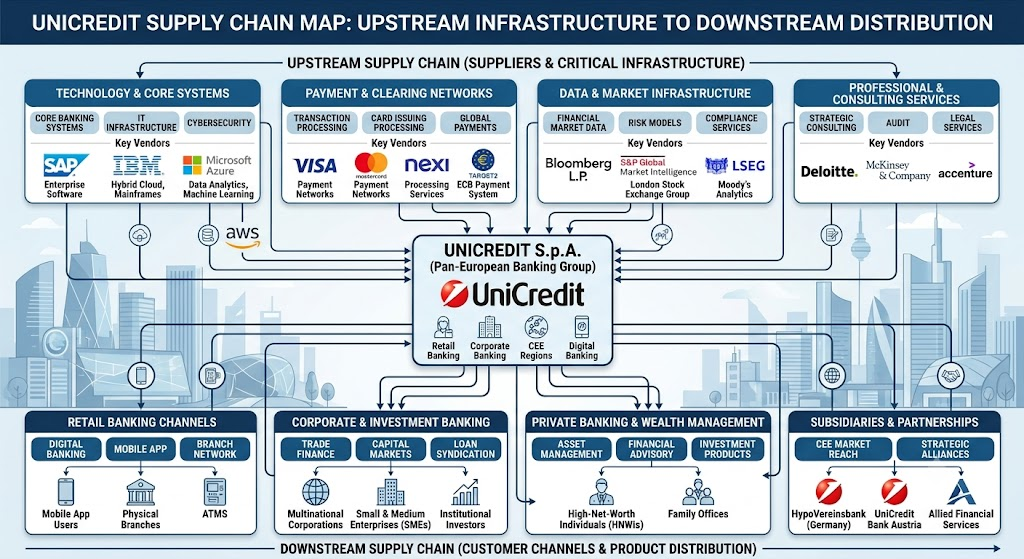
As a financial institution, UniCredit’s “supply chain” comprises upstream critical infrastructure vendors, technology platforms, data centers, and regulatory clearings, feeding into downstream distribution channels for commercial, retail, and investment banking customers.
Upstream Core Infrastructure & Key Vendors
- Core Banking Systems & IT Infrastructure: UniCredit relies heavily on enterprise software for transaction processing and core ledger systems. Key strategic IT vendors include SAP (for financial software and enterprise management platforms) and IBM (for enterprise hybrid cloud infrastructure and legacy mainframe support).
- Cloud Infrastructure & Digital Transformation: The bank utilizes multi-cloud hybrid strategies, partnering with key hyperscalers including Microsoft Azure and Amazon Web Services (AWS) to handle data analytics, customer-facing applications, and risk modelling engines.
- Payment Processing & Cards Clearing: Payments infrastructure and card processing activities rely on global payment networks (Visa, Mastercard) and European payment system processors such as Nexi S.p.A., which manages significant merchant acquiring and card issuing processing services for European banking groups.
- Data, Risk & Market Infrastructure: Financial market data, trade routing, and regulatory compliance data feed directly from key information suppliers including Bloomberg L.P., S&P Global Market Intelligence, and LSEG (London Stock Exchange Group).
Downstream Value Chain Integration
- The downstream network processes trade finance, corporate lending, wealth management, and retail credit products across a physical footprint of over 3,000 branches and fully integrated digital/mobile banking platforms across 13 core European markets.
Competitor Analysis
1. Competitors
- Primary Domestic Competitor: Intesa Sanpaolo (Italy).
- Primary European/Pan-Regional Competitors: BNP Paribas (France), Banco Santander (Spain), Deutsche Bank (Germany), and Erste Group (CEE region).
2. Technological Comparison
- Digital Transformation Efficiency: Under its strategic business plans, UniCredit centralized its IT architecture by streamlining core platform variations across its CEE and Western European subsidiaries. UniCredit’s digital migration rate for retail customers matches peers like Santander (~70%+ digital engagement rate), though Intesa Sanpaolo holds a slight technological edge in domestic digital-only banking via its custom-built digital platform, Isybank.
- Core Platform Modularity: UniCredit has systematically modernized its legacy IT infrastructure to API-first cloud architecture, reducing operational risk relative to legacy-heavy competitors like Deutsche Bank, which faced prolonged IT integration delays.
3. Financial Comparison
- Profitability (RoTE): UniCredit has delivered industry-leading Return on Tangible Equity (RoTE), reaching ~15%-17%(estimated) in recent fiscal cycles, outperforming peers like Deutsche Bank (~7%-9%) and competing closely with Intesa Sanpaolo (~17%-18%) and Banco Santander (~15%-16%).
- Efficiency (Cost-to-Income Ratio): UniCredit maintains a highly disciplined cost base with a Cost-to-Income ratio of ~39%-42%(estimated), outperforming European bank averages (~55%-60%) and Deutsche Bank (~65%-70%), driven by strict cost management under executive leadership.
- Capital Strength (CET1 Ratio): UniCredit maintains one of the strongest capital cushions among European Global Systemically Important Banks (G-SIBs), with a Common Equity Tier 1 (CET1) ratio typically ranging between 15.5% and 16.0%(estimated), significantly higher than BNP Paribas (~13.0%) and Santander (~12.5%).
Sources
Back to UniCredit