
Company History
- Post-War Foundation and Automotive Alignment(1948–1959): Established in 1948 as Nisshin Tsusho Kaisha, Ltd., the company assumed the trading operations of Toyota Industries. Rebranded to Toyoda Tsusho Kaisha, Ltd. in 1956, its early core function focused on domestic vehicle financing, steel procurement, and distribution for Toyota Motor Corporation.
- Global Logistics and Sogo Shosha Expansion(1960–1999): In 1964, Toyoda Tsusho expanded overseas export operations, aligning with Toyota’s international manufacturing footprint. Through domestic mergers—such as with Kasho Co., Ltd. in 2000—it scaled into a comprehensive general trading house, listing on the Tokyo and Nagoya stock exchanges.
- Tomen Merger and Industrial Diversification(2000–2011): In 2006, Toyota Tsusho executed a merger with Tomen Corporation. This expanded its portfolio beyond automotive metal processing into non-automotive chemicals, power infrastructure, agribusiness, and renewable energy generation.
- African Expansion and Green Energy Transition(2012–Present): In 2012, the firm acquired French distributor CFAO, establishing a multi-sector distribution network across Africa. It deepened its energy transition portfolio by acquiring majority control of Eurus Energy Holdings and investing upstream into battery materials, such as lithium extraction in Argentina.
Business Model and Strategy
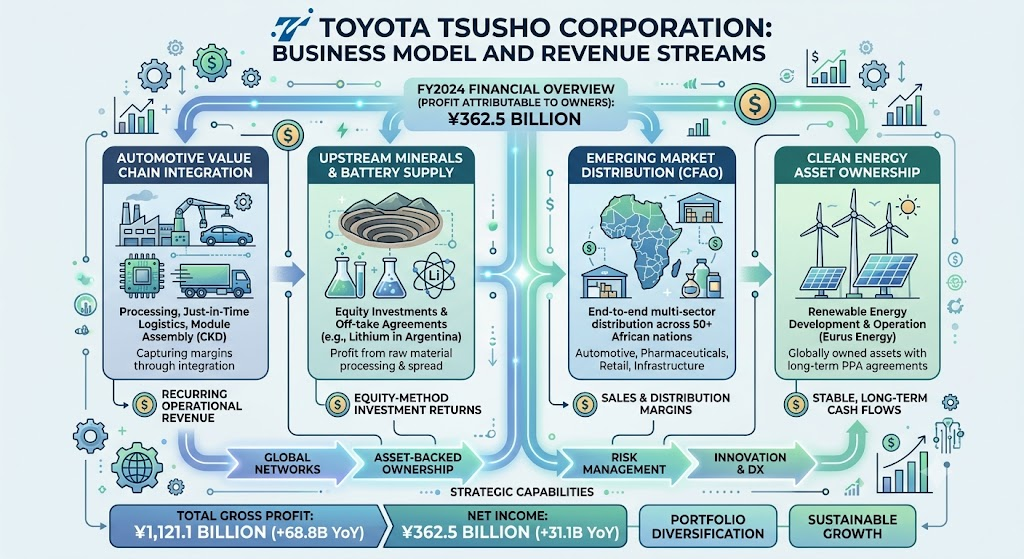
Toyota Tsusho monetizes its global footprint by moving beyond traditional low-margin brokerage fees toward asset-backed operational ownership, integrated value-chain processing, and equity-method investment returns. For FY2024(ended March 31, 2025), the company reported gross profit of 1,121.1 billion yen(+68.8 billion yen YoY)and profit attributable to owners of the parent of 362.5 billion yen(+31.1 billion yen YoY).
Its earning engines comprise four primary mechanisms:
- Automotive Value Chain Integration: The company acts as an operational coordinator rather than a pure distributor. It generates recurring margins by processing automotive steel coils, running just-in-time logistics, and assembling CKD(completely knocked down)vehicle modules.
- Upstream Mineral and Battery Supply Chains: The firm secures equity off-take arrangements in critical raw materials—notably lithium via the Salar de Olaroz project in Argentina—capturing profit spreads from upstream extraction to battery chemical processing.
- Emerging Market Distribution Platform(Africa/CFAO): Monopolizing end-to-end consumer and industrial distribution across over 50 African nations, CFAO monetizes automotive sales, pharmaceutical wholesaling, and retail infrastructure.
- Clean Energy Asset Ownership: Through Eurus Energy Holdings, Toyota Tsusho develops, owns, and operates wind and solar generation facilities worldwide, generating stable, long-term cash flows from utility power purchase agreements(PPAs).
Sources for Business Model Information
- https://www.toyota-tsusho.com/english/press/detail/250428_006573.html
- https://www.toyota-tsusho.com/english/ir/library/integrated-report/
- https://umbrex.com/resources/company-profiles/toyota-tsusho-corp/
AI Strategy, Budget, and Partnerships
Toyota Tsusho structures its digital operations through the “DX 2 AI Beyooond Initiative,” managed by a dedicated DX Acceleration Department and an executive DX Committee established in April 2025. Rather than developing foundational large models in-house, the company acts as a systems integrator and deployment partner, operationalizing enterprise AI and computer vision across heavy industry, global logistics, and inspection workflows.
- Strategic Deployment and Implementation: The internal AI Task Force develops applied generative AI use cases, including automated letter-of-credit(L/C)and shipping documentation drafting, environmental impact Q&A generation, and investment risk assessment models. Across manufacturing operations, the group has deployed computer vision solutions to fully automate legacy coil centers and metal inspection facilities.
- Capital and Budget Allocation: Digital transformation and AI integration are funded through Toyota Tsusho’s broader annual capital expenditure program and corporate venture allocations, complementing the Toyota Group’s multi-billion-dollar technology budget(including the $800 million Woven Capital Fund II and $670 million Toyota Invention Partners). Internal prototyping is accelerated via its “Digital X Lab,” which tests and builds applied AI prototypes within 2-to-4-week sprint cycles.
- Key Commercial Partnerships:
- TradeWaltz: Toyota Tsusho co-founded this cross-industry blockchain and trade data consortium alongside six Japanese trading and banking entities, integrating algorithmic document processing into global trade clearance.
- UVeye: Toyota Tsusho invested in and acts as a commercial distributor for UVeye, deploying AI-powered deep-learning optical drive-through scanners for real-time vehicle underbody and tire safety inspections.
- Zipline & Aerial Logistics: Partnered with autonomous drone logistics platforms to deploy autonomous medical delivery ne
back to Toyota Tsusho