
Corporate History
Origins and Industrial Weaving (1926–1936)
Founded in 1926 by Sakichi Toyoda as Toyoda Automatic Loom Works, Ltd., the company was established to manufacture and commercialize the revolutionary Type G automatic loom. In 1933, the company established an Automobile Department headed by Kiichiro Toyoda, which subsequently developed the Model AA passenger car and was spun off in 1937 to form Toyota Motor Corporation.
Post-War Diversification into Industrial Vehicles and Automotive (1940s–1980s)
Following World War II, the company diversified beyond textile machinery to mitigate cyclical risks. It entered the automotive engine and vehicle assembly business, producing engines and passenger cars for Toyota Motor. In 1953, it began manufacturing automotive air-conditioning compressors. In 1956, the company introduced the Model LA 1-ton forklift truck, establishing the industrial equipment foundation that would become its primary revenue driver.
Global Expansion and Strategic M&A (1990s–2010s)
Renamed Toyota Industries Corporation in 2001, the company expanded globally through large-scale international acquisitions. Key milestones included the acquisition of Sweden’s BT Industries in 2000 (securing European reach and warehouse truck capabilities) and the US-based Raymond Corporation. In 2017, TICO acquired Vanderlande Industries (airport baggage handling and warehouse automation) and Bastian Solutions, transforming the firm from a pure lift-truck manufacturer into an integrated, end-to-end logistics systems integrator.
Electrification, Automation, and Governance Reckoning (2020–Present)
Recent years have centered on warehouse electrification, autonomous vehicle solutions, and addressing compliance crises. Following the 2024 engine certification scandal, TICO initiated structural restructuring of its testing processes, refocused capital on software-driven materials handling, and began addressing cross-shareholdings under broader Tokyo Stock Exchange corporate governance reforms.
Business Model and Strategic Growth
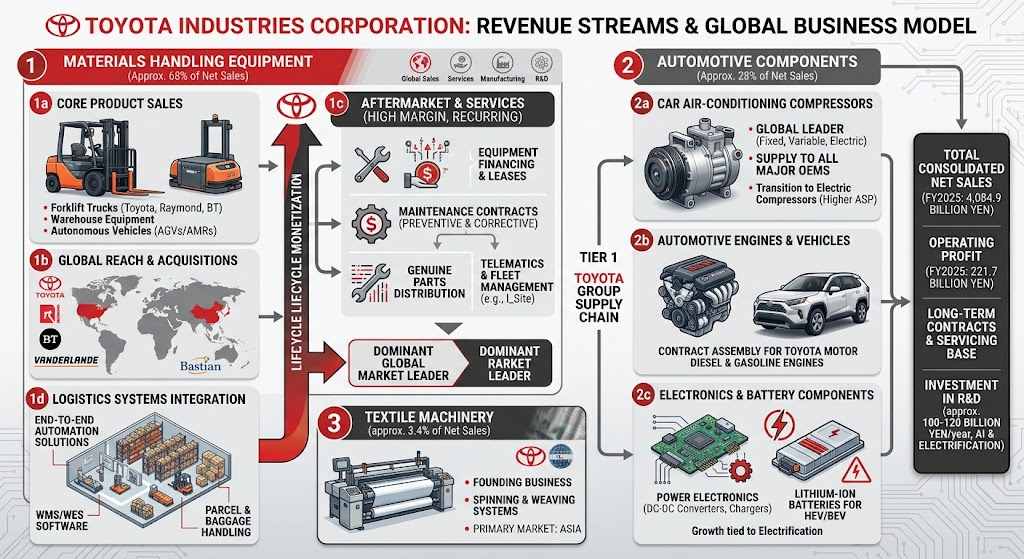
Toyota Industries monetizes primarily through three core mechanisms: industrial capital goods with high-margin recurring aftermarket revenue, tier-1 automotive component manufacturing tied to global vehicle production cycles, and automated logistics systems integration.
Revenue Breakdown and Financial Realities (FY2025 Actuals)
In the fiscal year ended March 31, 2025, TICO delivered consolidated net sales of 4,084.9 billion yen (a 6.6% year-over-year increase) and an operating profit of 221.7 billion yen.
- Materials Handling Equipment (68.2% of Net Sales): Net sales reached 2,786.3 billion yen. The business model does not rely solely on initial hardware sales (Toyota, Raymond, and BT forklifts). It relies heavily on high-margin lifecycle monetization, including equipment financing, operating leases, scheduled maintenance contracts, telematics subscriptions (e.g., I_Site fleet management), and genuine replacement parts. This recurring aftermarket base insulates cash flow during cyclical downturns in industrial capital spending.
- Automobile Segment (28.4% of Net Sales): Net sales reached 1,160.2 billion yen, delivering 45.0 billion yen in operating profit. This segment operates as a Tier-1 supplier and contract assembler:
- Car Air-Conditioning Compressors (480.9 billion yen): Global leader supplying fixed, variable, and electric compressors. As the auto sector transitions to hybrid (HEV) and battery electric vehicles (BEV), electric compressors carry higher average selling prices (ASPs) and software-integrated electronic control units.
- Engine Business (346.1 billion yen): Direct manufacture of diesel and gasoline engines for Toyota vehicles.
- Electronics and Battery Components (230.5 billion yen): High-growth sub-segment providing DC-DC converters, on-board chargers, and lithium-ion batteries.
- Vehicle Assembly (102.5 billion yen): Contract assembly of passenger vehicles, including the Toyota RAV4.
- Textile Machinery and Other (approx. 3.4% of Net Sales): Textile machinery accounted for roughly 60–90 billion yen, primarily serving Asian textile mills with spinning and air-jet weaving systems.
Strategic Growth Engine
TICO’s primary growth strategy is expanding Toyota Advanced Logistics Group (TALG). Through Bastian Solutions and Vanderlande, TICO captures complete warehouse turnkey contracts: hardware (AMRs, AGVs, sorters), proprietary warehouse execution software (WES), and long-term multi-year servicing contracts for e-commerce, parcel distribution, and global airports.
Business Model Information Sources
- https://www.toyota-industries.com/company/item/2025_annual_financial_report_E.pdf
- https://www.toyota-industries.com/company/item/2025_4Q_summary_E.pdf
- https://www.toyota-industries.com/company/item/2024_annual_financial_report_E.pdf
- https://www.toyota-industries.com/company/item/2024_4Q_presentation_E.pdf
Artificial Intelligence Strategy, Budget, and Partnerships
Strategic Objective
TICO’s AI strategy focuses on resolving structural labor shortages in logistics and material handling through vision-based autonomous mobile robots (AMRs), self-driving forklifts, and AI-driven dynamic warehouse fleet orchestration.
R&D Expenditure and Capital Allocation
Toyota Industries allocates approximately 100 to 120 billion yen annually to company-wide research and development, alongside annual capital expenditures exceeding 400 billion yen (488.5 billion yen invested in property, plant, and equipment in FY2025, heavily concentrated in materials handling lease equipment and automation lines). AI-specific research is channeled through dedicated internal advanced engineering centers in Japan, collaborating with the Toyota Research Institute (TRI) and venture capital arms like Toyota Ventures.
Key Partnerships and Implementations
- Gideon (Strategic Investment, September 2024): TICO made a major strategic investment in Croatian AI and 3D computer vision company Gideon. The partnership integrates Gideon’s proprietary visual-perception SLAM (Simultaneous Localization and Mapping) and artificial intelligence algorithms into Toyota’s automated vehicle lineup. Unlike traditional LiDAR-dependent systems that struggle with dynamic, unstructured loading docks, this partnership targets autonomous truck trailer loading and unloading and collaborative pallet transport.
- Third Wave Automation (Strategic Partnership): TICO established a core development partnership with California-based startup Third Wave Automation to co-develop next-generation autonomous reach trucks. Third Wave’s Collaborative Autonomy platform combines machine learning, edge computer vision, and dynamic obstacle detection with remote “shared autonomy” consoles, allowing human operators in a centralized office to supervise and intervene via low-latency teleoperation when edge AI flags low-confidence edge cases.
- Vanderlande AI Vision Sorting: Under the TALG banner, Vanderlande deploys deep-learning vision models for parcel singulation and robot picking (e.g., the Smart Item Robot). Machine vision models identify unstructured packages, calculate optimal gripper contact points in real time, and adjust picking parameters without human pre-programming.
- Autonomous Counterbalanced Lift Trucks: In domestic logistics hubs, TICO has implemented AI algorithms capable of 3D load recognition, dynamically detecting pallet fork pockets even when pallets are misaligned or damaged, and navigating dynamic multi-vehicle environments without fixed physical magnetic tracks or reflective targets.
back to Toyota Industries