
Market Position and Market Share
Tokio Marine Holdings,Inc.(8766.T) is Japan’s largest property and casualty(P&C) insurance group by market capitalization,underwriting profit,and net income,and ranks among the top global diversified insurance conglomerates. In the domestic Japanese non-life market,the industry operates as an oligopoly dominated by three major mega-groups: Tokio Marine Group,MS&AD Insurance Group,and Sompo Holdings.
- Domestic Non-Life Ranking and Share: Tokio Marine ranks #1 in domestic profitability and market capitalization,and alternates between #1 and #2 in domestic net premiums written(NPW) with MS&AD,controlling approximately 30% to 33% of Japan’s direct non-life underwriting market. Its core operating arm,Tokio Marine & Nichido Fire Insurance Co.,Ltd.,is Japan’s single largest P&C insurer.
- Global Footprint and Diversification:Unlike its domestic peers who rely heavily on Japan’s mature market,Tokio Marine generates nearly 50% of its business profits from overseas operations,primarily through premier specialty insurers in North America and Europe. On a consolidated top-line basis(net premiums written plus life premiums),the group writes approximately ¥6 trillion annually,delivering an adjusted net income surpassing ¥1 trillion.
Supply Chain and Critical Supplier Analysis
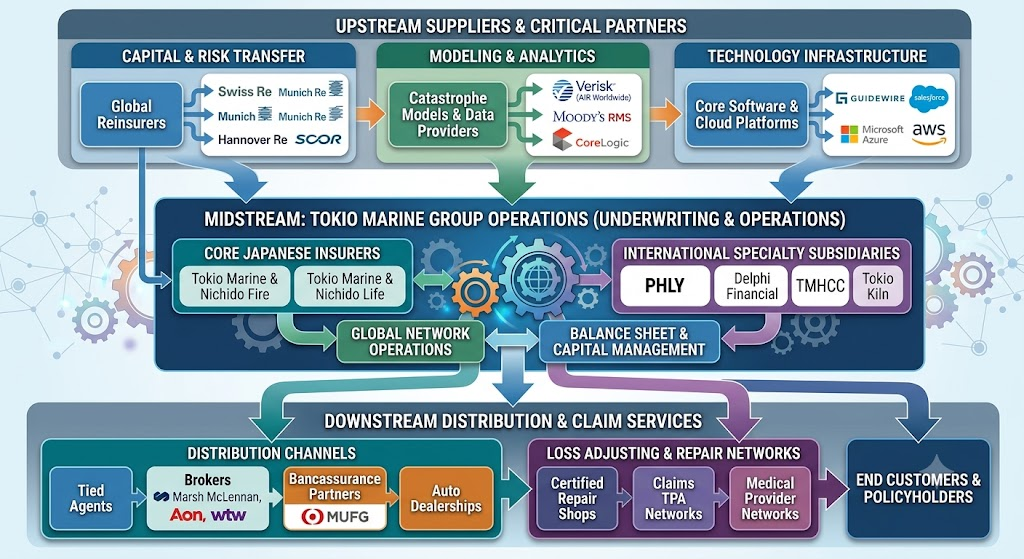
In the financial and insurance ecosystem,the supply chain is structured around capital origination,risk modeling,distribution,underwriting capacity,reinsurance transfer,and claim servicing.
- Upstream(Capital,Risk Capacity,and Reinsurance Suppliers):
- Global Reinsurers: Tokio Marine manages peak catastrophe(CAT) risks—such as typhoons,earthquakes,and hurricanes—by ceding risk to major global reinsurers. Key counterparties include Swiss Re,Munich Re,Hannover Re,and SCOR. These suppliers provide retrocession and catastrophe excess-of-loss treaties that protect the group’s balance sheet.
- Catastrophe Modeling and Risk Analytics Providers: Quantitative risk assessment and exposure management rely heavily on third-party catastrophe risk platforms,specifically Verisk(formerly AIR Worldwide),Moody’s RMS,and CoreLogic.
- Core Enterprise Software and Cloud Infrastructure: Critical infrastructure partners include Guidewire Software(for core policy administration,billing,and claims engines),Salesforce(distribution CRM),and cloud hyperscalers like Microsoft Azure and Amazon Web Services(AWS) to support real-time data processing,actuarial modeling,and digital underwriting.
- Midstream(Group Underwriting and Balance Sheet Operations):
- Core domestic underwriting is conducted via Tokio Marine & Nichido Fire Insurance and Tokio Marine & Nichido Life Insurance.
- International specialty risk is underwritten by specialized acquired subsidiaries: Philadelphia Insurance Companies(PHLY,non-profit and commercial niches in the US),Delphi Financial Group(employee benefits and excess workers’ comp),HCC Insurance Holdings(Tokio Marine HCC,financial lines,surety,and specialty casualty),and Tokio Marine Kiln(Lloyd’s of London syndicates).
- Downstream(Distribution Channels,Loss Adjusters,and Service Networks):
- Agency Networks and Financial Institutions: In Japan,distribution relies on tied agent networks,independent multi-line agencies,corporate agencies(including Mitsubishi Group keiretsu relationships),and bancassurance partnerships with megabanks like Mitsubishi UFJ Financial Group(MUFG).
- Auto Dealerships and Repair Networks: For motor insurance,auto dealerships and certified repair workshops serve as critical downstream point-of-sale agents and claims settlement touchpoints.
- Brokers and Wholesalers: In international markets,distribution is intermediated by major insurance brokerages including Marsh McLennan,Aon,WTW(Willis Towers Watson),and wholesale surplus lines brokers like Ryan Specialty and Amwins.
Competitor Analysis: Financial and Technical Comparison
Tokio Marine’s primary direct peers are the two other Japanese mega-insurers,MS&AD Insurance Group Holdings and Sompo Holdings,alongside global multi-line peers such as Chubb,Allianz,and Zurich.
- Financial Comparison:
- Profitability and Underwriting Discipline: Tokio Marine consistently reports superior underwriting margins compared to its domestic peers. Its consolidated combined ratio frequently runs 3 to 5 percentage points lower than MS&AD and Sompo,supported by the high-margin underwriting margins of its North American specialty units(TMHCC and PHLY).
- Return on Equity(ROE) and Net Income:Tokio Marine delivers an adjusted ROE in the 13% to 15% range,outperforming MS&AD(approx. 9% to 10%) and Sompo(approx. 10% to 12%). Its adjusted net income scale(around ¥1 trillion to ¥1.2 trillion) significantly outpaces both competitors.
- Cross-Shareholding Reduction: Following regulatory mandates from Japan’s Financial Services Agency(FSA),all three groups are divesting their legacy corporate strategic equity portfolios(policy shareholdings). Tokio Marine has committed to eliminating all non-life business-related policy shareholdings to zero,reallocating realized capital into shareholder returns(dividends/share buybacks) and M&A.
- Technical and Strategic Comparison:
- M&A Execution and Cultural Integration: While Sompo faced operational integration challenges with overseas acquisitions(e.g.,Endurance/Sompo International) and MS&AD focused heavily on Lloyd’s syndicates(Amlin),Tokio Marine’s cross-border programmatic M&A execution is widely regarded as industry benchmark. It grants substantial underwriting autonomy to acquired US specialty management teams while imposing strict financial hurdle rates and disciplined balance sheet oversight.
- Underwriting Technology and Specialty Product Complexity: Tokio Marine HCC and Philadelphia Insurance possess specialized underwriting IP in complex casualty,directors and officers(D&O) liability,transaction risk,cyber liability,and surety. Sompo has focused technological transformation around domestic nursing care and big-data platforms(via Palantir partnerships),whereas Tokio Marine emphasizes predictive risk engineering,satellite imaging for natural disaster claims assessment,and AI-driven catastrophe loss mitigation.
- Geographic Risk Balance: While MS&AD derives the majority of its overseas premium from Southeast Asia and Europe,Tokio Marine holds a substantial footprint in the high-rate US specialty lines market,providing superior geographical hedging against Japanese earthquake and typhoon exposure.
Information Sources
- https://www.tokiomarinehd.com/en/ir/download/o1ckc9000000cu1o-att/Part1_e.pdf
- https://www.tokiomarinehd.com/en/ir/download/f5hrqd0000005pb7-att/sustainability_web_2025.pdf
- https://www.fsa.go.jp/en/news/2025/20251215/02.pdf
- https://www.reinsurancene.ws/tokio-marines-international-business-sees-profit-rise-to-jpy-473-9bn-in-fy25/
- https://www.ir-tracker.com/en/columns/sector-analysis/insurance-3-comparison-2027
- https://www.sureligence.com/companies/tokio-marine-holdings/
back to Tokio Marine