
Thales Group holds a dominant global position as one of Europe’s largest and the world’s leading defense electronics and critical system integrators. Its competitive edge stems from stringent regulatory barriers and security certifications across multiple heavily regulated sectors.
Market Position & Share Across Core Divisions
- Defense Electronics & Radar Systems
- Global Position: Consistently ranks among the top 5 worldwide providers of defense electronics and C4ISR (Command, Control, Communications, Computers, Intelligence, Surveillance, and Reconnaissance) systems, holding the leading position in Europe.
- Key Strengths: Holds dominant market shares in air defense radar networks, naval sonar systems, and tactical radio communications. It is the global #1 provider of naval sonar equipment.
- Aerospace & Air Traffic Management (ATM)
- Avionics: Competes alongside Honeywell, RTX, and Garmin as a primary Tier-1 avionics supplier, serving major commercial aircraft platforms including Airbus and Boeing.
- Air Traffic Management: Ranks #1 globally, powering over 20% of the world’s airspace management and ground control radar infrastructure.
- Digital Identity & Security (DIS)
- Digital Identity & Biometrics: Post-acquisition of Gemalto, Thales is a primary global leader in e-Passports, national ID cards, and EMV payment chip technologies.
- Cybersecurity: Following its acquisition of Imperva, Thales expanded its footprint into application security, data protection, and enterprise cloud cybersecurity solutions.
Competitive Landscape
| Region / Domain | Thales Market Position | Primary Global Competitors |
| Americas Defense Market | Contender (operates within a highly fragmented global defense electronics market with a few percentage points of market share) | Lockheed Martin, RTX, Northrop Grumman |
| European Defense & Aviation | Market Leader (dominant footprint in defense electronics, radar arrays, and avionics modules) | Airbus Defence, BAE Systems, Leonardo |
| Global Air Traffic Management | Global #1 (highest worldwide market share and airspace coverage) | Indra Sistemas, L3Harris |
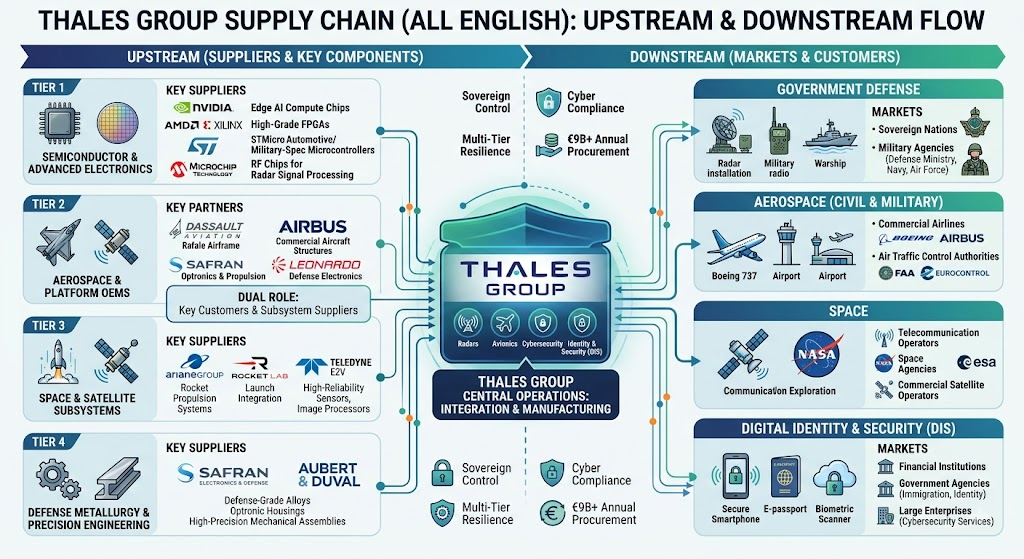
Thales Group spends over €9 billion annually on procurement across a global network of more than 17,500 suppliers. Given its footprint in defense and aerospace, the company’s supply chain strategy heavily emphasizes sovereign control, strict cyber compliance, and multi-tier resilience.
Supply Chain Overview
- Upstream Semiconductor & Electronics Layer: Relies on high-performance semiconductors, Field Programmable Gate Arrays (FPGAs), microwave power amplifiers, and radio-frequency (RF) modules essential for radar arrays and military communication hardware.
- Tier-1 Subsystems & System Integration: Collaborates with major aerospace and defense OEMs to perform large-scale system integration (e.g., fighter jet avionics, satellite payloads, and naval combat systems).
- Digital & Security Ecosystem: Partners with cloud infrastructure providers, chipmakers, and software vendors to support its Digital Identity & Security (DIS) business segment.
Key Suppliers & Ecosystem Partners
| Supply Chain Domain | Key Suppliers / Partners | Supplied Items & Strategic Role |
| Semiconductors & High-End Electronics | NVIDIA, AMD (Xilinx), STMicroelectronics, Microchip Technology | Edge AI compute chips, high-grade FPGAs, automotive/military-spec microcontrollers, and RF chips for radar signal processing. |
| Aerospace & Platform OEMs | Dassault Aviation, Airbus, Safran, Leonardo | Dual-role partners acting as both key customers and primary subsystem suppliers (e.g., Dassault manufactures the Rafale airframe, while Safran supplies optronics and propulsion). |
| Cybersecurity & IT Distribution | Exclusive Networks, Fortinet, Palo Alto Networks | Software distribution and security integration partners, expanding the reach of Thales’s DIS solutions. |
| Space & Satellite Subsystems | ArianeGroup, Rocket Lab, Teledyne e2v | Rocket propulsion systems, satellite launch integration, high-reliability optical sensors, and space-grade image processors (integrated via Thales Alenia Space). |
| Defense Metallurgy & Precision Engineering | Safran Electronics & Defense, Aubert & Duval | Defense-grade metal alloys, optronic housings, and high-precision mechanical assemblies built for extreme operational conditions. |
Financial Metrics & Competitive Benchmarking
- Revenue Scale & Profitability
- Scale Position: Generates approximately €22.8B in annual revenue. While smaller than top-tier US defense prime contractors like RTX (~$93.5B) or Lockheed Martin, Thales ranks on par with European Tier-1 defense and system integrators like BAE Systems and Leonardo (~€19.5B).
- Profitability & Margins: Maintains stable EBITDA margins between 14.5% and 15.5%, supported by elevated sovereign defense budgets and solid demand across its digital identity segments.
- Cash Flow Generation: Demonstrates strong cash conversion with a Free Cash Flow (FCF) yield of 7.66%, outperforming regional peers like Leonardo (~3.14%) and Rheinmetall (~1.65%).
- Key Financial Comparison
| Financial / Valuation Metric | Thales Group | Leonardo | RTX (Raytheon) | Rheinmetall |
| Annual Revenue (TTM) | ~€22.8B | ~€19.5B | ~$93.5B | ~€9.6B |
| Forward P/E Ratio | 23.5x | 23.2x | ~22.0x | 28.9x |
| EV / EBITDA | 14.7x | 17.6x | ~16.5x | 25.7x |
| Debt to Equity Ratio | 0.70 | 0.47 | 0.62 | 0.40 |
Technical Moats & Core Competencies
- Sovereign Electronic Warfare & Radar Architectures (AESA & Sonar)
- Technological Advantage: Leads in Active Electronically Scanned Array (AESA) radar systems for multi-target tracking. Commands the #1 global market share in naval sonar systems, backed by proprietary acoustic signal processing algorithms.
- Competitive Edge: Offers higher sovereignty, customization, and geopolitical neutrality for European and Middle Eastern defense procurements compared to US ITAR-restricted platforms.
- Flight-Critical Avionics & Air Traffic Management (ATM)
- Technological Advantage: Develops flight-control systems certified up to Design Assurance Level A (DAL A), the highest safety standard. Its ATM infrastructure manages over 20% of global air space.
- Competitive Edge: Operates in a consolidated oligopoly alongside Honeywell and Collins Aerospace (RTX), holding a distinct edge in automated airspace surveillance and integrated cockpit electronics.
- Embedded “Trustworthy” & Frugal Edge AI
- Technological Advantage: Focuses on low-power, edge-computed AI algorithms engineered to operate in bandwidth-constrained or offline environments. Its cortAIx framework ensures explainable, non-hallucinating AI for battlefield decision-making.
- Competitive Edge: While US defense primes focus heavily on centralized cloud AI infrastructures, Thales excels at embedding high-security AI directly into tactical hardware.
- Post-Quantum Cryptography & Cloud Security
- Technological Advantage: Integrates Gemalto and Imperva assets to deliver post-quantum cryptography (PQC), hardware security modules (HSM), and API application security.
- Competitive Edge: Bridges the gap between physical defense hardware and enterprise cybersecurity, competing effectively with pure-play software vendors like Palo Alto Networks and CrowdStrike while retaining a hardware-level security moat.
Source:
- https://www.thalesgroup.com/en/investor-relations/financial-indicators
- https://www.thalesgroup.com/en/research-and-innovation/ai-we-can-all-trust
- https://www.thalesgroup.com/en/news-centre/insights/united-arab-emirates/trusted-sovereign-ai-why-nations-can-no-longer-afford
- https://cpl.thalesgroup.com/encryption/hardware-security-modules
- https://www.imperva.com/blog/post-quantum-cryptography/
- https://www.fortunebusinessinsights.com/surveillance-radars-market-104290
Back to Thales