
The history of Thales Group can be divided into four key stages:
- Founding and Defense Foundation (1893–1967)Founded in 1893 as Compagnie Française pour l’Exploitation des Procédés Thomson-Houston (CFTH), the company initially focused on electrical equipment and wireless broadcasting. Through both World Wars, it pivoted toward defense electronics, becoming France’s primary supplier of military radio and radar systems.
- Thomson-CSF Restructuring and Expansion (1968–1999)In 1968, CFTH merged its defense electronics division with Compagnie Générale de Télégraphie Sans Fil to form Thomson-CSF, which was later nationalized in the 1980s. During this period, the company expanded internationally and consolidated its leadership in defense radar, avionics, and military communications.
- Privatization and Rebranding (2000–2018)Following its privatization in 1998, the company officially rebranded as Thales Group in 2000. Through key acquisitions (such as UK-based Racal Electronics), Thales diversified beyond defense into commercial aerospace, satellite infrastructure, and rail transport systems.
- Digital Security and AI Transformation (2019–Present)Thales acquired digital security giant Gemalto in 2019 and cybersecurity firm Imperva in 2024. Today, the group combines physical defense expertise with digital security solutions, focusing on cybersecurity, identity authentication, and defense-grade AI systems.
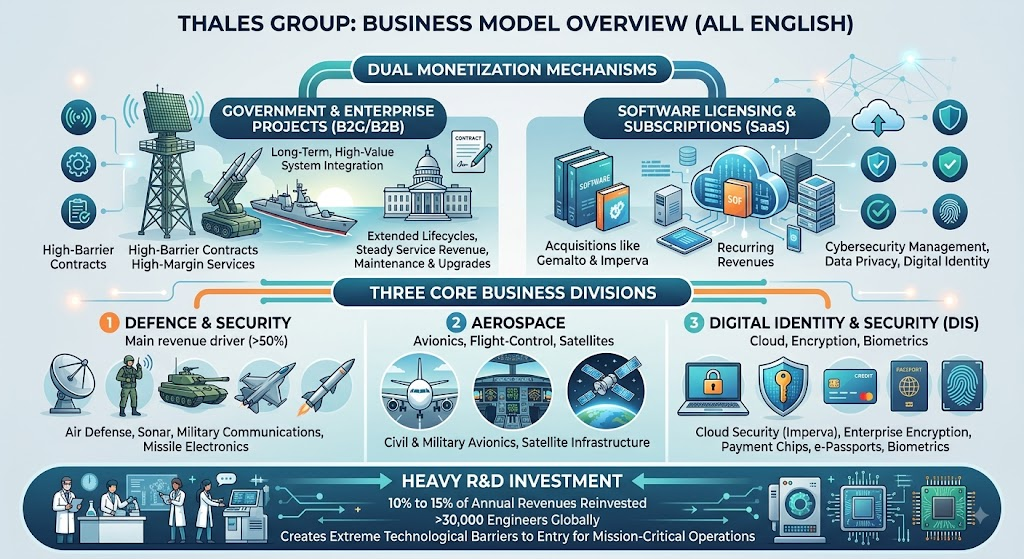
Thales Group operates a dual-engine business model designed to balance high-barrier government defense contracts with high-margin enterprise digital services, supported by a clear, long-term growth strategy.
Business Model
- Revenue Streams across Three Core Divisions
- Defense & Security: The primary revenue and profit driver (accounting for over 50% of total sales). Core offerings include air defense radar networks, sonar, military radio communications, and missile electronics sold directly to sovereign governments and military entities.
- Aerospace: Supplies civil and military avionics, flight-control systems, in-flight entertainment, and satellite payload/communications infrastructure.
- Digital Identity & Security (DIS): Provides cloud security solutions (via Imperva), enterprise data encryption, payment card chips, e-Passports, and biometric identity hardware.
- Dual Monetization Mechanisms
- Government & Enterprise Projects (B2G/B2B): Long-term, high-value system integration projects with extended lifecycles. These generate steady, multi-year maintenance, upgrade, and support service revenue.
- Software Licensing & Subscriptions (SaaS): Leveraging acquisitions like Gemalto and Imperva to capture recurring revenues through cybersecurity management software, data privacy tools, and digital identity platforms.
- Heavy R&D Investment as a Competitive MoatReinvests 10% to 15% of annual revenues into R&D, supported by more than 30,000 engineers, ensuring extreme technological barriers to entry for mission-critical operations.
Development Strategy
- Integration of Physical Defense and Digital SecurityCapitalizes on rising global defense budgets driven by geopolitical tensions while embedding advanced cybersecurity, data encryption, and AI directly into defense platforms, radar systems, and aerospace hardware.
- Targeted M&A for Digital TransformationExecutes inorganic growth to pivot away from pure hardware manufacturing. Key acquisitions like Imperva strengthen its cloud security capabilities, positioning Thales as a full-spectrum digital trust vendor.
- Focus on “Trustworthy AI”Develops high-security, explainable, and unbiased AI algorithms tailored for battlefield management, air traffic surveillance, and autonomous defense systems where zero failure is tolerated.
- Capacity Expansion and ExecutionScales up manufacturing facilities for radars, munition electronics, and space platforms to clear massive order backlogs and address elevated global defense procurement demand.
Thales Group’s AI strategy centers around “Trustworthy AI” and “Frugal AI,” specifically engineered for high-security, mission-critical environments in defense, aerospace, and digital identity—distinctly separate from consumer-grade generative models.
AI Strategy & Organizational Architecture
- cortAIx Division: Established cortAIx as its central AI accelerator and research institute, consisting of the cortAIx Accelerator, cortAIx Sensors, and cortAIx Lab, designed to integrate AI capabilities directly into core defense and civilian products.
- Product Deployment: Over 100 products embedded with AI algorithms, supporting real-time radar signature recognition, battlefield image analysis, cockpit decision assistance, and cyber threat detection.
- Key Features: Tailored for embedded, low-power edge computing operating in offline or bandwidth-constrained environments, maintaining strict sovereign data privacy and safety compliance.
Strategic Partnerships & Ecosystem
- Industrial Consortia (Confiance.ai): Serves as a leading founder of France’s national Confiance.ai initiative, collaborating with aerospace and industrial leaders to define global safety, transparency, and verification standards for industrial AI.
- Tech Pioneers & Ecosystems: Partners with semiconductor and edge-computing leaders (such as NVIDIA) while acquiring specialized software firms (e.g., Imperva) to bolster AI-driven cybersecurity defenses.
- Research Academia: Works closely with France’s CNRS (National Centre for Scientific Research) and leading European universities on foundational AI algorithms and quantum-AI hybrid computing.
Budget & Resource Allocation
- R&D Budget Allocation: Reinvests approximately €4.5 billion annually into overall enterprise R&D, with AI, quantum technologies, and cybersecurity prioritized as the top investment verticals.
- Talent Scale: Employs over 800 dedicated AI experts and research scientists, forming one of Europe’s largest specialized AI engineering workforces dedicated to critical infrastructure systems.
Source:
- https://www.thalesgroup.com/en/advanced-technologies/artificial-intelligence
- https://www.thalesgroup.com/en/research-and-innovation/ai-we-can-all-trust
- https://www.thalesgroup.com/sites/default/files/2026-07/Thales%20AI%20in%20Real%20Use%20-%20June%202026.pdf
- https://www.thalesgroup.com/sites/default/files/2026-06/Trustworthy%20AI%20-%20%20The%20fundamentals.pdf
- https://futurecio.tech/thales-chief-scientist-not-enough-transparency-today-for-trustworthy-ai/
Back to Thales