
Here is the history of Texas Instruments (TI), broken down into key developmental stages:
1. Geophysical Exploration Roots (1930–1951)
TI began in 1930 as Geophysical Service Inc. (GSI), a company specializing in seismic exploration for the petroleum industry. During World War II, GSI pivoted to producing electronic equipment for the U.S. military. In 1951, the company was reorganized and officially renamed Texas Instruments, shifting its primary focus to defense electronics and emerging semiconductor research.
2. Semiconductor Pioneer and the Integrated Circuit (1951–1970)
TI quickly became an industry trailblazer. In 1954, it commercialized the first silicon transistor and co-developed the first transistor radio. The defining moment came in 1958, when TI scientist Jack Kilby invented the integrated circuit (IC), a breakthrough that earned him a Nobel Prize and revolutionized modern electronics. During this era, TI also created the first hand-held electronic calculator.
3. Consumer Electronics and Global Expansion (1970–1990)
During the 1970s and 1980s, TI expanded aggressively into consumer markets with digital watches, home computers (such as the TI-99/4A), and educational devices like the “Speak & Spell.” In 1987, TI invented Digital Light Processing (DLP) technology, which went on to dominate movie theater and home projectors.
4. Strategic Refocus on Signal Processing (1990–2010)
In the late 1990s, TI underwent a massive strategic restructuring. The company sold off its defense electronics business to Raytheon and phased out its computer and consumer product lines. Instead, TI heavily concentrated its resources on Digital Signal Processing (DSP) and analog chips, which were becoming critical components for the rapidly booming mobile phone and telecommunications industries.
5. Transition to Analog and Embedded Leadership (2010–Present)
TI shifted its focus away from smartphones to target higher-margin, longer-lifecycle markets: industrial systems and automotive electronics. A milestone in this strategy was the 2011 acquisition of National Semiconductor for $6.5B, solidifying TI’s position as the world’s largest manufacturer of analog chips. Today, TI operates as a highly profitable giant, focusing on expanding its internal manufacturing capacity with advanced 300mm wafer fabs to support the global growth of smart and electrified technologies.
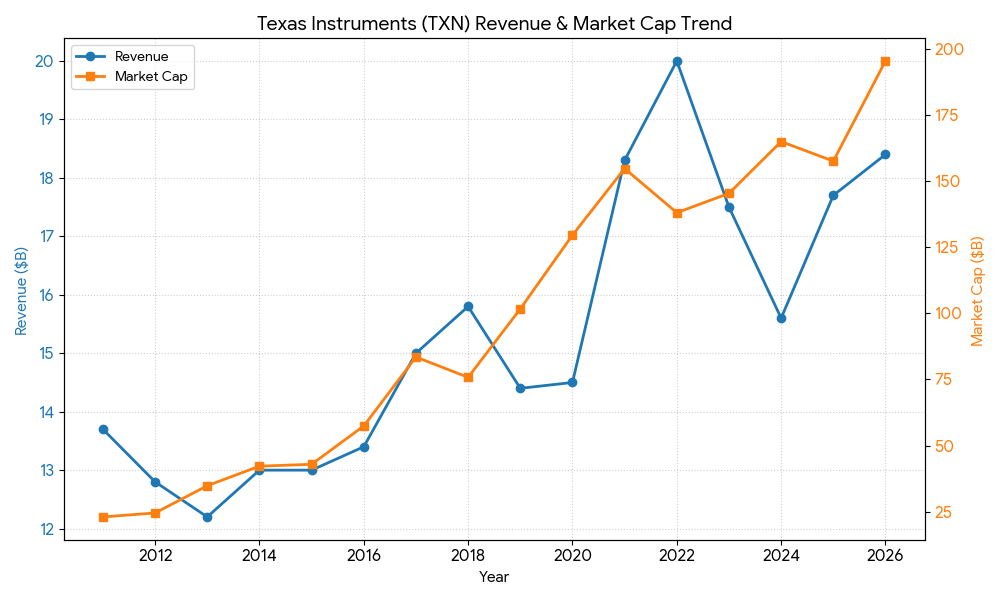
Here is a competitive analysis of Texas Instruments (TI), focusing on its strategic positioning, market barriers, and major rivals within the semiconductor industry.
1. Market Positioning and Core Moat
TI operates in a unique space compared to logic-chip giants like NVIDIA or Intel. TI’s true battlegrounds are Analog Chips and Embedded Processing, which serve as the unsung backbone of automotive electronics, industrial automation, and data center infrastructure. TI holds the world’s number-one market share in analog semiconductors (around 19% to 20%), sustained by three core pillars:
- 300mm (12-inch) Wafer Cost Advantage: TI has aggressively migrated its manufacturing lines to 300mm wafers. Compared to the 200mm (8-inch) wafers commonly used by competitors, 300mm production reduces chip manufacturing costs by roughly 40%, giving TI unparalleled pricing power and gross margin resilience.
- Massive Product Portfolio (SKUs): TI offers over 80,000 products, including power management ICs, signal chains, and amplifiers. Because replacing an analog chip after a customer’s product design-in phase requires highly expensive system-level retesting, switching costs are exceptionally high, locking in long-term customer loyalty.
- Direct-to-Customer (DTC) Model: Moving away from traditional, heavy reliance on third-party distributors, TI has shifted to a direct sales and e-commerce platform (TI.com). This gives the company better visibility into customer demand and captures higher margins.
2. Core Competitors by Segment
TI’s revenue is divided into two primary segments, each facing distinct competitive forces:
Analog Chips (Over 70% of Revenue)
- Analog Devices (ADI) — The Premium High-Performance Rival
- Competitive Dynamics: Following its acquisition of Maxim Integrated, ADI stands as TI’s most formidable rival in high-performance analog and mixed-signal fields. While TI wins on scale and cost-efficiency, ADI targets premium, high-precision niches like communications infrastructure and advanced medical equipment, commanding premium pricing.
- Infineon Technologies & onsemi — The Automotive and Power Giants
- Competitive Dynamics: These European and American heavyweights pose intense challenges in automotive electrification (EVs) and renewable energy systems. By securing high-value socket placements for silicon carbide (SiC), gallium nitride (GaN), and high-voltage power components in EV inverters and powertrains, they directly challenge TI’s power management domain.
Embedded Processing (15% to 20% of Revenue)
- NXP Semiconductors, STMicroelectronics, and Renesas Electronics
- Competitive Dynamics: In the microcontrollers (MCUs) and automotive central processing markets, these three companies boast deep relationships and long-term supply agreements with major automotive OEMs. TI’s embedded lines (such as Sitara and MSP430) face relentless pressure from this trio in high-end vehicle networking and secure edge computing.
3. The New Battlefield: AI Data Centers
The exponential growth of AI compute hardware has turned data center power infrastructure into a goldmine. High-performance GPUs require incredibly precise, stable, and high-density Power Management ICs (PMICs) to regulate massive electrical currents.
- TI’s Push: TI has capitalized heavily on this trend, reporting robust data center revenue growth driven by its advanced AI power management solutions.
- The Disruptor: Beyond traditional rivals, TI faces nimble, specialized players like Monolithic Power Systems (MPS), which excels in highly integrated, high-density power modules tailored specifically for AI server architectures.
4. Headwinds and Future Challenges
- Chinese Localization and Substitutes: In lower-end consumer and basic industrial electronics, domestic Chinese analog chipmakers (e.g., SG Micro) are utilizing aggressive pricing and state-backed localization policies to erode TI’s market share in mid-to-low-tier applications.
- Capital Expenditure Burden: TI has committed roughly $5B annually to construct new manufacturing facilities. During semiconductor downcycles or prolonged inventory corrections, these massive fixed depreciation charges can temporarily squeeze short-term net margins.
Overall, Texas Instruments maintains a highly defensible leadership position due to its manufacturing scale, sheer volume of product variants, and unmatched cost structure. While ADI fights for the high-end technological crown and automotive specialists crowd the vehicle space, TI continues to use its 12-inch wafer advantage and AI power management solutions to stay steps ahead of the herd.
Source:
- https://investor.ti.com/news-releases/news-release-details/ti-reports-first-quarter-2026-financial-results-and-shareholder
- https://www.ti.com/about-ti/newsroom/news-releases/2026/2026-04-22-ti-reports-first-quarter-2026-financial-results-and-shareholder-returns.html
- https://investor.ti.com/static-files/fc9d9346-cf77-40db-902a-e9961e9c5736
- https://futurumgroup.com/insights/texas-instruments-q1-fy-2026-data-center-and-industrial-demand-lift-outlook/
- https://www.tradingview.com/news/zacks:7ca467261094b:0-can-texas-instruments-analog-unit-extend-its-strong-sales-growth-run/
- https://seekingalpha.com/news/4578378-texas-instruments-expects-q2-2026-revenue-of-5b-5_4b-while-targeting-2b-3b-2026-capex
- https://investor.ti.com/
Back to Texas Instruments page