
Company History
Foundational Roots(1948–1980s)
The company originated within the Techint Group, founded by Italian industrialist Agostino Rocca. Industrial activities began with Dalmine in Italy and expanded into Latin America with the establishment of Siderca in Argentina in 1954 and Tamsa in Mexico. Throughout this period, these mills operated as regional tubular suppliers serving domestic state oil monopolies and regional industrial markets under the Techint umbrella.
Consolidation and the Birth of Tenaris(1990s–2002)
In the 1990s, the Techint Group initiated a global integration strategy, unifying its independently run pipe manufacturers under a unified brand and industrial system. This included acquiring control of Sviat in Italy, AlgomaTubes in Canada, and NKKTubes in Japan. In 2001, the brand “Tenaris” was formally launched, followed by an corporate restructuring in 2002 that established Tenaris S.A. in Luxembourg and listed its shares on stock exchanges in New York, Milan, Buenos Aires, and Mexico.
Global Scale and Premium Dominance(2003–2019)
Tenaris accelerated cross-border acquisitions to solidify its premium OCTG leadership. Key milestones included the acquisition of Silcotub(Romania, 2004), Maverick Tube Corporation(US, 2006), and Hydril(US, 2007), which granted proprietary premium connection technology. In 2017, Tenaris opened a $1.8 billion greenfield seamless pipe mill in Bay City, Texas, establishing a direct domestic footprint within the US shale market and rolling out its Rig Direct supply model globally.
Strategic Pivot and Energy Transition(2020–Present)
The company adapted to pandemic demand shocks through cost restructuring and targeted acquisitions, notably acquiring IPSCO Tubulars in the US in 2020 and completing the acquisition of Shawcor’s pipe coating business(now TenarisShawcor)in 2023. Today, Tenaris is expanding its capabilities in hydrogen transport, carbon capture and storage(CCS), and low-carbon electric arc furnace steelmaking while defending its high margins in deepwater and unconventional shale plays.
Business Model and Strategy
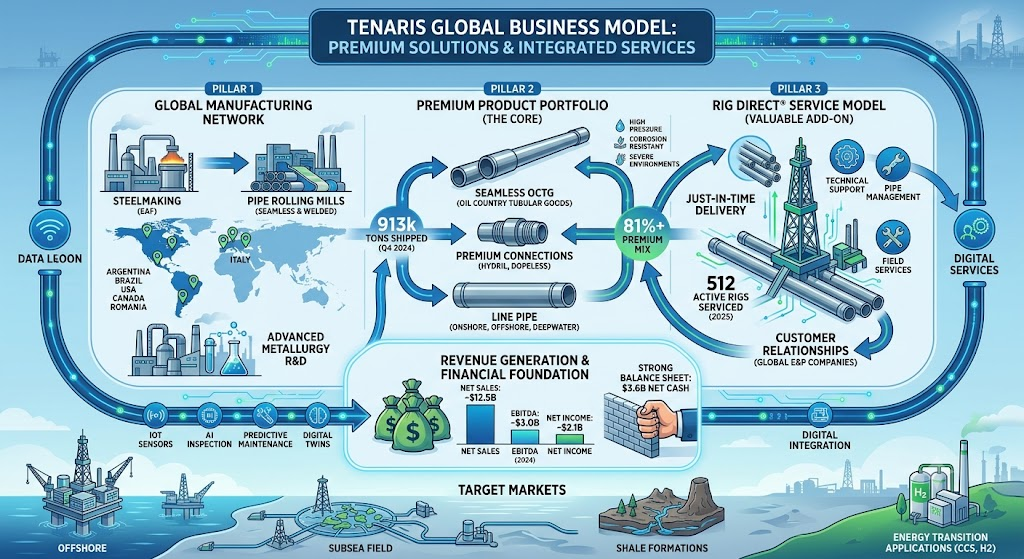
Tenaris monetizes its business primarily through the design, manufacturing, and direct delivery of specialized tubular products, deriving the majority of its net sales from the Tubes operating segment, with a secondary contribution from Other activities(including industrial suction rods, coiled tubing, and pipe coating).
In fiscal year 2024, Tenaris recorded $12.52 billion in net sales, generating $3.05 billion in EBITDA(24.4% margin)and $2.08 billion in net income. Within its core Tubes division, which generated $2.70 billion in Q4 2024, revenue is geographically diversified:
- North America: $1.13 billion(42% of Q4 Tubes sales), led by US onshore and offshore Gulf of Mexico operations.
- Asia Pacific, Middle East, and Africa: $629 million(23% of Q4 Tubes sales), anchored by long-term offshore and deep-gas contracts.
- South America: $595 million(22% of Q4 Tubes sales), driven by offshore Brazil pre-salt developments and Argentina’s Vaca Muerta shale.
- Europe: $341 million(13% of Q4 Tubes sales), serving offshore North Sea and specialized mechanical markets.
The monetization mechanics center on three primary value-capture layers:
- High-Margin Premium Product Mix: The core profit engine is high-spec seamless pipes, which comprised 748,000 metric tons of the 913,000 metric tons shipped in Q4 2024(over 81% of total volume). Seamless tubes, combined with proprietary Hydril wedge threads and Dopeless surface technologies, command significant pricing premiums over commodity welded tubes because they withstand sour gas, corrosive subsea conditions, and high-pressure shale fracturing.
- Direct-to-Operator Rig Direct Service: Instead of selling through traditional third-party distributors who extract margin, Tenaris delivers “just-in-time” pipe directly to customer rig sites, managing pipe yards, maintenance, thread inspection, and run-in monitoring. By late 2025, Tenaris serviced 512 active drilling rigs globally under this turnkey arrangement. This locks in multi-year framework agreements, increases customer switching costs, and allows Tenaris to capture logistics and technical field service fees.
- Counter-Cyclical Asset Deployment & Decarbonization: Tenaris minimizes production costs by pairing electric arc furnaces(EAF)with localized scrap sourcing and renewable power(such as its wind farms in Argentina). Its strategy focuses on maintaining an unleveraged fortress balance sheet—holding $3.6 billion in net cash at the end of 2024—allowing it to self-fund major capital expenditures($694 million in 2024)while returning capital through dividends($758 million)and buybacks($1.44 billion).
Sources for Business Model Information
- https://ir.tenaris.com/news-releases/news-release-details/tenaris-announces-2024-fourth-quarter-and-annual-results/
- https://ir.tenaris.com/static-files/2abcb623-7301-48f6-a7de-745b79636b98
- https://www.tenaris.com/en/news/2025/tenaris-2024-annual-report-industrial-leadership-sustainability-and-community-impact
- https://www.tenaris.com/en/sustainability/innovation
AI Strategy, Budget, and Partnerships
Tenaris embeds artificial intelligence primarily within its industrial automation, manufacturing execution systems(MES), and drilling support services under its broader Industry 4.0 and Smart Factory programs.
Strategic Allocation and Operational Scale
Tenaris allocates substantial technical and financial capital to operations technology. In 2025, the company invested $64 million directly into research and development(R&D), supporting an in-house team of 263 specialized researchers and data scientists across its global technical centers in Campana(Argentina), Dalmine(Italy), Veracruz(Mexico), and Houston(US). This R&D core collaborates directly with plant operations teams to deploy computer vision and machine learning(ML)models onto shop-floor manufacturing lines.
Core AI Deployments and Concrete Applications
- Computer Vision for Automated Quality Inspection: In its rolling and finishing mills, Tenaris deploys high-speed optical camera arrays combined with convolutional neural network(CNN)algorithms. These systems inspect pipe surfaces, wall thickness tolerances, and threaded connections at production speeds, detecting micro-defects and metallurgical fractures before pipes reach heat treatment, reducing scrap generation.
- Predictive Maintenance and Digital Twins: Using IoT sensor suites embedded across hot-rolling mills and electric arc furnaces, machine learning algorithms analyze vibration, thermal degradation, and motor amperage to anticipate component failures. Digital twin models of reheating furnaces dynamically regulate burner temperatures based on pipe dimensions and alloy grades, optimizing thermal efficiency and reducing natural gas consumption.
- Remote Monitoring Center(RMC): Located at its North American headquarters in Houston, Texas, Tenaris operates an AI-assisted Remote Monitoring Center. The RMC ingests real-time telemetry from rig sites, running predictive algorithms to track casing runs, torque-turn curves, and pipe string integrity. This identifies cross-threading or mechanical resistance issues in real time, preventing downhole well integrity failures.
Ecosystem Partners and Collaborations
Tenaris works with external cloud and enterprise software partners to host its data architecture, leveraging Microsoft Azure for cloud infrastructure and IoT Hub connectivity. For industrial edge analytics and control-loop hardware, Tenaris interfaces with industrial automation specialists such as Siemens and Rockwell Automation. On the research front, Tenaris collaborates with university research institutes—including the Politecnico di Milano and Argentine national universities—focusing on advanced finite element analysis(FEA), automated robotic inspection cells, and data-driven metallurgy.
Back to Tenaris