
Market Position and Market Share
Telenor ASA holds a dominant position across the Nordic telecommunications landscape and maintains major joint ventures and stakes in South and Southeast Asia. Globally, the group serves over 207 million mobile subscribers across eight operating markets.
- Norway (Home Market): Telenor is the undisputed market leader (Rank 1). In mobile connectivity, Telenor commands approximately 45%–46% of the Norwegian mobile subscriber market share with 2.6 million mobile subscribers, comfortably ahead of Telia Norway (Rank 2, ~35% share). In Norwegian fixed broadband, Telenor also ranks 1st in retail connections with over 700,000 subscribers.
- Nordic Footprint: Across the wider Nordic region (Norway, Sweden, Finland via DNA, and Denmark), Telenor ranks as the 2nd largest integrated telecom group behind Telia Company, with more than 10 million mobile customers and 2.2 million broadband users.
- Sweden: Ranks 3rd in mobile with 3.0 million subscribers (trailing Telia and Tele2).
- Finland (DNA): Ranks 3rd with 2.8 million mobile subscribers, competing closely with Elisa and Telia Finland.
- Denmark: Ranks 2nd–3rd with 1.7 million mobile customers.
- Asian Markets: Through structural partnerships and subsidiaries, Telenor holds leading positions in Bangladesh (Grameenphone, Rank 1 with over 80 million subscribers), Thailand (True Corporation, merged entity ranking 1st in mobile subscribers), and Malaysia (CelcomDigi, leading mobile operator by market share).
Supply Chain Analysis and Key Suppliers
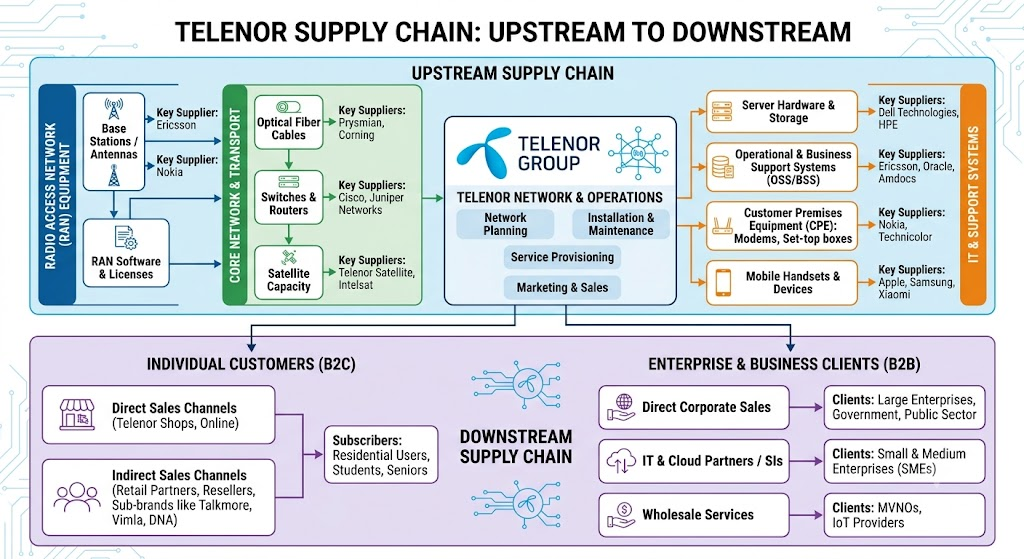
Telenor operates as a network and digital service orchestrator, relying on a layered upstream supply chain to construct, upgrade, and maintain its fixed and wireless communications networks:
- Upstream Infrastructure & Network Equipment Vendors:
- Radio Access Network (RAN) & Core Telecom Infrastructure: Telenor phased out legacy high-risk Chinese equipment (Huawei, ZTE) in its Nordic networks following European security directives. Its primary 5G RAN and core vendors are Ericsson (Sweden) and Nokia (Finland). Ericsson provides a substantial share of 5G RAN deployments in Norway and Sweden, while Nokia powers core elements and transport networks.
- Passive Infrastructure & Tower Assets: Telenor carved out its Nordic physical tower infrastructure into dedicated business units (Telenor Tower Holding / shared joint ventures like TT-Netværket in Denmark and Net4Mobility in Sweden) to improve capital allocation.
- Compute & AI Infrastructure: Upstream digital computing architecture relies heavily on NVIDIA for high-performance AI infrastructure and software frameworks, along with public hyperscalers (Amazon Web Services and Microsoft Azure) for hybrid cloud processing and internal enterprise systems.
- Midstream / Operational Layer:
- Fiber rollouts and tower maintenance depend on local civil engineering, trenching, and field operations contractors (such as Eltel and local construction partners across Scandinavia).
- Spectrum rights allocated by national regulatory bodies (such as Nkom in Norway and PTS in Sweden) form the fundamental licensed input for midstream operations.
- Downstream Delivery & Customers:
- B2C Distribution: Direct retail stores, online self-service channels, and sub-brands (e.g., Talkmore in Norway, Vimla in Sweden, Moi in Finland) catering to value-conscious consumers.
- B2B & Public Sector: High-margin enterprise networking, private 5G networks, cloud migration, and national cybersecurity operations (notably stopping billions of cyber threats annually for institutional and consumer clients).
Competitor Analysis: Technical and Financial Comparison
Telenor’s primary regional competitors in Northern Europe are Telia Company (Sweden/Finland/Norway), Tele2 (Sweden/Baltics), and Elisa (Finland/Estonia).
| Competitor | Market Focus | Revenue / Financial Scale | Profitability Profile | Network & Tech Strategy |
| Telenor | Norway, Nordics, Asia JVs | Full-year revenue ~NOK 76–80B; Group EBITDA ~NOK 35B | EBITDA margin ~44%–46%; Strong FCF conversion (~NOK 11–13B) | Dual-vendor Nordic 5G (Ericsson/Nokia); AI infrastructure alliance with NVIDIA; heavy emphasis on sovereign security |
| Telia Company | Sweden, Finland, Norway, Baltics | Full-year net sales ~SEK 85–90B | EBITDA margin ~36%–38%; Historically weighed down by media/TV unit write-downs | Aggressive 5G Standalone (SA) deployments with Ericsson; undergoing corporate restructuring to cut operational overhead |
| Tele2 | Sweden, Baltics | Full-year revenue ~SEK 29–31B | EBITDA margin ~38%–40%; Lean overhead structure | Network sharing pioneer (shares Net4Mobility infrastructure with Telenor in Sweden); low capex footprint |
| Elisa | Finland, Estonia | Full-year revenue ~EUR 2.2–2.3B | EBITDA margin ~35%–37%; Industry-leading operational efficiency | Software-driven automation; developed in-house automated network operations tools (Elisa Automate / Polystar) exported globally |
- Technical Comparison:
- Network Architecture & Sharing: Unlike single-network purists, Telenor aggressively leverages network sharing joint ventures to drive capex efficiency—sharing 4G/5G infrastructure with Tele2 in Sweden (Net4Mobility), with Telia in Finland (Finnish Shared Network), and with Norlys in Denmark (TT-Netværket).
- Software & AI Capabilities: While Elisa leads in homegrown telecom automation software and selling telecom operations software to third parties, Telenor has anchored its strategy on enterprise-grade cybersecurity and partnerships with NVIDIA to embed AI into network routing, fraud prevention, and call center automation.
- Financial Comparison:
- Margins & Leverage: Telenor maintains higher EBITDA margins (over 44%) than Telia, largely due to its high-margin position in Norway and lean joint-venture operating structures in Asia. Telia’s margins have suffered historically from non-core broadcast/media acquisitions (TV4/C More), from which it has sought to retreat.
- Cash Flow & Dividend Durability: Telenor delivers consistent free cash flows before M&A (targeting ~NOK 13 billion) supporting a stable dividend profile (NOK 9.60 per share for 2024). In contrast, Tele2 operates a capital-light Swedish cash machine with high capital return payouts, whereas Elisa offers lower absolute scale but superior return on invested capital (ROIC) due to fixed-line and unlimited mobile data penetration in Finland.
Sources
- https://www.telenor.com/investors/reports-and-information/annual/annual-report-2024/
- https://live.euronext.com/sites/default/files/company_press_releases/attachments_oslo/2025/03/20/641718_Annual%20Report%202024-English.pdf
- https://www.telecomtv.com/content/access-evolution/telenor-solid-2024-on-the-right-track-for-2025-52298/
- https://www.telenorasia.com/announcements/year-in-review-2024/
- https://tefficient.com/seven-signs-that-competition-in-nordic-telco-is-cooling-down/
- https://danelfin.com/stocks/TEL.OL-telenor-asa-vs-TELIA.ST-telia-compare
Back to Telenor