
Market Position and Market Share
TDK Corporation(Tokyo Denki Kagaku)is one of the world’s largest comprehensive electronic component and advanced materials manufacturers, generating annual net sales exceeding 2.2 trillion yen(approximately 2.20 to 2.50 trillion yen across FY2025–FY2026). The company holds dominant global leadership across several specialized hardware segments:
- Lithium-ion Polymer Batteries: Through its subsidiary Amperex Technology Limited(ATL), TDK is the undisputed global leader in small-sized lithium-ion pouch cells for consumer electronics(smartphones, tablets, laptops, and wearables). ATL commands approximately 35%–40% of the worldwide smartphone battery cell volume, acting as the primary supplier to top-tier smartphone OEMs including Apple, Samsung, and Xiaomi.
- HDD Magnetic Recording Heads:TDK is the world’s leading merchant supplier of magnetic heads for hard disk drives(HDDs), holding a dominant merchant market share estimated at over 80% to 90% for external drive vendors(such as Western Digital and Seagate), particularly for nearline and enterprise cloud storage drives.
- Passive Components(MLCCs, Ferrite, and Inductors): In multilayer ceramic chip capacitors(MLCCs), TDK ranks consistently among the top 5 global suppliers with an estimated 6%–8% global share, trailing Murata Manufacturing and Samsung Electro-Mechanics. However, TDK holds top-tier positions(#1 to #2 globally)in ferrite cores, automotive-grade inductors, and EMC filters.
- Sensors and Magnetic Application Products: TDK is a leading player in micro-electro-mechanical systems(MEMS)microphones, 6-axis motion sensors(via its InvenSense acquisition), and automotive tunneling magnetoresistance(TMR)angle and position sensors.
Upstream and Downstream Supply Chain Analysis and Key Suppliers
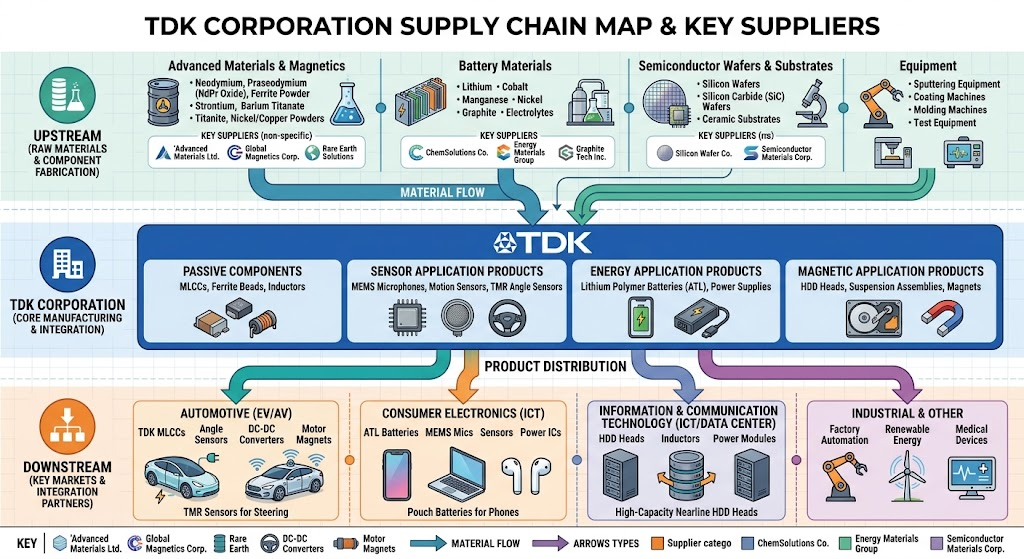
TDK operates a vertically integrated model originating from advanced material synthesis through component sub-assembly.
- Upstream(Raw Materials and Chemical Refining):
- Battery Materials: For its Energy Application Products division(ATL), the primary cost drivers are cathode active materials(lithium cobalt oxide/LCO and nickel-manganese-cobalt/NMC), anode materials(synthetic/natural graphite and silicon-carbon composites), electrolytes, and lithium salts(LiPF6). Upstream refined chemicals and precursors are procured from chemical and battery material suppliers such as Beijing Easpring, Shanshan Technology, BTR New Material, Ningbo Rongbai, and chemical refining partners across East Asia.
- Passive & Magnet Raw Materials:TDK’s core ceramics and magnets depend on high-purity barium titanate, nickel/copper electrode powders, iron oxide, strontium carbonate, and rare earth elements(REEs)including neodymium, praseodymium(NdPr), dysprosium(Dy), and terbium(Tb). While China remains the predominant source for ionic clay heavy rare earths, non-China sources such as Lynas Rare Earths supply NdPr oxide to diversify geopolitical risk. TDK also collaborates with metal powder providers such as DOWA Holdings and Shoei Chemical for conductive pastes.
- Semiconductor Wafers: Sensor Application Products(InvenSense)source MEMS and ASIC wafers from pure-play foundries, predominantly TSMC and GlobalFoundries.
- Downstream(Tier-1 Integration and End Markets):
- Information & Communication Technology(ICT): Direct supply to global consumer electronics leaders including Apple, Samsung Electronics, HP, Lenovo, and major Chinese OEMs. Products include pouch batteries, camera module voice coil motor(VCM)actuators, RF passive components, and MEMS motion sensors.
- Cloud Data Storage: HDD heads and suspension assemblies are supplied directly to Seagate Technology and Western Digital for mass storage and nearline AI enterprise server HDDs.
- Automotive & Industrial: Products pass either directly to automotive OEMs(such as Toyota, Honda, and European EV makers)or via Tier-1 auto suppliers(such as Denso, Bosch, and Continental). Key shipments include high-reliability automotive MLCCs, DC-DC power modules(TDK-Lambda), TMR angle sensors for electric power steering, and motor ferrite magnets.
Competitor Analysis: Technological and Financial Comparison
TDK’s business portfolio blends materials science, venture-style M&A diversification, and electrochemical manufacturing.
- Primary Competitors by Segment:
- Passive Components: Murata Manufacturing(Japan), Samsung Electro-Mechanics(South Korea), Taiyo Yuden(Japan), and Yageo(Taiwan).
- Battery Solutions: Sunwoda Electronic(China), Desay Battery(China), LG Energy Solution(South Korea), and BYD(China).
- Sensors: Bosch Sensortec(Germany), STMicroelectronics(Switzerland/EU), and Melexis(Belgium).
- Power Systems: Delta Electronics(Taiwan)and MinebeaMitsumi(Japan).
- Technological Comparison:
- TDK vs. Murata Manufacturing: Murata pursues a deep, organic “polishing” strategy centered around ceramic dielectric powders and thin-sheet ceramic sintering, maintaining undisputed leadership in high-capacitance, ultra-miniature MLCCs(0201/01005 metric sizes)and RF filter modules. TDK, conversely, leverages broader multi-physics integration: magnetic ferrite synthesis, thin-film head sputtering, MEMS motion tracking(InvenSense), and electrochemistry(ATL). In MLCCs, TDK differentiates by emphasizing high-voltage, high-temperature automotive-grade reliability rather than competing solely on miniaturized consumer MLCC volumes.
- TDK vs. Bosch / STMicroelectronics: While Bosch and STMicroelectronics lead broad automotive MEMS and standard microcontrollers, TDK’s InvenSense specializes in high-precision 6-axis inertial measurement units(IMUs)and low-power motion tracking algorithms, alongside industry-leading sensitivity in TMR magnetic angle sensing.
- Financial Comparison:
- Profitability and Margins:Murata consistently generates high operating profit margins(historically 15%–20%+), supported by internal equipment fabrication and proprietary ceramic formulations. TDK’s operating profit margin typically fluctuates around 8%–11%, reflecting higher exposure to competitive consumer battery assembly pricing and cyclical HDD demand.
- Revenue Scale and Capital Allocation: TDK’s total revenue(approx. 2.2–2.5 trillion yen)is comparable to or exceeds Murata’s, largely boosted by the scale of ATL’s battery business(which contributes over 50% of TDK’s consolidated revenue). However, because of capital-intensive battery cell lines and ongoing capacity expansion, TDK carries a slightly higher debt-to-equity ratio(approx. 0.34x–0.40x)and a lower structural ROIC(around 7%–9%)compared to Murata’s net-cash balance sheet and double-digit ROIC profile.
Information Sources
- https://www.tdk.com/system/files/integrated_report_pdf_2025_en.pdf
- https://www.tdk.com/system/files/company_profile_2026_EN_0702.pdf
- https://www.tdk.com/en/ir/individual_investors/business/index.html
- https://www.tdk.com/en/sustainability/governance/responsible-minerals
- https://rare-earth-mining.com/tdk-rare-earth-magnets/
- https://note.com/all_zero/n/ne25abd21ef78?hl=en
back to TDK