
Market Position and Market Share
Takeda Pharmaceutical Company Limited(TYO: 4502, NYSE: TAK) is the largest biopharmaceutical company in Japan and ranks among the top 15 to 20 largest pharmaceutical companies globally by revenue.In the broader Asian market, it is the third-largest pharmaceutical enterprise by sales, trailing only Chinese state-backed distributors Sinopharm and Shanghai Pharmaceuticals.
- Global Market Share: In the worldwide prescription pharmaceutical market(totaling approximately $1.15 trillion to $1.2 trillion), Takeda holds a global market share of roughly 2.3% to 2.6%, generating annual revenue of approximately ¥4.26 trillion to ¥4.40 trillion(around $29 billion to $30 billion USD).
- Domestic Market Share: In Japan, Takeda maintains the #1 domestic prescription market share at approximately 6.5% to 7.2%, outpacing domestic peers such as Daiichi Sankyo, Astellas Pharma, and Chugai Pharmaceutical.
- Therapeutic Area Standing:
- Gastroenterology(GI): Holds a top-tier position driven by its flagship gut-selective biologic Entyvio(vedolizumab), which commands over 25% of the global biologic market share in inflammatory bowel disease(IBD, comprising ulcerative colitis and Crohn’s disease).
- Plasma-Derived Therapies(PDT): Ranks #3 globally with an estimated 17% to 19% market share, trailing CSL Behring(~35%) and Takeda’s peer Grifols(~20%).
- Rare Diseases and Neuroscience: Strong specialized standing in hereditary angioedema(HAE) with Takhzyro holding a leading prophylaxis market share, and attention deficit hyperactivity disorder(ADHD) via Vyvanse(lisdexamfetamine), which is now navigating generic erosion across North America and Europe.
Supply Chain Analysis and Key Suppliers
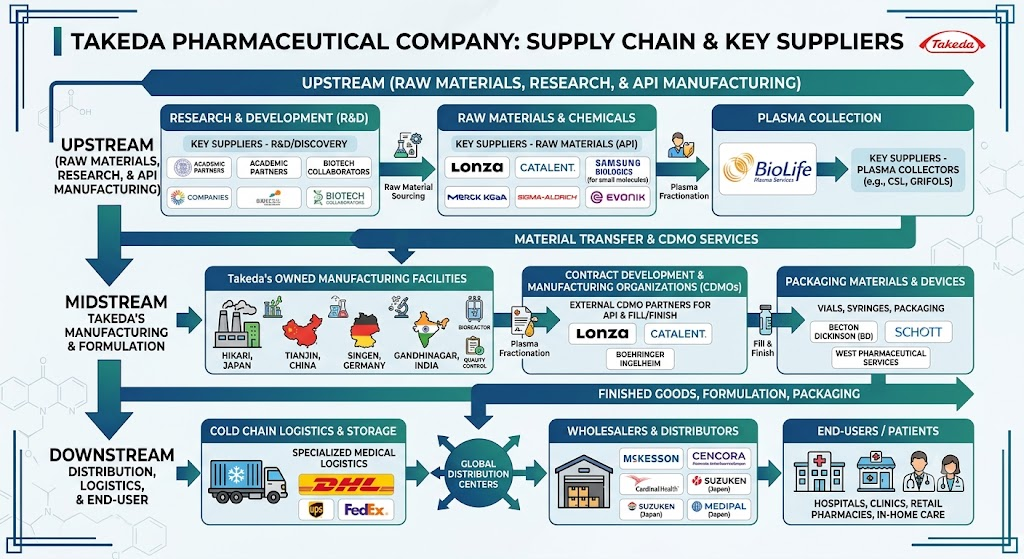
Takeda operates a vertically integrated yet partner-reliant pharmaceutical supply chain spanning specialized plasma collection, upstream chemical synthesis, biologic manufacturing, contract fabrication, and global cold-chain distribution.
- Upstream: Raw Materials, CDMOs, and Plasma Sourcing
- Biologics and Small Molecule API: While Takeda operates internal API and drug substance sites(e.g., Hikari in Japan, Singen in Germany, and Dublin in Ireland), it relies extensively on tier-1 Contract Development and Manufacturing Organizations(CDMOs). Key partners include Lonza Group, Samsung Biologics, and Boehringer Ingelheim for mammalian cell culture, as well as Evonik and Thermo Fisher Scientific(Patheon) for high-potency chemical intermediates and specialized excipients.
- Plasma Fractionation Network: Because plasma cannot be synthetically produced, Takeda manages BioLife Plasma Services, an extensive upstream network of over 240 dedicated plasma collection centers across the United States and Europe. Key consumable suppliers for plasmapheresis include Haemonetics Corporation and Fresenius Kabi(providing apheresis separation devices, single-use harvest kits, and anticoagulant solutions).
- Single-Use Bioprocessing and Reagents: Upstream cell culture operations rely heavily on consumable single-use bioreactor systems, filtration membranes, and growth media supplied by Danaher Corporation(Cytiva), Merck KGaA(MilliporeSigma), and Sartorius AG.
- Midstream: Formulation, Fill-Finish, and Packaging
- Aseptic Fill-Finish: Finished drug production is handled through a hybrid model. Takeda utilizes internal sterile suites in Lessines(Belgium), Vienna(Austria), and Thousand Oaks(California), alongside external fill-finish capacity from Catalent(part of Novo Holdings) and Vetter Pharma.
- Primary Packaging and Delivery Devices: High-precision containment and automated drug delivery systems are critical for subcutaneous therapies(e.g., Entyvio pen and Takhzyro pre-filled syringes). Key suppliers include Becton Dickinson(BD Medical – Pharmaceutical Systems), Stevanato Group(glass cartridges and vials), Schott Pharma, and West Pharmaceutical Services(elastomeric stoppers and plunger seals).
- Downstream: Cold Chain Logistics and Distribution
- Temperature-Controlled Logistics: A substantial portion of Takeda’s revenue comes from biologics and plasma fractions that require strict 2°C to 8°C cold chains or sub-zero cryopreservation. Primary specialized freight forwarders and temperature-controlled logistics handlers include World Courier(AmerisourceBergen/Cencora), Marken(UPS Healthcare), and DHL Global Forwarding.
- Wholesalers and Distributors: Finished drug distribution relies on major pharmaceutical wholesalers in primary markets:
- United States: McKesson, Cencora(AmerisourceBergen), and Cardinal Health handle over 85% of commercial volume.
- Japan: Suzuken, Alfresa Holdings, Medipal Holdings, and Toho Pharmaceutical govern domestic distribution through standard wholesale consignment channels.
Competitor Analysis: Technical and Financial Comparison
Takeda competes across four distinct vectors: global multinational pharma, domestic Japanese giants, pure-play plasma specialists, and oncology innovators. Its primary competitors include AbbVie, Johnson & Johnson, CSL Behring, and Daiichi Sankyo.
Technical and R&D Capabilities Comparison
- Gastroenterology and Immunology:
- Takeda vs. AbbVie & Johnson & Johnson: Takeda’s Entyvio targets $\alpha_4\beta_7$ integrin, delivering gut-selective anti-inflammatory action with a lower systemic immunosuppression profile compared to legacy TNF inhibitors. However, AbbVie(Skyrizi targeting IL-23, and Rinvoq, an oral JAK inhibitor) and Johnson & Johnson(Tremfya and Stelara) have established strong efficacy data and convenient oral or rapid-acting dosing profiles, creating competitive pressure on Entyvio’s first-line biologic share.
- Plasma-Derived Therapies(PDT):
- Takeda vs. CSL Behring & Grifols: CSL Behring maintains an advantage in yield optimization and immunoglobulin concentration(Privigen, Hizentra), coupled with a lower donor-acquisition cost structure per liter. While Takeda’s Gammagard Liquid and Cuvitru are commercially competitive, CSL has scaled recombinant options and gene therapies(e.g., Hemgenix for hemophilia B), whereas Takeda withdrew or deprioritized selected early gene-therapy programs to reallocate capital.
- Oncology and Modality Shift:
- Takeda vs. Daiichi Sankyo: Daiichi Sankyo transitioned into a premier global oncology leader via its proprietary DXd antibody-drug conjugate(ADC) technology platform(partnered with AstraZeneca for Enhertu and datopotamab deruxtecan). In contrast, Takeda historically relied on proteasome inhibitors(Velcade, Ninlaro) and targeted small molecules(Adcetris regional rights, Alunbrig, Fruquintza). Takeda has sought external licensing deals and early-stage cell therapies to close the modality gap, but it trails Daiichi Sankyo in wholly owned, transformative oncology platforms.
Financial and Operational Comparison
- Revenue Scale and Growth Profile: Takeda generates approximately $29B to $30B annually. It operates below mega-cap giants like Johnson & Johnson(
$85B+) and AbbVie($54B), but remains larger than domestic Japanese peers Daiichi Sankyo($11B to $12B) and Astellas($10B to $11B). - Balance Sheet Leverage: Takeda’s financial structure remains defined by the debt incurred from its $62 billion acquisition of Shire in 2019. While management has reduced net debt-to-adjusted EBITDA from over 4.7x down toward the 2.0x–2.5x target range, its leverage remains elevated compared to cash-rich peers like Daiichi Sankyo or Johnson & Johnson, restricting large-scale M&A and requiring disciplined capital allocation toward debt repayment and dividend defense.
- Operating Margins: Takeda operates with core operating profit margins generally in the 27% to 30% range. This lags capital-efficient mega-pharma competitors such as AbbVie(operating margins frequently exceeding 40% to 45%), driven partly by the high cost of goods sold(COGS) inherent in plasma collection networks and the post-patent generic decline of high-margin assets like Vyvanse.
- R&D Productivity: Takeda commits approximately 15% to 18% of revenue to R&D annually(roughly ¥700B to ¥750B). While in line with the industry median, its R&D conversion efficiency has faced headwind challenges due to pipeline attrition in late-stage candidates, leading Takeda to favor external licensing and bolt-on acquisitions to bolster pipeline depth.
Sources
- https://www.takeda.com/investors/
- https://www.forbes.com/companies/takeda-pharmaceutical/
- https://en.wikipedia.org/wiki/Takeda_Pharmaceutical_Company
- https://www.sec.gov/edgar/browse/?CIK=0001759655
back to Takeda