
Corporate History
Origins and Industrial Electrification(1897–1950s)
Founded in Osaka in 1897 as Sumitomo Copper Rolling Works, the enterprise emerged from the historic Besshi Copper Mine operations of the Sumitomo Group. It quickly shifted into manufactured electric wire production in 1900 and high-voltage underground cables in 1911. In 1931, it began producing cemented carbide tools(Igetalloy), laying the groundwork for materials science diversification beyond base metals. The company adopted its current name, Sumitomo Electric Industries, Ltd., in 1939.
Post-War Modernization and Global Expansion(1960s–1980s)
During Japan’s rapid economic growth, Sumitomo Electric entered the automotive component sector, delivering its first four-wheel vehicle wiring harnesses in 1961. In the 1970s, it commercialized compound semiconductors and pioneered the vapor-phase axial deposition(VAD) manufacturing method for ultra-pure silica optical fibers. It established its first overseas manufacturing footprint in Thailand in 1969 and delivered the world’s first bidirectional CATV fiber network in 1978.
Telecommunications Boom and Material Specialization(1990s–2010s)
The company scaled into a premier supplier of global telecommunications infrastructure, manufacturing high-density fiber-optic cables, optical transceivers, and synthetic diamond tooling. Concurrently, it built out a worldwide network of automotive parts plants across North America, Europe, and Southeast Asia to supply Japanese OEMs and multinational carmakers locally.
Energy Transition, Mobility, and AI Infrastructure(2020s–Present)
Sumitomo Electric pivoted toward structural megatrends, securing billions of euros in European High-Voltage Direct Current(HVDC) grid interconnections for offshore wind farms while commercializing ultra-low-loss optical components and multi-core fibers engineered specifically for hyperscale AI compute clusters.
Business Model and Growth Strategy
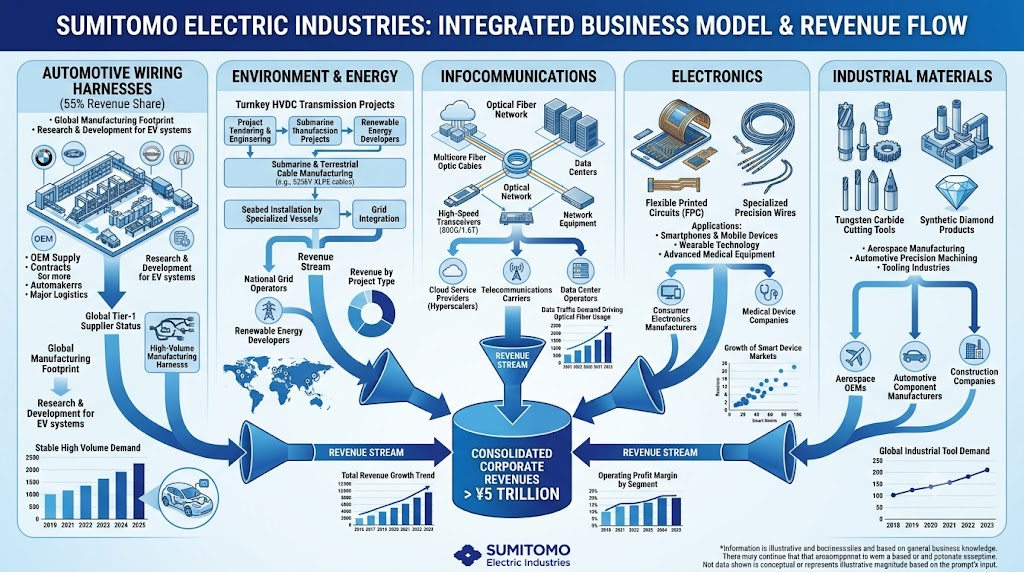
Sumitomo Electric generates revenue through five core operational segments: Automotive, Environment & Energy, Infocommunications, Electronics, and Industrial Materials. Consolidated net sales reached ¥4.68 trillion in FY2024 and exceeded ¥5.11 trillion in FY2025, driven by record operating profits expanding past ¥418 billion.
The primary monetization mechanics and segment performance include:
- Automotive: Accounts for roughly 55% of total corporate revenues. The company earns recurring, high-volume revenue by supplying full-vehicle wire harnesses, high-voltage harnesses, and electronic control connectors directly to Tier-1 OEMs including Toyota, Nissan, and Stellantis. Monetization relies on long-cycle model contracts, though margins are tight(typically 3–5% operating margin) due to intense OEM pricing pressure.
- Environment & Energy: Delivers high-margin project-based revenues from turnkey engineering, procurement, and construction(EPC) of submarine and terrestrial HVDC power transmission systems. Sumitomo Electric captures lucrative enterprise value through proprietary 525 kV cross-linked polyethylene(XLPE) cable technology. It secured massive multi-billion-euro contracts in Germany(e.g., Korridor B and Rhein-Main-Link valued at over €3 billion) and acquired a majority stake in German cable manufacturer Südkabel to lock in localized European manufacturing capacity.
- Infocommunications: Functions as a critical growth engine by providing ultra-low-loss optical fibers, optical transceivers(400G/800G/1.6T), fusion splicers, and multi-core fiber(MCF) cables to telecom operators and hyperscale cloud providers. While smaller in total revenue share(~6%), it commands structurally higher margins and direct exposure to data center capital expenditure cycles.
- Electronics and Industrial Materials: Monetizes specialized material formulations, including flexible printed circuits(FPC), electronic irradiation wires, synthetic polycrystalline diamonds, and tungsten carbide cutting tools sold to semiconductor equipment makers and precision machining operations.
The overarching corporate strategy centers on rebalancing its capital portfolio away from pure volume-based commodity harnesses toward high-value-added components: scaling HVDC grid backlogs, transitioning standard car harnesses into integrated EV power management modules, and commercializing optical interconnect components for AI clusters.
Business Model Sources
- https://sumitomoelectric.com/ir/highlights
- https://sumitomoelectric.com/press/2024/06/prs025
- https://sumitomoelectric.com/president/2024/11/202420
AI Strategy, Budget, and Partnerships
Sumitomo Electric pursues a two-pronged AI strategy: commercializing high-bandwidth physical hardware for AI compute clusters and embedding generative/predictive AI directly across its global manufacturing lines.
Hardware for AI Infrastructure
As generative AI workloads accelerate intra-datacenter server interconnect bandwidth requirements, electrical copper interconnects encounter severe reach, heat, and latency limits. Sumitomo Electric addresses this bottleneck through optical transceivers(800 Gbps and 1.6 Tbps), advanced optical engine packaging, and multi-core optical fibers(MCF). In March 2024, the company recorded an ultra-low transmission loss of 0.1397 dB/km for its silica-core Z-PLUS Fiber and introduced 19-core standard-cladding fiber architectures to dramatically compress transceiver power consumption and physical rack cabling bulk inside AI clusters.
R&D Budget and CapEx Allocation
The company maintains sustained capital deployment dedicated to next-generation optical and power electronics:
- Research and Development Spending: Grew from ¥142.0 billion in FY2023 to ¥156.3 billion in FY2024, reaching ¥162.9 billion in FY2025. A significant portion of this research budget is concentrated within its Transmission Devices Laboratory and Information Technologies Laboratories for optical engines, co-packaged optics(CPO), and edge AI integration.
- Capital Expenditures: Sustained at roughly ¥243 billion annually, expanding manufacturing lines for precision optical components and high-speed active optical cables(AOC).
Strategic Partnerships and Standardization Initiatives
- IOWN Global Forum(Innovative Optical and Wireless Network): Partnering closely with NTT, Intel, and Sony to construct the All-Photonics Network(APN). Sumitomo Electric develops the core APN-T(transceivers) and APN-S/APN-G(all-optical switching and splitting modules) that eliminate optical-electrical-optical conversions in next-generation AI inter-datacenter networks.
- National Research Collaborations: Partnered with Japan’s National Institute of Information and Communications Technology(NICT) and KDDI Research to achieve world records in standard-diameter multi-core fiber transmission reaching multi-petabit per second throughput.
- Smart Factory and Edge AI: Deploying internal machine learning vision systems and automated predictive analytics across its harness and wire fabrication plants, standardizing automated optical inspection(AOI) to reduce defect rates and optimize supply chain resource planning.
back to Sumitomo Electric