
Corporate History and Developmental Stages
Stage 1: Origins and Post-War Foundation(1919–1940s)
The Sumitomo keiretsu traces its cultural roots back to Masatomo Sumitomo’s 17th-century copper-refining enterprise in Kyoto. However, Sumitomo Corporation itself was formally founded in December 1919 as the Osaka North Harbour Company, focused on coastal reclamation and urban real estate development in Osaka. In 1945, following the post-World War II dissolution of the zaibatsu conglomerates, the company changed its name to Nippon Engineering Co., Ltd. and entered general commercial trading to assist with national reconstruction, merging with Osaka Hokko to re-anchor the modern enterprise.
Stage 2: Rapid Trade Expansion and Global Sogo Shosha Transformation(1950s–1970s)
In 1952, the company adopted the name Sumitomo Shoji Kaisha, Ltd. and established overseas representative offices in key international trade centers, starting in New York. Throughout Japan’s high-growth post-war era, the firm operated as an export-import trade intermediary, handling raw material imports(iron ore, coking coal) and finished industrial exports(steel, machinery, textiles) on slim intermediary commission fees(known as kosen), supporting the broader Sumitomo industrial keiretsu.
Stage 3: Transition to Equity Investing and Global Diversification(1980s–1990s)
The company formally renamed itself Sumitomo Corporation in 1978. As client companies globalized and direct internet communication threatened the traditional middleman trading role, Sumitomo pivoted from simple commission-based brokerage toward direct corporate equity investment. It acquired stakes in power plants, infrastructure concessions, and consumer-facing companies, including the creation of Jupiter Telecommunications(J:COM) in 1995, transforming the company into a business operator and asset owner.
Stage 4: Portfolio Consolidation and Downstream Expansion(2000s–2010s)
Sumitomo reorganized into multi-divisional strategic units, actively expanding non-resource businesses such as supermarket chains(Summit), media platforms, pharmaceutical marketing, and IT systems integration through SCSK Corporation(formed in 2011). Concurrently, it committed massive capital to upstream resource ventures, such as copper mines in the Americas and nickel operations in Madagascar, exposing the balance sheet to global commodity cycles.
Stage 5: Strategic Business Unit Model and Portfolio Reallocation(2020s–Present)
Buffeted by severe impairments in upstream resource projects, Sumitomo launched structural reforms to improve capital efficiency. Under its Medium-Term Management Plan 2026(“No. 1 in Each Field”), the group reorganized its operating structure into 41 Strategic Business Units(SBUs) governed by strict ROIC-WACC hurdles. The strategy prioritizes stable cash-generating pillars—such as aircraft leasing, digital services, real estate, and agricultural distribution—while accelerating the divesting of underperforming assets.
Business Model and Monetization Strategy
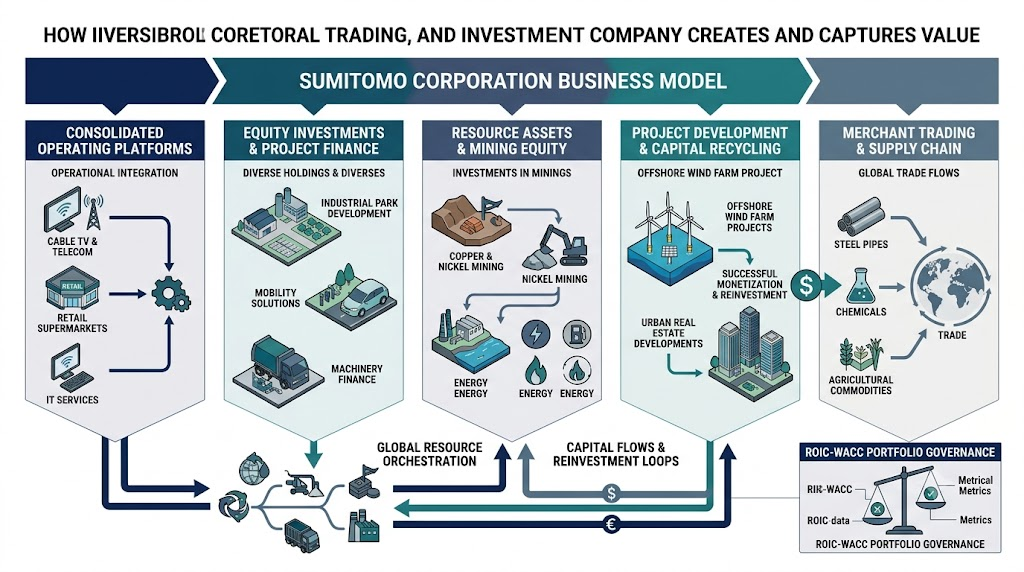
Sumitomo Corporation earns money through a hybrid model combining long-term equity-method investment returns, consolidated operating cash flows, asset management fees, and trade-spread arbitrage. The core economic engine has moved decisively away from margin-thin trade intermediation to active capital allocation and business operation.
Primary Monetization Streams
- Consolidated Operating Platform Profits: Rather than passive investment, Sumitomo controls or co-manages operating enterprises, capturing operational EBITDA directly. Flagship platforms include SCSK(digital IT services), J:COM(Japan’s largest broadband and cable provider), and Summit Inc.(supermarket retail). These recurring, service-oriented cash flows generate steady domestic subscription and retail revenues insulated from commodity shocks.
- Equity-Method Investment Returns & Dividends: Across industrial infrastructure, automotive dealerships, construction machinery distributors, and overseas industrial parks, Sumitomo takes meaningful equity stakes(20% to 50%). It extracts recurring cash dividends and proportionate net income under the equity method, deploying financial leverage to amplify project-level ROE.
- Resource Royalties and Upstream Equity Stakes: Sumitomo monetizes minority and operating stakes in copper(e.g., Minera San Cristóbal historically, Cerro Verde, Morenci), coal, and nickel mining assets. In upcycles, these assets yield massive profit margins and free cash flow; in downcycles, Sumitomo mitigates losses via financial hedging and asset sales.
- Project Development & Capital Recycling Gains: In renewable energy(offshore wind, solar), thermal power plants, and real estate, Sumitomo acts as an originator and general developer. It packages the land, concessions, financing, and EPC contractors, operates the asset through initial stabilization, and divests partial or full stakes to institutional investors and infrastructure funds, crystallizing upfront development premiums and ongoing management fees.
- Traditional Merchant Trading Spreads: The legacy trading business survives in specialized niches—such as tubular steel products for global energy producers, agricultural grain supply chains, and specialized chemical distribution. Sumitomo secures bulk discounts, assumes logistics/counterparty risk, and captures the bid-ask spread along the transport corridor.
Financial Execution and Portfolio Economics
Under its Medium-Term Management Plan 2026, Sumitomo targets a corporate ROE of 12% or higher, recording consolidated net profit of ¥600.3 billion in FY2025(with an ROE of 12.9%). Capital allocation is governed by a planned ¥1.8 trillion strategic investment budget focused on eight high-return areas: agriculture, construction systems, leasing, energy solutions, steel, digital, healthcare, and real estate. To enforce discipline, each of the 41 Strategic Business Units is evaluated against tailored Return on Invested Capital(ROIC) targets relative to its Weighted Average Cost of Capital(WACC), with mandatory capital divestment triggered when businesses persistently fail to cover their cost of capital.
Business Model Source References
- https://www.sumitomocorp.com/en/jp/ir/investors/enhancement
- https://umbrex.com/resources/company-profiles/sumitomo-corp/
- https://note.com/nekota_toure/n/n9dd7d74fc82f?hl=en
- https://www.sumitomocorp.com/en/jp/business
- https://www.sumitomocorp.com/-/media/Files/hq/ir/report/investors-guide/2025/investors_guide_2025.pdf
Artificial Intelligence Strategy, Investments, and Partnerships
Sumitomo Corporation has framed artificial intelligence and digital transformation as systemic core drivers of its portfolio competitiveness rather than standalone experimental projects. Its overarching roadmap is organized under the corporate slogan “Refine with Digital, Earn with Digital” and formalized in its DAIS(Digital & AI Strategy) architecture.
Strategic Consolidation and Institutional Setup
In December 2025, Sumitomo executed the largest single strategic capital investment in its corporate history: an ¥882 billion tender offer to acquire full 100% ownership of SCSK Corporation(Japan’s premier enterprise systems integrator, in which Sumitomo previously held a 50.6% stake). In April 2026, Sumitomo established a dedicated Digital AI Group led by a dedicated Group CEO/CDO/CIO, creating an integrated organizational pipeline directly linking enterprise IT architecture with its 900+ global operating companies and 100,000 corporate clients. The stated financial objective of DAIS is to improve group-wide ROIC by more than 1.0% by FY2030, while targeting a doubling of SCSK’s operating profit levels.
Strategic Pillars and Core Focus Areas
Sumitomo’s AI roadmap concentrates strictly on the enterprise application layer, software integration, and data monetization, avoiding costly frontier foundation model development:
- Internal Process Transformation: Accelerating operational efficiency across corporate functions and group subsidiaries by embedding AI copilots into routine contracting, document review, and risk screening.
- Industrial & Physical Asset Intelligence: Applying proprietary machine learning models to the group’s physical assets—such as automated predictive maintenance in railway systems, logistics fleet routing, and smart real estate management.
- Offering-Based External AI Solutions: Transforming SCSK from a customized labor-intensive software house into a scalable, productized AI service provider selling agentic workflows to external enterprise clients.
Partnerships, Deployments, and Empirical Metrics
- Microsoft Enterprise Alliance: Sumitomo instituted an enterprise-wide deployment of Microsoft 365 Copilot to approximately 9,000 employees globally. As of late 2025, monthly active user(MAU) adoption reached 90%, generating an audited operational time savings of 10,560 hours per month and recurring annual corporate cost reductions calculated at approximately ¥1.2 billion. SCSK simultaneously deployed Copilot across 7,000 internal engineering seats to build custom external Copilot Agents.
- Infrastructure AI & Rail Inspection Consortium: Sumitomo partnered with 33 regional and national railway operators across Japan to deploy computer vision and machine-learning anomaly detection algorithms for automated track inspections, mitigating chronic domestic labor shortages.
- Smart City Digital Twins: Partnering with SCSK, Sumitomo integrates real-time predictive AI algorithms into large-scale urban development projects, notably the Hanoi Smart City development in Vietnam and the Hakozaki smart redevelopment in Fukuoka, managing automated energy microgrids and autonomous mobility networks.
- Insight Edge Inc.: Sumitomo’s specialized internal agile development team works directly with business divisions to deploy advanced analytics, proprietary quantum computing algorithms for combinatorial optimization, and specialized logistics algorithms across complex global supply chains.
back to Sumitomo Corporation