
Market Position and Market Share
Sumitomo Mitsui Trust Group, Inc.(SMTH, TYO: 8309) is Japan’s only dedicated independent trust banking group, operating primarily through its core subsidiary, Sumitomo Mitsui Trust Bank, Limited(SMTB). Unlike Japan’s three mega banking groups(MUFG, SMBC Group, and Mizuho), SMTH operates as a specialized trust bank rather than a universal mega-commercial bank.
- Domestic Ranking & Assets:SMTH ranks as the 5th largest banking institution in Japan by total assets(surpassed only by MUFG, SMFG, Mizuho, and Japan Post Bank), with total consolidated assets exceeding JPY 70 trillion(approximately USD 500-600 billion depending on foreign exchange rates).
- Trust Assets & Custody Market Share: SMTB holds the #1 market position in Japan for trust assets under custody/administration, exceeding JPY 140 trillion in trust assets. Together with Master Trust Bank of Japan(in which SMTB is a key stakeholder alongside peers), the group commands over 30% of Japan’s institutional asset custody market.
- Corporate Pension Administration: The group maintains a leading market share of roughly 25% to 30% in corporate defined benefit(DB) and defined contribution(DC) pension administration and asset management in Japan, ranking #1 alongside Mitsubishi UFJ Trust and Banking.
- Real Estate Brokerage & Securitization: SMTH is ranked among the top 2 in commercial real estate trust brokerage transaction volumes among Japanese financial institutions, holding approximately 20% to 25% of the institutional real estate trust market.
- Asset Management(AUM):Through SuMi TRUST Asset Management and Nikko Asset Management, group AUM exceeds USD 650 billion, positioning it as one of the top 3 asset managers in Japan and within the top 30 globally.
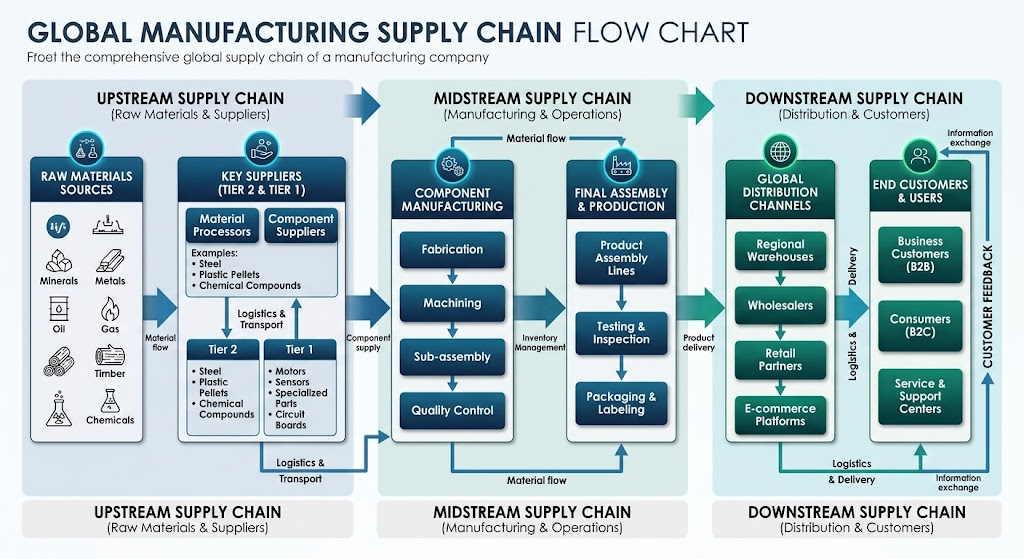
Supply Chain & Value Chain Analysis
In the financial and trust banking sector, the “supply chain” reflects the flow of wholesale capital, technology infrastructure, custodial networks, and distribution channels.
- Upstream(Capital Sources, Financial Infrastructure & Core IT Providers):
- Capital & Deposit Providers: Domestic retail depositors, corporate treasury cash, and public/corporate pension funds provide the underlying liability and trust liquidity base.
- Core Banking & Cloud Vendors: SMTH relies on key enterprise technology vendors. IBM Japan and NTT DATA serve as primary system integrators for its mission-critical core banking and accounting engines. For next-generation digital trust, cloud data, and security architectures, SMTH leverages AWS, Microsoft Azure, and specialized cyber vendors(such as CrowdStrike and Palo Alto Networks).
- Custodial Settlement Systems: Core clearing and securities settlement systems are tethered directly to the Bank of Japan Financial Network System(BOJ-NET), the Japan Securities Depository Center(JASDEC), Euroclear, and Clearstream for cross-border assets.
- Midstream(Value-Added Trust & Asset Operations):
- Trust Structuring & Fiduciary Operations: Asset administration, real estate appraisal, securitization, and stock transfer agency services(handling corporate shareholder registries and AGM voting processes).
- Asset Management Operations: Portfolio management execution via SuMi TRUST AM and Nikko AM, with transaction execution facilitated through major domestic and global brokerages(Nomura, Daiwa, Goldman Sachs, Morgan Stanley).
- Downstream(Distribution Channels & End Clients):
- Institutional Clients: Corporate clients, sovereign wealth entities, corporate pension associations, and regional banks seeking specialized yield, asset securitization, or ESG infrastructure financing.
- Retail Distribution: High-net-worth individuals(HNWIs) and mass affluent households targeted via dedicated branch networks, inheritance planning consultations, and digital channels such as SBI Sumishin Net Bank(a joint venture with SBI Holdings).
Competitor Analysis: Technical and Financial Comparison
SMTH’s primary direct competitor is Mitsubishi UFJ Trust and Banking Corporation(MUTB, a subsidiary of MUFG), followed by Mizuho Trust & Banking(MHTB) and Nomura Holdings in wealth management and asset administration.
Financial Metrics Comparison
| Financial Metric | Sumitomo Mitsui Trust Group(SMTH) | Mitsubishi UFJ Financial Group(MUFG / MUTB) | Mizuho Financial Group(Mizuho Trust) |
| Business Structure | Pure-play Trust Bank Holding Model | Universal Mega-Bank Holding Model | Universal Mega-Bank Holding Model |
| Fee Income Ratio | ~50% – 55%(Substantially higher non-interest income exposure) | ~35% – 40%(Higher reliance on traditional loan net interest income) | ~35% – 40%(High net interest income exposure) |
| ROE(Consolidated) | ~7.0% – 8.5% | ~8.0% – 9.5% | ~7.5% – 8.5% |
| CET1 Ratio | ~11.5% – 12.5%(Solid Basel III compliance) | ~12.5% – 13.5% | ~11.0% – 12.0% |
| Asset Sensitivity | Lower sensitivity to loan volume; higher sensitivity to AUM, stock market levels, and real estate fees | High sensitivity to commercial lending spreads and international loan growth | High domestic corporate loan book sensitivity |
Technical, Structural & Strategic Comparison
- Pure-Play Trust Focus vs. Bank-Led Conglomerates:
- SMTH: SMTH’s key differentiator is independence from standard commercial mega-bank hierarchies. This structure prevents internal conflicts between commercial lending mandates and fiduciary asset management duties. Its fee-to-revenue ratio is structurally higher than commercial banks.
- Competitors(MUTB & MHTB): MUTB benefits from the immense balance sheet and international branch reach of MUFG, often cross-selling trust products to large corporate clients financed by MUFG Bank. However, MUTB transferred its domestic retail lending operations directly into MUFG Bank to focus purely on institutional asset servicing, whereas SMTH retains a full private banking and residential trust mortgage franchise.
- Technology & Custody Infrastructure:
- SMTH: SMTH has prioritized modernizing trust accounting and digital inheritance workflows. SMTB is an active pioneer in security token offerings(STOs), asset-backed digital securities, and blockchain-based asset registration through partnerships(including Progmat, co-developed with peers).
- Competitors: MUFG/MUTB led the creation of the Progmat digital asset infrastructure consortium, positioning MUTB slightly ahead in standardization of tokenized securities. However, SMTH remains competitive in agile integration of asset management sub-advisory platforms and ESG infrastructure funds.
- Balance Sheet Vulnerability & Rate Sensitivity:
- Because SMTH holds a larger proportion of securities holdings and trust banking assets relative to conventional commercial loans, its earnings are less driven by base lending NIM(Net Interest Margin) expansion and more tethered to equity market valuations, client asset inflows, and real estate deal velocity compared to MUFG and SMFG.
Sources
- https://www.smtg.jp/english/
- https://www.smtb.jp/english/
- https://en.wikipedia.org/wiki/Sumitomo_Mitsui_Trust_Holdings
- https://www.sumitrust-am.com/
- https://www.globaldata.com/company-profile/sumitomo-mitsui-trust-holdings-inc/
back to Sumimoto Mitsui Trust