
Company History
- Foundation & Divergent Predecessors(1924–1999): The group traces its origin to two pioneer trust banks. Mitsui Trust Company was established in March 1924 as Japan’s first trust company under the Trust Law of 1922. Sumitomo Trust Co., Ltd. was subsequently founded in July 1925 in Osaka. Both institutions evolved through post-war industrial finance reforms, changing corporate titles in 1948 and 1952 to become full-service trust and banking institutions supporting long-term corporate credit and asset custody.
- Post-Bubble Consolidation & Holding Company Emergence(2000–2010): Following Japan’s financial crisis, Mitsui Trust and Banking merged with The Chuo Trust & Banking in 2000 to form The Chuo Mitsui Trust and Banking Co., Ltd. In 2002, Mitsui Trust Holdings, Inc.(later renamed Chuo Mitsui Trust Holdings, Inc.) was formed as the umbrella holding company. Concurrently, Sumitomo Trust expanded its asset management footprint by acquiring asset management franchises, including Nikko Asset Management in 2009.
- The Megamerger & Unified Integration(2011–2012): In April 2011, Chuo Mitsui Trust Holdings and The Sumitomo Trust and Banking Co., Ltd. integrated management via a share exchange, establishing Sumitomo Mitsui Trust Holdings, Inc. In April 2012, operating entities Chuo Mitsui Trust, Chuo Mitsui Asset Trust, and Sumitomo Trust merged to form Sumitomo Mitsui Trust Bank, Limited(SMTB).
- Corporate Rebranding & Modernization(2023–Present): The group adopted its current trade name, Sumitomo Mitsui Trust Group, Inc., to reflect a broader integrated financial services framework. Recent initiatives include restructuring private equity and infrastructure asset platforms, absorbing IT subsidiary Sumitomo Mitsui Trust Systems & Services in April 2026 to consolidate core architecture, and unwinding strategic cross-shareholdings to optimize balance sheet return on equity.
Business Model & Strategic Development
Sumitomo Mitsui Trust Group generates revenue through an integrated trust-banking architecture that monetizes balance-sheet lending alongside high-margin, asset-light fee businesses:
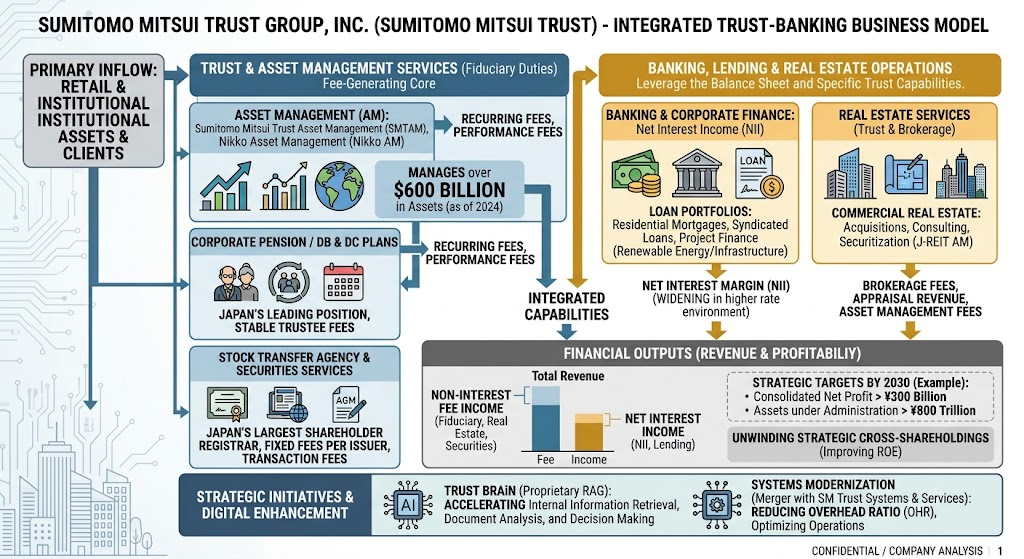
- Trust & Asset Management Services(Fee-Based Engines): The core profit driver consists of asset management and investor services. Through operating units such as Sumitomo Mitsui Trust Asset Management and Nikko Asset Management, the group manages over $600 billion in institutional and retail assets. Revenue is generated through recurring management fees, custodial fees, and performance fees. The group commands a leading position in defined-benefit and corporate pensions in Japan, managing institutional retirement pools and earning stable administrative trust fees.
- Asset Administration & Stock Transfer Agency: SMTB acts as Japan’s largest stock transfer agent, maintaining shareholder registries, managing general shareholder meetings, and processing dividend payments for listed Japanese corporations. This yields predictable recurring fee income while cementing primary relationships with corporate boards and executives.
- Real Estate Brokerage & Consulting: Leveraging commercial trust powers, the group earns transaction fees and appraisal revenue by advising corporations and high-net-worth individuals on commercial real estate acquisitions, property securitization(J-REIT asset management), and corporate headquarters reallocations.
- Banking & Corporate Lending Operations: The group collects net interest income(NII) from residential mortgages, corporate syndicated loans, and project finance across renewable energy and infrastructure. In the rising interest rate environment initiated by the Bank of Japan, SMTB has widened its net interest margin while deploying deposits into higher-yielding domestic government bonds and central bank reserves.
- Strategic Growth Trajectory: Management’s long-term plan targets over ¥300 billion in consolidated net profit and ¥800 trillion in assets under administration/custody(AUF) by 2030. Strategic capital is systematically channeled toward alternative private assets—such as domestic renewable infrastructure funds and global private debt gatekeeping—to expand recurring non-interest fee revenue while divesting legacy equity portfolios.
Sources for Business Model Information
- https://www.smtg.jp/english/
- https://www.smtg.jp/english/investors/
- https://en.wikipedia.org/wiki/Sumitomo_Mitsui_Trust_Holdings
AI Development Strategy, Budget & Partnerships
- Strategic Architecture & “Trust BRAiN”: Sumitomo Mitsui Trust Group approaches artificial intelligence not as a standalone venture, but as an enterprise-wide modernization engine to reduce its overhead ratio(OHR) and enhance fiduciary analytical precision. A key milestone is the internal launch and scaling of “Trust BRAiN,” the group’s proprietary Retrieval-Augmented Generation(RAG) platform. “Trust BRAiN” ingests dense legacy legal trusts, pension bylaws, regulatory disclosures, and corporate registry contracts to enable instantaneous data retrieval for compliance officers, relationship managers, and wealth planners.
- System Consolidation & Investment Deployment: To eliminate administrative friction and fast-track digital initiatives, the bank formally completed the merger of its main banking entity and its technology subsidiary, Sumitomo Mitsui Trust Systems & Services, in April 2026. IT and digital transformation investments represent an ongoing allocation embedded in multi-year budgets exceeding ¥100 billion across systems overhaul, core digital banking upgrades, and cloud orchestration, supporting operational automation across trust and securities execution.
- Strategic Partnerships & Ecosystem Deployments:
- Enterprise Cloud & Foundation Models: The group collaborates with major technology infrastructure providers, leveraging Microsoft Azure and AWS enterprise tenancies for isolated generative AI modeling that meets strict Japanese Financial Services Agency(FSA) data sovereignty and privacy mandates.
- Venture & Big Data Analytics: SMTB participates directly in strategic corporate venture capital(CVC) partnerships, such as co-investing with technology ventures like Think Nature to deploy biodiversity and natural capital big data analytics platforms into sustainable asset management offerings.
- Digital Asset Infrastructure: Through entities such as Japan Digital Asset Trust(JDAT), the group has partnered with domestic digital exchanges and institutional technology providers to deploy algorithmic compliance, custodial reconciliation, and blockchain-based asset administration tools.
back to Sumimoto Mitsui Trust