
Stryker’s corporate history can be categorized into three distinct phases, evolving from a specialized orthopedic startup into a global medical technology titan through strategic innovation and acquisitions.
Phase 1: Foundation and Orthopedic Innovation (1941–1970s)
In 1941, orthopedic surgeon Dr. Homer Stryker founded the company in Michigan. His first major innovation was the oscillating saw, which enabled the removal of plaster casts without cutting the patient’s skin. Building on this, the company focused on pioneering orthopedic equipment, including mobile hospital beds and specialized surgical tools, establishing a reputation for solving clinical challenges in orthopedics.
Phase 2: Expansion and Product Diversification (1979–2000s)
Following its IPO in 1979, Stryker launched an aggressive growth strategy, moving beyond its core orthopedic roots. The company expanded into medical instrumentation and endoscopy through strategic acquisitions. Key milestones included the purchase of Osteonics, which launched Stryker into the joint replacement market, and the acquisition of Leibinger and Howmedica, significantly bolstering its global market share in neurosurgery and orthopedic implants.
Phase 3: Digital Transformation and Smart Surgery (2010s–Present)
In the modern era, Stryker has pivoted toward robotics and data-driven medicine. The 2013 acquisition of Mako Surgical was a major turning point, as its robotic-arm assisted system revolutionized the precision of joint replacement procedures. Since then, the company has continued to acquire firms like Wright Medical and Vocera, expanding its footprint into digital patient care, smart communications, and neurovascular intervention, effectively transitioning into a comprehensive provider of integrated medical technology solutions.
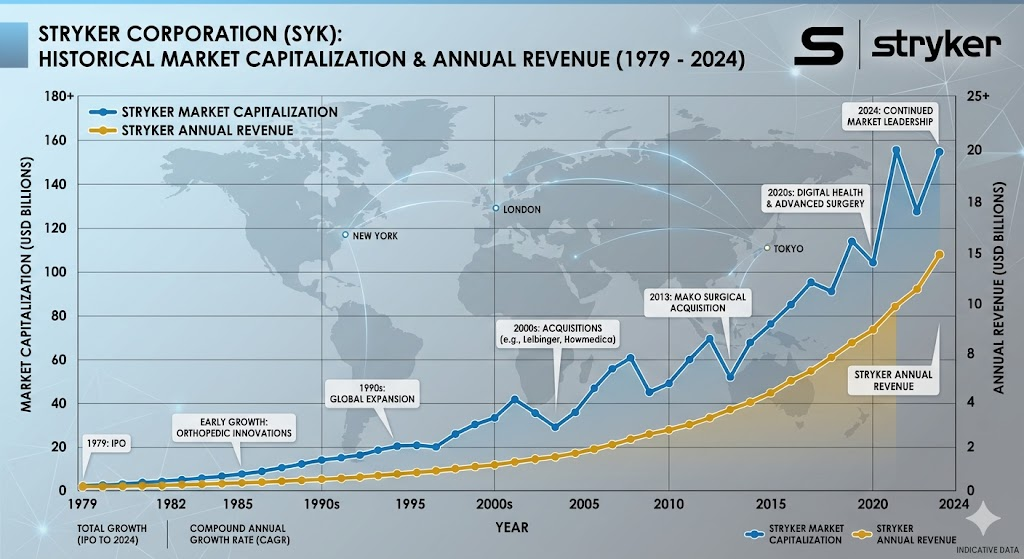
Stryker’s competitive strength lies in its balanced business portfolio, which integrates robust organic R&D with a disciplined acquisition strategy, allowing it to maintain market leadership across orthopedics and medical-surgical sectors.
1. Competitive Landscape
Stryker faces competition across several tiers within the global medical technology market:
- Diversified Medtech Giants: Companies such as Medtronic, Johnson & Johnson, and Abbott. These firms possess broader product portfolios and massive global networks, competing directly with Stryker in surgical equipment, neurotechnology, and consumables.
- Orthopedic and Specialized Rivals: Firms like Zimmer Biomet and Smith & Nephew. These companies are deeply entrenched in the orthopedic implant market and serve as traditional rivals in joint replacements and trauma products.
- Niche and Emerging Tech Players: Companies like Intuitive Surgical. While Stryker holds a lead in orthopedic robotics (Mako), Intuitive Surgical maintains high market prominence in broader applications of robotic-assisted surgery.
2. Core Competitive Advantages (Moat)
- Mako Robotic Platform: By introducing Mako robotic-arm assistance for joint replacement, Stryker has established a high-switching-cost ecosystem that enhances surgical precision and reduces patient recovery times.
- Strategic M&A Strategy: Unlike competitors that prioritize massive mega-mergers, Stryker focuses on strategic, bolt-on acquisitions (e.g., the recent acquisition of care.ai), allowing it to quickly integrate digital patient care and AI software capabilities.
- Strong Brand Loyalty: Through long-term surgical training programs and deep-seated partnerships with hospitals, Stryker ensures high adoption rates for its surgical instruments and consumables in clinical settings.
3. Challenges and Threats
- Digital Ecosystem Competition: Rivals are aggressively developing more comprehensive digital healthcare platforms. Stryker must successfully transition from hardware-dominant dominance to a data-driven medical ecosystem to sustain its market position.
- Price Sensitivity: As healthcare systems face tightening budget constraints, Stryker faces risks related to downward pressure on reimbursement rates and aggressive pricing competition.
- Core Market Maturity: The traditional orthopedic implant market is reaching saturation, making differentiation increasingly difficult. Stryker must continue to innovate to maintain its profit margins.
4. Financial Positioning
Stryker demonstrates strong performance in revenue scale and profitability, particularly in return on equity (ROE). However, in terms of net margins, competitors focused on high-margin, cutting-edge segments (such as Intuitive Surgical) may occasionally outperform.
Overall, Stryker shows more resilient growth potential than traditional orthopedic-only manufacturers, largely due to its financial flexibility and its ability to integrate hardware advantages with the growing demand for digital healthcare solutions.
Source:
- https://www.stryker.com/us/en/about/our-history.html
- https://www.stryker.com/us/en/about/our-businesses/orthopaedics.html
- https://www.stryker.com/us/en/about/our-businesses/medsurg-and-neurotechnology.html
- https://investor.stryker.com/financial-information/quarterly-results
Back to Stryker page