
Company History
- Foundation and State-Backed Consolidation (1987–1997):Formed in 1987 as SGS-Thomson through the merger of Italy’s SGS Microelettronica and France’s Thomson Semiconducteurs, the company aimed to create a European semiconductor champion capable of competing with American and Japanese rivals. Led by Pasquale Pistorio, the company was publicly listed in 1994 and officially rebranded as STMicroelectronics in 1998.
- Diversification and Mobile Era Expansion (1998–2012):ST expanded into consumer electronics, digital TV decoders, and mobile communications.During this phase, ST created joint ventures such as ST-Ericsson (wireless basebands) and Numonyx (flash memory with Intel). However, intense competition in the smartphone baseband market led to heavy financial losses, prompting a major strategic retreat from mobile basebands in the early 2010s.
- Industrial & Automotive Pivot (2013–2019): Under structured restructuring programs, ST refocused its business model toward high-margin industrial applications, smart driving, and embedded processing. The launch and scaling of the STM32 32-bit microcontroller family turned ST into a global leader in general-purpose MCUs. Concurrently, pioneering commercialization of Silicon Carbide (SiC) MOSFETs secured primary supplier status for premium electric vehicle platforms.
- 300mm Manufacturing and Edge AI Transition (2020–Present):ST accelerated investments in 300mm silicon wafer fabrication (e.g., Agrate, Italy) and vertically integrated SiC substrate production (Catania, Italy). The current era focuses on embedding neural processing units directly onto microcontrollers and sensors to lead the edge AI hardware ecosystem.
Business Model and Growth Strategy
ST operates as an Integrated Device Manufacturer (IDM), handling both product design and internal front-end and back-end manufacturing across 14 principal manufacturing sites globally. The company generates revenue by selling finished semiconductor components and integrated solutions directly to original equipment manufacturers (OEMs) and through global distributor networks servicing over 200,000 customers.
The business is structured around key reporting segments: Analog, MEMS & Sensors (AM&S), Power & Discrete Products (P&D), Embedded Processing (featuring STM32 microcontrollers), and RF/Optical Communication. In typical market cycles, ST targets annual revenues exceeding $11B–$17B, with gross margins targeted around 35%–40% depending on fab utilization rates.
ST’s core growth strategy relies on two main pillars:
- Electrification and Digitalization of Automotive: Capitalizing on EV power architecture through Silicon Carbide (SiC) MOSFETs and GaN (Gallium Nitride) solutions, while supplying microcontroller units for Advanced Driver Assistance Systems (ADAS) and domain controllers.
- Embedded Processing Supremacy: Leveraging its proprietary STM32 ecosystem to capture broad industrial IoT and smart device deployments. The company re-invests roughly 10%–12% of annual revenue into R&D ($2.5B+ annual capital expenditures during peak expansion) to maintain proprietary fabrication capabilities.
Information sources for business model and financial structure:
- https://investors.st.com/st-glance
- https://www.bccresearch.com/company-index/profile/stmicroelectronics/financial-statements
- https://www.alpha-sense.com/earnings/stm/
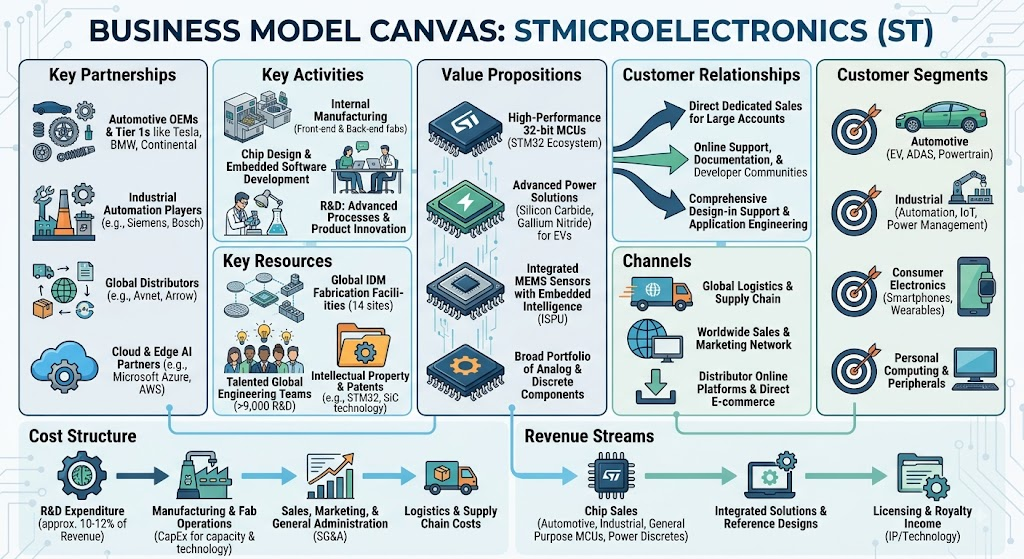
AI Strategy, Budget, and Partnerships
ST’s artificial intelligence strategy focuses on Edge AI (TinyML), embedding neural acceleration capabilities directly on edge devices, microcontrollers, and smart sensors rather than relying on cloud computing. This approach solves edge-computing constraints related to power consumption, latency, data privacy, and bandwidth.
Key Technical Implementations and Concrete Examples:
- Neural-ART Accelerator & NPU Integration: ST integrates dedicated hardware neural processing units (NPUs) into its flagship microcontroller lines, such as the STM32N6 series, allowing real-time computer vision, audio processing, and anomaly detection to run locally at milliwatt power levels.
- Intelligent Sensor Processing Unit (ISPU):ST embeds autonomous C-programmable DSP cores capable of running machine learning models directly inside MEMS sensors (e.g., accelerometers and gyroscopes). This enables industrial machinery to perform predictive maintenance and vibration analysis continuously without waking the main system processor.
- ST Edge AI Suite: A comprehensive, unified software suite that enables developers to optimize, convert, and benchmark pre-trained neural network models (from PyTorch, TensorFlow Lite, or ONNX) onto STM32 microcontrollers and smart sensors.
Budget and Investment Allocation:
ST maintains a global R&D force of over 9,000 engineers (~18% of its 49,000 global workforce). The company consistently channels significant portions of its annual R&D expenditure toward embedded processing architectures and TinyML toolchains. Capital expenditure plans support advanced embedded non-volatile memory processes (e.g., 18nm Fully-Depleted Silicon-On-Insulator / FD-SOI) designed specifically to run ultra-low-power AI workloads.
Strategic Partnerships and Ecosystem:
- Industrial and Automation Ecosystem: Partnerships with factory automation suppliers to integrate AI-driven predictive maintenance directly into motor drives and condition-monitoring modules.
- Cloud & Edge Software Partners: Integration partnerships with Microsoft Azure IoT, AWS IoT, and edge AI platforms (such as Edge Impulse) to streamline developer workflows from cloud model training to STM32 chip deployment.
- Automotive Partners: Collaborations with top-tier automotive OEMs and Tier-1 suppliers to deploy AI-driven battery management systems (BMS), predictive tire-wear monitoring, and in-cabin sensing systems.
Back to STMicroelectronics