
The history of Southern Company can be categorized into four key stages:
Early Consolidation and Formation (1900s–1940s)
The company originated from the integration of various regional power companies. In the 1920s, the Commonwealth & Southern Corporation (C&S) consolidated multiple electricity and transit firms across the Southeast. Following the Public Utility Holding Company Act of 1935, C&S was divested. Southern Company was officially incorporated in 1945 as a holding company to manage core subsidiaries, including Georgia Power, Alabama Power, Mississippi Power, and Gulf Power.
Expansion and Traditional Energy Dominance (1950s–1990s)
This era was marked by rapid expansion and steady growth in service demand. The company focused on building robust transmission networks and large-scale power plants, relying primarily on coal, natural gas, and some hydroelectric power to support the industrialization and population growth of the American Southeast. This period solidified the company’s high market share and established its stable regulated utility business model.
Market Diversification and Strategic Transformation (2000s–2015)
Facing increasingly stringent environmental regulations and the need for structural energy changes, the company began adjusting its strategy. In addition to increasing the proportion of natural gas generation, it began investing in nuclear power. In 2016, the company acquired AGL Resources (now Southern Company Gas) for approximately 12B, expanding its operations from pure electricity to natural gas distribution and significantly enhancing revenue stability and service coverage.
Green Energy and Technological Innovation (2016–Present)
In recent years, the company has entered a phase of deep energy transition. Beyond completing the major expansion project at the Vogtle nuclear plant, the company has invested heavily in carbon capture technology, grid digitization, and renewable energy (solar and wind). Its current core strategy focuses on decarbonization and grid modernization, with a commitment to achieving net-zero operational emissions by 2050 to address climate change and maintain its competitiveness in the modern U.S. energy market.
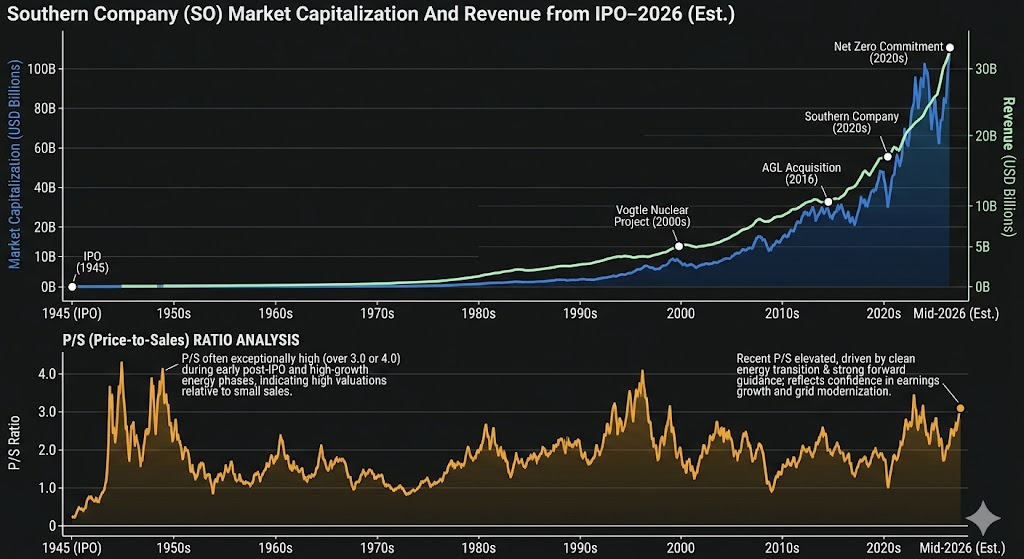
Southern Company occupies a dominant position in the U.S. electric utility sector. Its competitive landscape is primarily defined by asset scale, the regulatory environment, and the pace of energy transition. The following is a competitive analysis of the company:
1. Key Competitors
Southern Company’s primary rivals are large, diversified energy holding companies, including:
- NextEra Energy (NEE): The market leader by valuation in the utility sector, focusing heavily on renewable energy and grid infrastructure. Its scale and speed in clean energy transition set the industry benchmark.
- Duke Energy (DUK): Maintains significant operational overlap with Southern Company in the U.S. Southeast. With comparable revenue scale, its business model is similarly balanced between regulated power and natural gas distribution.
- American Electric Power (AEP): Possesses strong competitive advantages in transmission network layout, spanning 11 states, with an increasing focus on large-scale power users like data centers.
- Constellation Energy (CEG): Primarily focused on power generation and retail energy markets. As the largest independent power company, it holds a unique advantage in nuclear power and clean energy supply.
2. Core Competitive Advantages
- Regional Monopoly: Through subsidiaries like Georgia Power and Alabama Power, the company benefits from stable growth in the U.S. Southeast, driven by population influx and industrial expansion—particularly the surging electricity demand from data centers.
- Large-Scale Project Execution: The recent completion of the Vogtle nuclear power plant expansion strengthens its base-load supply, providing stable, zero-carbon power amid decarbonization trends.
- Major Customer Pipeline: The company has signed power supply agreements with tech giants such as Meta and Microsoft, with over 11 GW of contracted large-load capacity, providing a clear path for future growth.
- Stable Growth Profile: Through massive infrastructure investment (projected capital expenditure of 81B from 2026 to 2030), the company maintains stable rate structures and dividend-paying capacity.
3. Challenges and Risks
- Capital Expenditure Pressure: To meet the explosive growth in electricity demand, the company must execute highly intensive infrastructure and power resource development; fluctuations in financing costs could put pressure on profitability.
- Regulatory and Policy Risks: Utilities are subject to strict oversight by state Public Service Commissions (PSCs). Balancing rate adjustments and profitability within a shifting political and economic environment remains a constant challenge.
- Energy Transition Competition: Compared to peers like NextEra Energy, who began their renewable energy transitions earlier, Southern Company must strike a precise balance between maintaining grid reliability and meeting long-term decarbonization targets.
4. Financial Metric Comparison (2026 Estimates)
| Company | Market Cap (Approx.) | Net Profit Margin | Key Positioning |
| Southern Company | 106B | 14.5% | SE regional leader; strong in nuclear/large load |
| NextEra Energy | 184B | 29.4% | Global leader in wind/solar; fastest scaling |
| Duke Energy | 96B | – | Extensive coverage; direct competitor in the SE |
| AEP | 72B | 16.3% | Grid transmission advantage; high growth in load |
In summary, Southern Company is currently enjoying the “data center demand boom.” Its core strategy involves leveraging massive capital expenditures to strengthen its grid and power generation capabilities, thereby solidifying its monopolistic position in the Southeast. Simultaneously, it is utilizing nuclear and natural gas to manage long-term decarbonization pressures.
Source:
- https://www.southerncompany.com/
- https://www.nyse.com/quote/XNYS:SO
- https://www.nexteraenergy.com/
- https://www.duke-energy.com/
- https://www.aep.com/
- https://www.constellationenergy.com/
Back to Southern Company page