
History and Milestones
Early Foundation and Fire Brigade Origins (1888–1944)
The company traces its roots to Tokyo Fire Insurance Company, established in 1888 as Japan’s first dedicated private fire insurer. Operating in an era dominated by wooden urban structures, it maintained its own dedicated fire brigade to protect policyholders, laying the groundwork for customer-focused risk mitigation. Over subsequent decades, industrialization drove domestic expansion into marine, transit, and general casualty lines.
Consolidation and Financial Deregulation (1944–2009)
In 1944, Tokyo Fire merged with several peers to form The Yasuda Fire & Marine Insurance Co., which operated under Japan’s postwar regulated financial framework. Following the 1996 financial Big Bang and deregulation of the Insurance Business Act, Yasuda Fire merged with Nissan Fire & Marine and Taisei Fire & Marine in 2002 to create Sompo Japan Insurance Inc.
Holding Company Formation and Global Expansion (2010–2022)
In April 2010, Sompo Japan and Nipponkoa Insurance established a joint holding company(NKSJ Holdings, renamed Sompo Holdings in 2016), completing their full operational merger in 2014. To offset domestic market stagnation, Sompo acquired UK-based Canopius in 2014 and US/Bermuda-based specialty insurer Endurance Specialty Holdings for $6.3 billion in 2017, rebranding its global franchise as Sompo International. During this phase, Sompo also entered domestic eldercare through acquisitions such as Watami no Kaigo.
Governance Overhaul and Portfolio Realignment (2023–Present)
In 2023, Sompo Japan was engulfed in the Bigmotor insurance fraud scandal, having seconded staff and failed to stop fraudulent vehicle claims. This resulted in an FSA business improvement order in January 2024 and executive resignations, including CEO Kengo Sakurada. Under subsequent leadership, Sompo accelerated governance reforms, committed to eliminating strategic cross-shareholdings to zero by FY2030, and restructured operations under two main pillars: SOMPO P&C and SOMPO Wellbeing.
Business Model and Growth Strategy
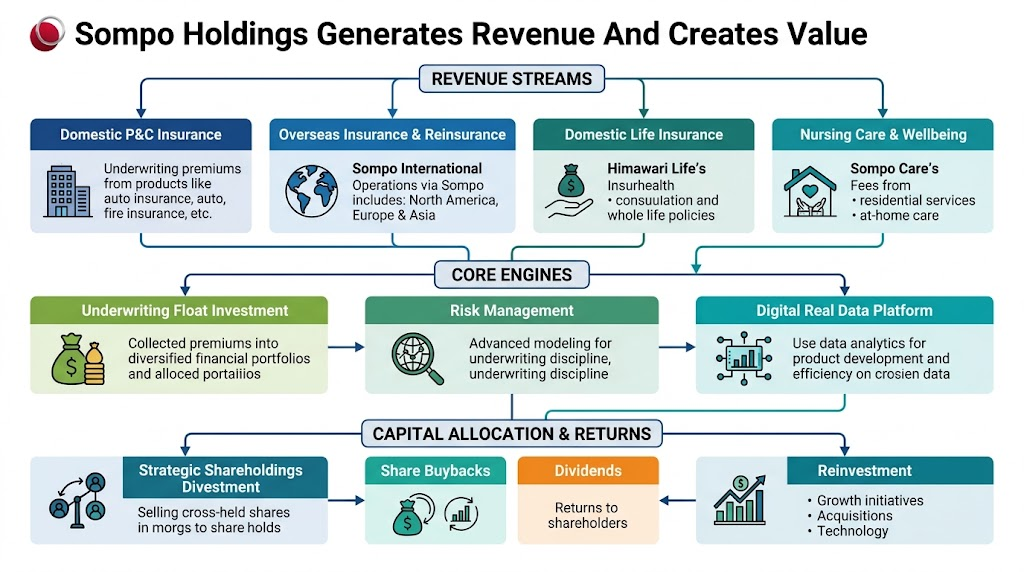
Sompo operates an integrated risk and service monetization model, generating revenue primarily through insurance underwriting margins, net investment income(NII) on float assets, and recurring operational fees from nursing care.
Revenue Generation Mechanics:
- Domestic P&C Insurance: Underwritten through Sompo Japan, covering auto, fire, and casualty insurance. Revenue stems from net written premiums minus claims and operating expenses(targeting a combined ratio under 95%). While motor insurance premiums face repair cost inflation and mature claim volumes, fire insurance pricing has undergone upward rate revisions to absorb climate risks.
- Overseas Insurance and Reinsurance: Handled by Sompo International, focusing on commercial specialty lines, agricultural coverage, and reinsurance. This segment generates high-margin underwriting profits in hard market cycles and sizable investment yields, producing more than half of group adjusted profits in recent fiscal years.
- Domestic Life Insurance: Driven by Sompo Japan Himawari Life under its Insurhealth model, combining traditional protection policies with preventative health monitoring. Profits derive from mortality margins, expense margins, and investment spreads on policyholder reserves.
- Nursing Care & Wellbeing: Sompo Care generates recurring fee revenue via government long-term care insurance disbursements and co-pays across residential nursing homes and home-visit services.
Strategic Trajectory and Capital Allocation:
Under its Mid-Term Management Plan, Sompo targets an adjusted consolidated ROE of 13% to 15% and an adjusted EPS CAGR exceeding 12%. In FY2024, adjusted consolidated profit reached ¥334.3 billion, led by strong overseas underwriting gains and foreign exchange tailwinds. To optimize capital efficiency, Sompo is divesting its legacy corporate equity cross-shareholdings(unwinding over ¥150 billion to ¥200 billion incrementally toward zero by FY2030), channeling freed capital into share repurchases(¥260 billion executed in FY2024) and high-return underwriting capacity.
Information Sources
- https://www.sompo-hd.com/en/ir/
- https://www.sompo-hd.com/-/media/hd/en/files/doc/pdf/annualreports/2025/annualreport2025_1.pdf
- https://www.sompo-hd.com/-/media/hd/en/files/doc/pdf/e_ir/2025/e_ir_20250520.pdf
- https://the-shashi.com/en/tse/8630/
AI Strategy, Budget, and Partnerships
Sompo’s digital and artificial intelligence strategy centers on transforming the group from a pure risk indemnifier into a predictive data platform, branded internally as the Real Data Platform(RDP) and spearheaded by its digital subsidiary, SOMPO Light Vortex.
Core Strategic Alliances and Equity Commitments:
- Palantir Technologies Collaboration: Sompo established Palantir Technologies Japan KK in late 2019 as a 50-50 joint venture. In June 2020, Sompo made a direct $500 million equity investment in Palantir ahead of its US public debut. In August 2025, Sompo expanded this relationship through a multi-year software expansion contract following an earlier $50 million platform commitment in 2023, embedding Palantir Foundry and Artificial Intelligence Platform(AIP) into Sompo’s operations.
- Deployment in Nursing Care (egaku): Utilizing Palantir’s data infrastructure, Sompo Care developed “egaku,” an operational AI analytics system deployed across hundreds of eldercare facilities. The platform aggregates caregiver telemetry, vital statistics, medication schedules, and resident behavioral data to optimize staffing rotas, forecast cognitive deterioration, and predict fall risks, driving care productivity gains.
- Underwriting and Claims Automation: In domestic and international P&C lines, Sompo utilizes computer vision and machine learning models for remote vehicle damage assessment and commercial property risk pricing, reducing claim turnaround latency.
Capital Allocation and Digital Budget:
Sompo earmarked over ¥50 billion in ongoing digital transformation and R&D capital expenditure across its medium-term plan cycle, supporting digital talent upskilling, cloud data migration, and venture investments through Sompo Digital Lab hubs located in Tokyo, Silicon Valley, and Tel Aviv. The group has also monetized parts of its appreciated Palantir equity holdings to fund domestic digital infrastructure and AI deployment initiatives.
back to Sompo