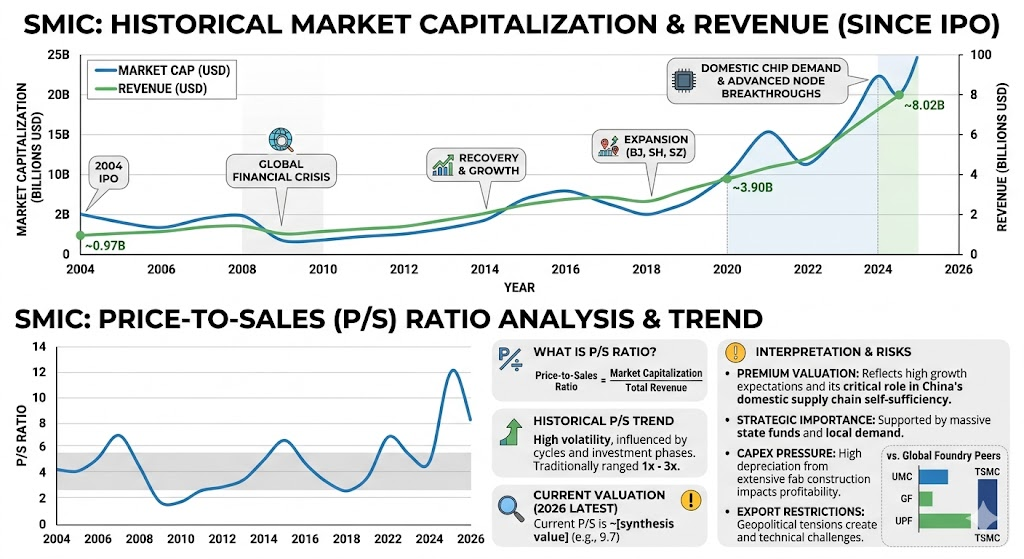
The development history of Semiconductor Manufacturing International Corporation (SMIC) can be divided into the following four phases:
Founding and Initial Phase (2000-2004)
Dr. Richard Chang founded SMIC in 2000. The company initially acquired a wafer fab from Texas Instruments in Italy and launched the construction of its first 8-inch fab in Shanghai’s Zhangjiang Hi-Tech Park. During this period, the goal was rapid capacity expansion and successful mass production. The company went public on both the Hong Kong and New York Stock Exchanges in 2004, establishing its position as a leader in China’s foundry industry.
Technology Catch-up and Integration Phase (2005-2014)
The company faced various challenges, including patent litigation and management changes. The focus during this period was on improving yields and advancing toward more sophisticated processes, transitioning from early 0.35-micron and 0.18-micron technologies to 65nm and 45/40nm nodes. Simultaneously, the company underwent production line consolidation and gradually stabilized its operating cash flow with government support.
Independent R&D and Transformation Phase (2015-2019)
Following the appointment of Dr. Mong-Song Liang, SMIC achieved breakthroughs in R&D, successfully introducing the 28nm process and moving toward FinFET process nodes. The company increased investments in advanced process research, aiming to narrow the technical gap with global giants like TSMC, and began construction of its first fab dedicated to advanced processes in Shanghai.
Strategic Reshaping and Expansion Phase (2020-Present)
Driven by the external geopolitical environment, SMIC’s strategy shifted toward the extreme expansion of mature process nodes and the construction of an independent supply chain. The company listed on the STAR Market in 2020, raising funds to massively expand mature-process production lines in Beijing, Shanghai, Shenzhen, and Tianjin. Currently, the company focuses on meeting the massive domestic demand in China for power management, IoT, and automotive chips through large-scale fab investments while continuing to explore alternative paths for advanced processes.
SMIC’s current competitive landscape is heavily driven by geopolitics and national policy. The analysis below covers market share, technical positioning, and key competitors:
Market Position and Competitive Landscape
As of 2026, SMIC holds approximately 5% of the global wafer foundry market, ranking as the third-largest foundry by revenue, trailing behind TSMC and Samsung.
- Market Role: As the core of China’s semiconductor supply chain, SMIC is heavily reliant on the domestic market (accounting for approximately 88.9% of total revenue). Driven by the Made in China initiative, its market demand benefits from strong strategic protection.
- Primary Challenges: Due to the lack of access to EUV lithography equipment, SMIC’s technology lags behind the industry’s first tier (TSMC). Additionally, its massive expansion strategy imposes significant capital expenditure pressure, with profitability in the near term being eroded by high depreciation and equipment costs.
Major Competitors
SMIC’s competitors can be categorized based on market strategy and process nodes:
| Competitor | Competitive Dimension | Relationship with SMIC |
| TSMC | Advanced Process & Scale | The absolute market leader (approx. 70% share), leading SMIC by 2-3 technology generations. There is currently no direct price competition; SMIC primarily serves as a local alternative. |
| Samsung | Advanced Process | One of the few firms capable of sub-3nm nodes, though it faces yield and market share pressure. It competes indirectly with SMIC in China for certain non-core advanced designs. |
| UMC / GlobalFoundries | Mature & Specialty Nodes | Direct competitors focusing on 28nm and above. They overlap heavily with SMIC in price, quality, and automotive electronics markets. |
| Hua Hong | Domestic Chinese Market | A fellow local foundry focusing on analog, power, and embedded NVM. It competes with SMIC for market share within the domestic Chinese fabless ecosystem. |
Current Competitive Advantages and Core Risks
- Advantages:
- Policy Backing: Supported by national-level “Big Funds,” ensuring priority in resource acquisition and production capacity expansion.
- Localization Demand: As China’s AI and industrial control sectors surge, SMIC has become the sole pillar for local giants, such as Huawei, to realize chip self-sufficiency.
- Risks:
- Technical Ceiling: Restricted by U.S. export controls, advanced processes (7nm and the planned 5nm) rely entirely on DUV multi-patterning, resulting in high costs and yields (estimated at 20-40%) that fall below international standards.
- Profitability: High capital expenditures (budgeted at historical highs for 2026) and depreciation pressure keep the company’s free cash flow under tight constraint, leaving its commercial competitiveness heavily reliant on national subsidies.
In summary, SMIC is currently not prioritizing commercial profit competition against global leaders. Instead, it prioritizes supply chain autonomy and is undergoing a critical strategic transformation from a traditional foundry to a key supporter of domestic AI computing infrastructure.
Source:
- https://www.smics.com/
- https://www.tsmc.com/
- https://www.samsung.com/
- https://www.umc.com/
- https://gf.com/
- https://www.huahonggrace.com/
- https://www.hkex.com.hk/
- https://www.sse.com.cn/
Back to SMIC page