
Market Position and Market Share
Shionogi&Co.,Ltd.(TYO:4507)is a major research-driven Japanese pharmaceutical company,historically ranking within the top 8 to 10 pharmaceutical companies in Japan by domestic prescription drug revenue and market capitalization.Globally,Shionogi holds a dominant presence in specific therapeutic niches,most notably infectious diseases(HIV,influenza,COVID-19)and central nervous system(CNS)disorders.
In the global HIV integrase inhibitor market,Shionogi holds an intellectual property footprint through its long-standing collaboration with ViiV Healthcare(a joint venture majority-owned by GSK,with Pfizer and Shionogi holding 78.3%,11.7%,and 10%equity stakes,respectively).Dolutegravir-based regimens(Tivicay,Triumeq,Dovato)and long-acting cabotegravir(Vocabria,Apretude,Cabenuva)anchor global HIV antiretroviral therapies.ViiV regimens maintain approximately 25%to 30%global market share in the HIV antiretroviral treatment market,competing directly with Gilead Sciences(which holds ~50%to 55%market share led by Biktarvy).Royalties and dividend income from ViiV Healthcare represent Shionogi’s largest single profit engine,generating over JPY 150 billion to JPY 200 billion annually.
In the acute influenza antiviral segment,Shionogi discovered baloxavir marboxil(Xofluza),commercialized domestically by Shionogi and globally by Roche/Genentech.In Japan,Xofluza captures approximately 30%to 45%of the prescription market share during active seasonal outbreaks,alternating lead share with Daiichi Sankyo’s Inavir(laninamivir)and generic oseltamivir.In the COVID-19 therapeutic market,Shionogi developed ensitrelvir(Xocova),an oral 3CL protease inhibitor.Following its standard approval in Japan in 2024,Xocova established a leading share(exceeding 60%to 70%of oral COVID-19 antiviral prescriptions domestically),outpacing Pfizer’s Paxlovid and MSD’s Lagevrio due to broader indication parameters across non-high-risk patients.In specialized antibiotics,its siderophore cephalosporin,cefiderocol(Fetroja/Fetcroja),holds a critical position in treating multi-drug-resistant Gram-negative bacterial infections globally.
Upstream and Downstream Supply Chain Analysis and Key Suppliers
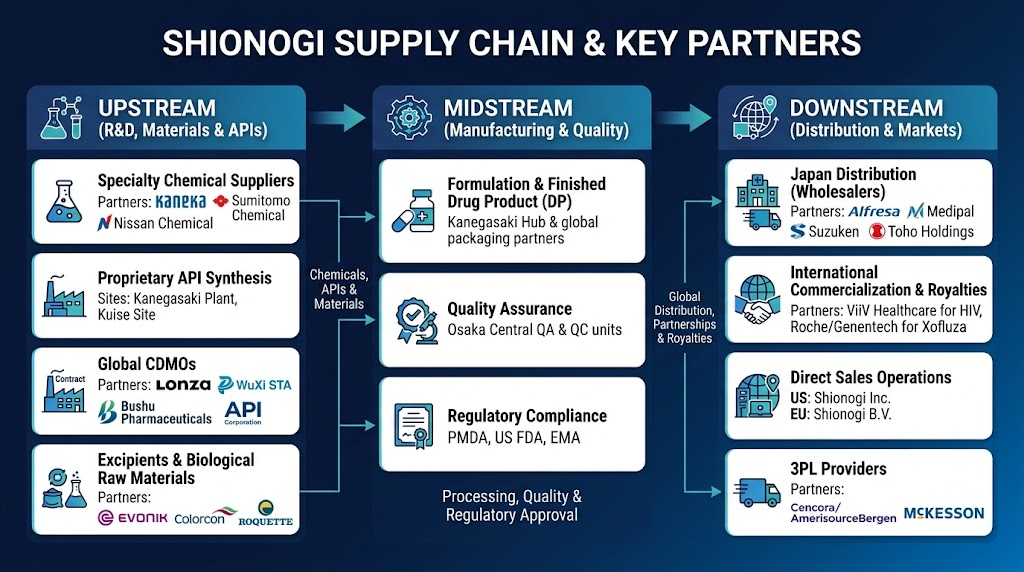
Shionogi’s supply chain model combines internal active pharmaceutical ingredient(API)synthesis and drug product formulation with external contract development and manufacturing organizations(CDMOs),chemical suppliers,and multinational commercialization partners.
Upstream Supply Chain(R&D,Raw Materials,and API Synthesis):
- Starting Materials and Intermediates: The core chemical synthesis for small-molecule antiviral and antibacterial platforms relies on specialized fine-chemical suppliers across Japan,China,and Europe.Key raw materials for heterocyclic cores(such as the polycyclic pyridone scaffolds in baloxavir and ensitrelvir)are sourced from specialty chemical manufacturers,including domestic Japanese suppliers such as Kaneka Corporation,Sumitomo Chemical,and Nissan Chemical.
- API Manufacturing: Shionogi utilizes its domestic facilities(primarily the Kanegasaki Plant in Iwate Prefecture and Kuise Site in Hyogo Prefecture)for proprietary API scaling,pilot batches,and controlled manufacturing of small-molecule compounds.To ensure supply redundancy and geographic resilience,Shionogi contracts global CDMOs such as Lonza,WuXi STA,and domestic Japanese CDMOs(such as Bushu Pharmaceuticals and API Corporation)for secondary API synthesis and backup chemical production.
- Biological Raw Materials and Excipients: For specialized delivery mechanisms,injectables,and formulation excipients,Shionogi procures pharmaceutical-grade polymers and functional excipients from global suppliers including Evonik,Colorcon,and Roquette.
Midstream Manufacturing and Packaging:
- Formulation and Finished Drug Product(DP): Solid oral dosage forms(tablets and capsules)and injectable aseptic fills are executed at Shionogi’s primary manufacturing hub in Kanegasaki,supported by certified external finished dosage packagers across North America and the EU for export products.
- Quality Control and Regulatory Audits: Upstream validation conforms to dual cGMP compliance standards under the Japanese PMDA,US FDA,and EMA,with critical analytical testing handled via Shionogi’s central quality assurance units in Osaka.
Downstream Supply Chain(Distribution,Commercialization,and Royalties):
- Domestic Japan Channel: Shionogi distributes finished pharmaceuticals through Japan’s consolidated pharmaceutical wholesaling networks.Over 85%of domestic distribution volume flows through the four primary Japanese wholesale groups:Alfresa Holdings,Medipal Holdings,Suzuken,and Toho Holdings.These wholesalers supply university hospitals,clinics,and dispensing pharmacies nationwide.
- International Out-Licensing and Distribution: Outside Japan,Shionogi largely relies on multinational partnerships to avoid extensive direct overseas sales forces.Roche handles worldwide commercial manufacturing,marketing,and logistics for Xofluza(excluding Japan and Taiwan).ViiV Healthcare handles worldwide distribution for dolutegravir and cabotegravir.For cefiderocol(Fetroja),Shionogi established direct sales operations via Shionogi Inc.(US)and Shionogi B.V.(Europe),contracting specialized third-party logistics(3PL)providers such as AmerisourceBergen(Cencora)and McKesson for hospital-direct cold-chain and secure shipping.
Competitor Analysis: Technical and Financial Comparison
Shionogi competes with multinational pharmaceutical giants and specialized domestic peers across infectious disease,immunology,and CNS therapeutic landscapes.Its two primary global benchmark competitors are Gilead Sciences and Pfizer,while its primary domestic counterpart in anti-infectives is Takeda Pharmaceutical and Daiichi Sankyo.
Technological and Pipeline Comparison:
- Infectious Diseases(HIV):
- Shionogi/ViiV vs.Gilead: Gilead is the global market leader in HIV oral single-tablet regimens(STRs),centered on Biktarvy(bictegravir/emtricitabine/tenofovir alafenamide).Shionogi/ViiV counters with Dovato(two-drug regimen)to reduce cumulative drug toxicity and long-acting injectable regimens(Cabenuva,administered monthly or every two months).Gilead leads in ultra-long-acting subcutaneous capsid inhibitors with lenacapavir(Sunlenca),pushing administration intervals to six months.Shionogi and ViiV are developing third-generation integrase strand transfer inhibitors(INSTIs)to match or exceed six-month dosing intervals.
- Antivirals(COVID-19 and Influenza):
- Shionogi vs.Pfizer vs.Roche: In oral COVID-19 antivirals,Pfizer’s Paxlovid(nirmatrelvir/ritonavir)requires ritonavir boosting,which introduces extensive cytochrome P450(CYP3A)drug-drug interactions.Shionogi’s ensitrelvir(Xocova)is a non-covalent,non-peptidic oral 3CL protease inhibitor that does not require ritonavir co-administration,reducing interaction liabilities.In influenza,Shionogi’s baloxavir(Xofluza)inhibits cap-dependent endonuclease,offering single-dose oral clearance compared to the 5-day twice-daily neuraminidase inhibitor regimen of oseltamivir(Roche’s Tamiflu).
- Antimicrobial Resistance(AMR):
- Shionogi vs.Pfizer/Merck: Shionogi’s cefiderocol utilizes an engineered siderophore “Trojan horse” mechanism that binds to extracellular iron to penetrate the outer membrane of Gram-negative pathogens via bacterial iron transport systems.This delivers efficacy against carbapenem-resistant strains where conventional beta-lactam/beta-lactamase inhibitor combinations(e.g.,Pfizer’s Zavicefta,Merck’s Zerbaxa)face resistance.
Financial Comparison:
| Financial Metric | Shionogi&Co.(TYO:4507) | Gilead Sciences(NASDAQ:GILD) | Pfizer(NYSE:PFE) | Takeda(TYO:4502) |
| Annual Revenue | ~JPY 430B-470B(~US$2.9B-$3.2B) | ~US$27B-$28B | ~US$58B-$60B | ~JPY 4,200B-4,400B(~US$28B-$30B) |
| Operating Margin | ~35%-40% | ~30%-35%(Non-GAAP) | ~20%-25%(Adjusted) | ~11%-15%(Core) |
| Gross Margin | ~75%-80% | ~78%-82% | ~68%-72% | ~68%-72% |
| R&D Intensity(%Rev) | ~18%-22% | ~20%-22% | ~18%-20% | ~16%-18% |
| Balance Sheet Profile | Net cash position,minimal debt | Moderate leverage,steady cash flow | High debt load post-Seagen M&A | High leverage from Shire acquisition |
Financial Strengths and Vulnerabilities:
- Margin Efficiency: Shionogi posts an operating margin(35%to 40%)that ranks among the highest in the global pharmaceutical industry.This is driven by high-margin royalty streams from ViiV Healthcare and Roche,which incur negligible cost of goods sold(COGS)and minimal operational SG&A expense for Shionogi.
- Balance Sheet Health: Shionogi operates with virtually zero net debt and maintains significant cash reserves and investment securities(exceeding JPY 300 billion),contrasting with the debt-leveraged balance sheets of Pfizer(following its US$43B Seagen acquisition)and Takeda(following its Shire buyout).
- Concentration Risk: Shionogi’s financial profile exhibits vulnerability to patent expiration cliffs on key HIV royalties.The primary compound patents covering dolutegravir begin expiring between 2027 and 2030 across major jurisdictions,threatening a substantial portion of Shionogi’s operating profit unless long-acting cabotegravir formulations and pipeline assets(such as next-generation INSTIs,qisengro,and CNS compounds)scale sufficiently to replace this cash flow.
Information Sources
- https://www.shionogi.com/global/en/investors.html
- https://www.shionogi.com/global/en/investors/ir-library/integrated-reports.html
- https://www.viivhealthcare.com/en-gb/investor-relations/
- https://www.gsk.com/en-gb/investors/
- https://www.gilead.com/investors
- https://www.pmda.go.jp/english/index.html
- https://www.sec.gov/edgar/searchedgar/companysearch
back to Shionogi