
Corporate History
Foundation and Early Growth(1878–1940s) Founded in Osaka by Gisaburo Shiono as a traditional Japanese and herbal medicine wholesale business, the company incorporated as Shionogi & Co., Ltd. in 1919. It shifted toward Western-style industrial medicine, establishing manufacturing plants and supplying vital domestic pharmaceuticals through the pre-war and wartime eras.
Antibiotic Specialization and Global Out-Licensing(1950s–1990s) Following World War II, Shionogi established its identity as an anti-infective specialist. Through extensive synthesis programs, it discovered cefaloridine, cefamandole derivatives, and flomoxef. In the 1990s, Shionogi discovered rosuvastatin(Crestor), an HMG-CoA reductase inhibitor out-licensed to AstraZeneca, which became a multi-billion-dollar global blockbuster and funded modern internal R&D platforms.
HIV Royalties and ViiV Joint Venture(2000s–2010s) Shionogi collaborated with GlaxoSmithKline(later forming ViiV Healthcare alongside Pfizer) to discover integrase strand transfer inhibitors. This led to dolutegravir(Tivicay, Triumeq, Dovato) and cabotegravir(Vocabria, Apretude). In parallel, Shionogi discovered baloxavir marboxil(Xofluza) for influenza, partnering with Roche/Genentech for global distribution while retaining Asian commercial rights.
Medium-Term Transformation and Pandemic Response(2020s–Present) Under the “Shionogi Transformation Strategy 2030″(STS2030), the firm accelerated overseas expansion, acquiring Qpex Biopharma in 2023 to expand its antimicrobial pipeline(specifically xeruborbactam). During the pandemic, it developed the oral COVID-19 therapeutic ensitrelvir(Xocova) and recombinant protein vaccine Kowner. The company is actively restructuring its revenue mix ahead of major HIV patent expirations.
Business Model and Growth Strategy
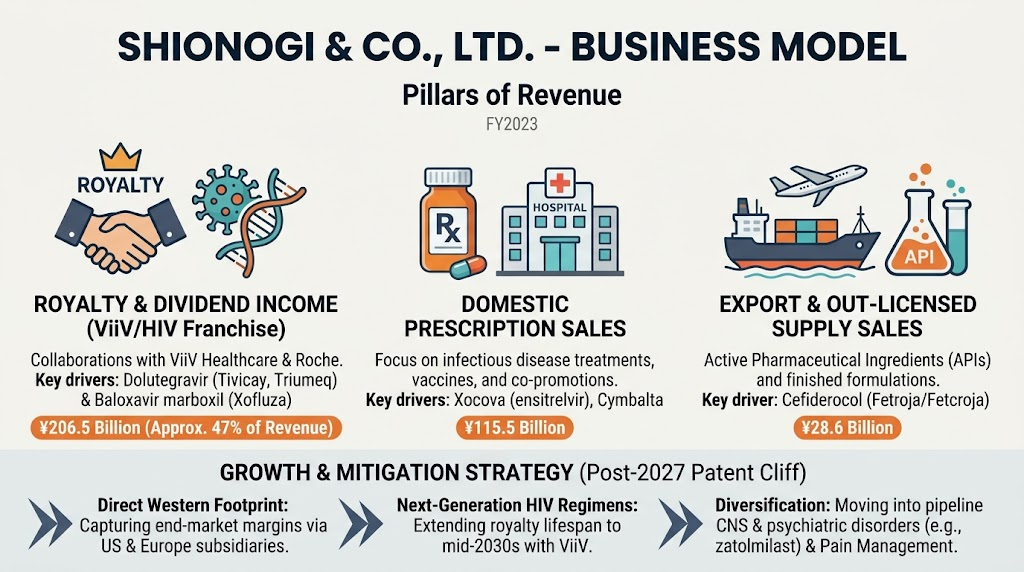
Shionogi operates a high-margin, research-centric business model centered on three primary cash-generating pillars: royalty income, international product supply, and domestic prescription sales. Unlike global mega-pharma firms with massive commercial salesforces in every market, Shionogi optimizes capital efficiency by discovering novel chemical entities(NCEs) in-house, retaining domestic and select East Asian commercial rights, and out-licensing global commercial rights to multinational partners in exchange for double-digit royalties and milestone payments.
Revenue Mechanics and Financial Contribution For fiscal year 2023(FY2023, ended March 31, 2024), Shionogi reported total revenue of ¥435.1 billion(an 11.2% year-over-year increase) and an operating profit of ¥153.4 billion, yielding an operating margin of 35.3%.
- Royalty and Dividend Stream(ViiV/HIV Franchise): The core profit driver is royalty revenue and dividend income from its 10% equity holding in ViiV Healthcare. Dolutegravir-related income and other HIV royalties contributed ¥206.5 billion in FY2023, representing roughly 47% of total consolidated revenue. These royalties carry virtually 100% gross margins, underpinning corporate operating cash flow.
- Domestic Prescription Sales: Domestic prescription pharmaceuticals generated approximately ¥115.5 billion in FY2023. Revenue is driven by Xocova(ensitrelvir, ¥52.8 billion in FY2023), infectious disease vaccines, and domestic co-promotion portfolios with partners like Eli Lilly(Cymbalta).
- Export and Out-Licensed Supply Sales: Shionogi sells active pharmaceutical ingredients(APIs) and finished formulations to partners like Roche for Xofluza and Roche/F. Hoffmann-La Roche for cefiderocol(Fetroja/Fetcroja). Cefiderocol, a siderophore cephalosporin for carbapenem-resistant Gram-negative infections, is commercialized directly by Shionogi in the US and Europe, delivering global product sales of ¥28.6 billion in FY2023.
Development and Growth Strategy Shionogi’s strategic roadmap aims to replace the forecasted ¥100+ billion annual cash gap that will emerge when dolutegravir loses exclusivity between 2027 and 2029:
- Direct Commercial Footprint in the West: Moving away from pure licensing to capture end-market margins via subsidiaries Shionogi Inc.(US) and Shionogi B.V.(Europe), led by proprietary sales of Fetroja.
- Next-Generation HIV Regimens: Developing third-generation integrase inhibitors and ultra-long-acting injectables with ViiV to extend the royalty lifespan into the mid-2030s.
- Portfolio Expansion beyond Anti-Infectives: Allocating R&D investments toward psychiatric/neurological disorders(e.g., pipeline candidate zatolmilast for Fragile X syndrome, licensed from Tetra Therapeutics) and pain management.
Sources
- https://www.shionogi.com/global/en/investors/ir-library/annual-report.html
- https://www.shionogi.com/global/en/investors/ir-library/financial-results.html
- https://www.shionogi.com/global/en/company/strategy.html
- https://www.sec.gov/edgar/searchedgar/companysearch
AI Development Strategy, Budget, and Partnerships
Shionogi views artificial intelligence not as an isolated IT initiative, but as an operational foundation to compress small-molecule discovery timelines, optimize clinical trial enrollment, and transition toward a digital healthcare provider under its STS2030 vision.
R&D Budget Allocation for Digital and Discovery Transformation Shionogi allocates approximately 18% to 20% of consolidated revenue to R&D annually(amounting to ¥80 billion–¥90 billion per fiscal year). Within this allocation, direct capital expenditures and operational spend on digital transformation(DX), computational chemistry, and AI platforms account for an estimated ¥5 billion to ¥8 billion annually. Management has targeted a 50% reduction in lead optimization cycle times and a 30% reduction in candidate attrition through AI adoption.
Core AI Partnerships and Practical Implementations
- FGen Biosystems / Phenotypic Screening AI: Shionogi partnered with synthetic biology and screening platforms to apply machine learning algorithms to high-throughput phenotypic screening data, predicting off-target toxicity profiles and metabolic stability before physical compound synthesis.
- Collaboration with Fujitsu(Quantum-Inspired Computing): Shionogi partnered with Fujitsu to deploy its “Digital Annealer”—a quantum-inspired computing platform—combined with molecular dynamics AI models. This platform processes complex conformational search spaces to design lead small molecules targeting challenging protein-protein interactions(PPIs) that standard chemical docking algorithms fail to resolve.
- Collaboration with Preferred Networks(PFN): Leveraging PFN’s deep learning architectures, Shionogi integrates deep generative models to design de novo chemical libraries for anti-infective and antiviral targets, filtering candidates against biological activity datasets gathered over decades in Shionogi’s Osaka research laboratories.
- AI-Driven Clinical Development & Decentralized Trials: The company has integrated natural language processing(NLP) and predictive patient recruitment analytics using real-world data(RWD) platforms in Japan(such as Medical Data Vision datasets). During the development of ensitrelvir, predictive epidemiological modeling and machine-learning-driven symptom tracking enabled rapid Phase 2/3 enrollment during fluctuating pandemic waves across Japan, South Korea, and Vietnam.
- Diagnostic AI and Digital Therapeutics(DTx): Beyond drug discovery, Shionogi partnered with Akili Interactive to commercialize EndeavorRx(SDT-001) in Japan, an FDA-cleared video-game digital therapeutic that leverages adaptive sensory stimuli algorithms to treat pediatric attention-deficit/hyperactivity disorder(ADHD).
back to Shionogi