
Company History
- Foundation and Early Years (1926-1945): Established in September 1926 as Shin-Etsu Nitrogen Fertilizer Co., Ltd. in the Nagano prefecture to produce chemical fertilizers and lime nitrogen. During World War II, the company expanded its electrochemical footprint, changing its name to Shin-Etsu Chemical Co., Ltd. in 1940 and acquiring electrochemical and plant facilities in Niigata and Fukui.
- Post-War Diversification and Material Breakthroughs (1946-1989): Following the war, Shin-Etsu listed on the Tokyo Stock Exchange in 1949 and began aggressive technological diversification. It commenced commercial production of silicone in 1953 and polyvinyl chloride (PVC) in the 1950s. In 1967, it began researching and producing semiconductor silicon, eventually establishing Shintech in the United States in 1973 to scale up PVC production globally.
- Global Expansion and Market Dominance (1990-2019): Under long-term leadership, notably Chairman Chihiro Kanagawa, Shin-Etsu perfected a low-cost, high-efficiency manufacturing and plant-management system. It expanded Shintech into the world’s largest PVC producer with multiple massive expansions in Texas and Louisiana, while simultaneously securing the top global market share for 300mm semiconductor silicon wafers.
- Modern Era and Strategic Resilience (2020-Present): Navigating global supply chain disruptions, post-pandemic demand swings, and geopolitical realignments, Shin-Etsu has continued focusing on high-margin advanced materials like photoresists, photomask substrates, and rare-earth magnets, while celebrating its centenary milestone and maintaining robust shareholder returns.
Business Model and Growth Strategy
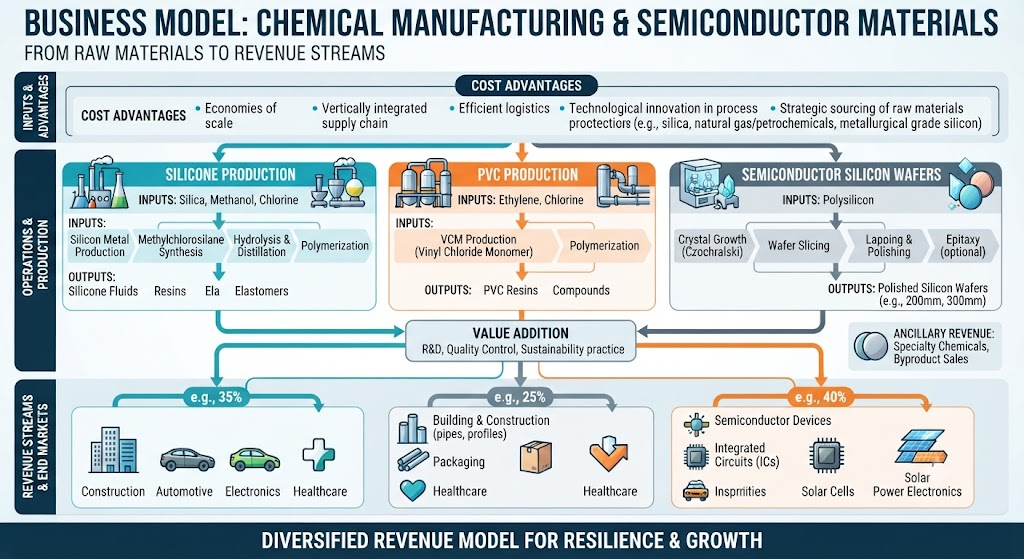
Shin-Etsu generates revenue by manufacturing and globally distributing foundational and high-tech functional materials across four core segments: Infrastructure Materials (primarily PVC and caustic soda), Electronics Materials (semiconductor silicon wafers, photoresists, and photomask blanks), Functional Materials (silicones, cellulose derivatives, and synthetic pheromones), and Processing & Specialized Services. Rather than relying on traditional supply chain integration markup, the company operates on a decentralized, highly specialized product strategy focused on niche dominance where it can command high pricing power.
Its profitability engine relies heavily on continuous process innovation, high capacity utilization, and massive single-site scaling—exemplified by its US subsidiary Shintech, which leverages low-cost US shale gas and domestic raw materials to supply cost-efficient PVC globally. By tightly linking production planning directly to actual customer demand and avoiding bloated corporate overhead, Shin-Etsu consistently achieves operating profit margins well above industry averages. For instance, in recent fiscal years, the company has routinely generated net sales exceeding 2.5 trillion yen with operating income margins scaling past 25% to 30% during peak semiconductor and housing cycles, driven primarily by its high-margin semiconductor silicon and specialized functional chemicals divisions.
- https://www.shinetsu.co.jp/en/
- https://www.shinetsusilicones.com/chemical-company.aspx
- https://en.wikipedia.org/wiki/Shin-Etsu_Chemical
AI Development Strategy and Execution
Shin-Etsu approaches artificial intelligence not as a consumer-facing software provider, but as a critical upstream materials enabler and internal operational optimizer. The company develops and supplies the advanced chemical components that make physical AI hardware and next-generation data centers possible. This includes manufacturing ultra-pure semiconductor silicon wafers essential for AI accelerators and GPUs, cutting-edge photoresists and photomask blanks required for sub-nanometer logic chip fabrication, and high-performance rare-earth neodymium magnets utilized in high-efficiency electric motors, robotics, and voice-coil motors for data storage.
Internally, Shin-Etsu leverages digital transformation and AI-driven process control within its massive chemical plants and cleanrooms to optimize thermal efficiency, predict equipment failures, and automate quality control in silicon pulling and polymer synthesis. While specific standalone AI software budget figures are integrated into its broader R&D and capital expenditure budgets—which regularly allocate hundreds of billions of yen annually to plant automation and semiconductor material capacity expansions—the company collaborates closely with major global semiconductor foundries (such as TSMC) and electronics manufacturers to co-develop materials tailored precisely to advanced node packaging and AI hardware scaling requirements.
Back to Shin-Etsu Chemical