
Sanofi holds a top-tier position in the global pharmaceutical industry, having strategically transformed into a pure-play biopharmaceutical company with dominant market share across several key therapeutic segments.
Global Positioning & Ranking
- Global Revenue Ranking: Consistently ranks among the Top 10 global pharmaceutical giants(Pharma Top 10), typically holding the 9th or 10th spot worldwide. Following the carve-out of its consumer healthcare division(Opella), Sanofi now focuses entirely on high-margin biopharmaceuticals and vaccines.
- European Footprint: Represents one of the largest biopharmaceutical powerhouses in Europe, alongside peers like Roche, Novartis, and AstraZeneca.
Key Market Segments & Market Share Analysis
1. Immunology & Biologics — Dominant Market Leadership
- Dupixent Monopoly: Co-developed with Regeneron, Dupixent is the absolute global market leader among interleukin-4/13(IL-4/IL-13) inhibitors.
- Market Share Performance: Dupixent holds over 80% of the global biologic market share for moderate-to-severe atopic dermatitis. With recent expansions into indications such as chronic obstructive pulmonary disease(COPD), it remains one of the top three best-selling prescription medications globally.
2. Vaccines — Global Duopoly Leader
- Industry Position: Sanofi Pasteur, alongside GlaxoSmithKline(GSK), forms a global duopoly in the vaccine market, protected by exceptionally high barriers to entry.
- Segment Share Breakdown:
- Influenza Vaccines: World-leading supplier of flu vaccines, maintaining dominant market share in high-dose influenza vaccines across North America and Europe.
- Pediatric & RSV Protection: With Beyfortus(co-developed with AstraZeneca), Sanofi captured a commanding share of the global infant respiratory syncytial virus(RSV) prevention market.
3. Rare Diseases — Top 3 Specialist Leader
- Industry Position: Building on its acquisition of Genzyme, Sanofi holds a top global market position in rare genetic metabolic conditions(e.g., Pompe disease, Gaucher disease), supported by robust patent protection and pricing authority.
4. General Medicines & Diabetes — Managed Cash-Cow Phase
- Legacy Position: While its long-acting insulin Lantus historically held the #1 market share globally, Sanofi’s share in diabetes is gradually stepping down following its decision to exit new R&D in cardiovascular and metabolic diseases, managing this segment primarily for ongoing cash generation.
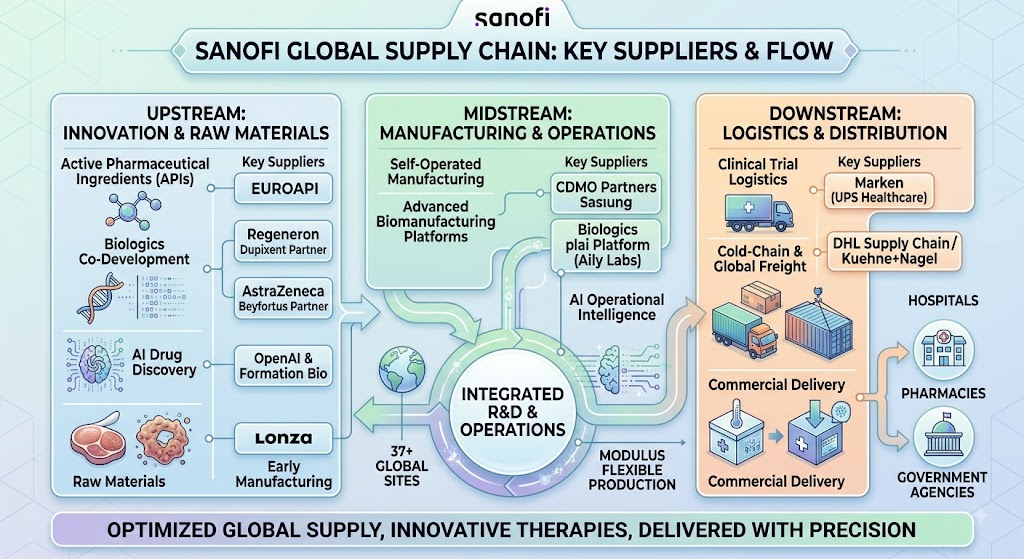
Sanofi manages its global supply chain across 37 self-operated manufacturing facilities worldwide, investing over €1 billion annually into digital transformation and modular biomanufacturing platforms like its Modulus flexible production facility.
Supply Chain Framework
- Upstream: Active Pharmaceutical Ingredients (APIs) & CDMO Outsourcing
- Raw Materials & APIs: Procures chemical intermediates, bioprocessing reagents, and active pharmaceutical ingredients (APIs). While Sanofi spun off a portion of its API business into EUROAPI, it maintains dedicated commercial sourcing agreements.
- Contract Research & Manufacturing (CRO/CDMO): Collaborates with leading CDMOs and AI drug discovery partners for complex biologics, antibodies, and mRNA platforms.
- Midstream: Smart Manufacturing & Modular Production
- Modular Biomanufacturing (Modulus): Utilizes continuous biomanufacturing and modular platforms capable of switching production lines between different vaccines or biologics within days.
- AI-Driven Demand Forecasting: Deploys its enterprise decision platform plai to monitor global inventory in real time, reducing low-stock risks by up to 80%.
- Downstream: Cold-Chain Logistics & Global Distribution
- Temperature-Controlled Logistics: Biologics (e.g., Dupixent) and vaccines (e.g., Beyfortus, influenza vaccines) require end-to-end, cold-chain distribution networks with strict temperature monitoring and reverse logistics capabilities.
Key Suppliers & Strategic Partners
- Core Biologics & Co-Development Partners:
- Regeneron: Sanofi’s premier biopharmaceutical strategic partner, jointly developing and supplying the flagship drug Dupixent.
- AstraZeneca: Co-development and manufacturing partner for Beyfortus (RSV monoclonal antibody).
- APIs & Contract Manufacturing (CDMO):
- EUROAPI: Spun off from Sanofi, it remains a primary European API supplier for Sanofi’s small-molecule portfolios.
- Lonza & Samsung Biologics: Key CDMO partners offering large-scale mammalian cell culture and antibody manufacturing capacity.
- Clinical & Commercial Logistics Providers:
- Marken (UPS Healthcare): Core global logistics partner for clinical trial drug supply, operating across 31+ depots to handle temperature-sensitive clinical logistics.
- DHL Supply Chain / Kuehne+Nagel: Primary global freight and cold-chain warehousing providers for commercial pharmaceuticals and vaccines.
- Digital & AI Supply Chain Enablers:
- Aily Labs: Strategic developer behind the plai platform, enabling real-time supply chain monitoring and predictive analytics.
- OpenAI & Formation Bio: Software partners optimizing clinical trial supply allocation and operational workflows.
Sanofi faces direct competition in the global biopharmaceutical market from four main multinational pharmaceutical giants: Roche, Novartis, AstraZeneca, and GlaxoSmithKline (GSK).
Below is a detailed analysis of Sanofi’s financial positioning, technical strengths, and competitive landscape.
Financial Analysis & Metric Benchmarking
From a financial perspective, Sanofi demonstrates strong operational cash flows and solid gross margins, primarily propelled by the explosive growth of Dupixent and capital optimization following the spin-off of its consumer healthcare unit (Opella).
Financial Metrics Peer Comparison
| Metric / Company | Sanofi | Roche | Novartis | AstraZeneca | GSK |
| Primary Revenue Driver | Dupixent, Beyfortus | Hemlibra, Ocrevus | Entresto, Kesimpta | Farxiga, Tagrisso | Shingrix, Trelegy |
| Gross Margin | ~74-76% | ~78-80% | ~76-78% | ~80-82% | ~72-74% |
| R&D Intensity (% of Revenue) | ~18-20% | ~21-23% | ~20-21% | ~22-24% | ~17-19% |
| Core Operating Margin | ~28-30% | ~32-34% | ~35-37% | ~30-32% | ~29-31% |
| Capital Allocation Focus | Pure-play BioPharma, heavy AI & M&A | ADC biologics & oncology | Pure-play BioPharma, share buybacks | Oncology & rare disease M&A | Vaccines, respiratory & debt reduction |
Financial Strengths & Risks
- Financial Strengths:
- Dupixent Cash Flow Engine: Dupixent contributes nearly 30% of total company revenues, generating exceptionally steady, high-margin cash flows that fund intensive external M&A and digital/AI investments.
- Lean Balance Sheet: Following the carve-out of Opella, capital expenditure (CapEx) needs have reduced, allowing the high gross margins of innovative prescription therapeutics to shine.
- Financial Risks:
- Product Concentration Risk: Revenue relies heavily on Dupixent. This concentration ratio is noticeably higher than the lead products of peers like Novartis (Entresto) or Roche (Ocrevus), creating single-product vulnerability.
Technology & Pipeline Analysis
Sanofi is undergoing a pivotal technology platform upgrade, maintaining deep moats in immunology and vaccines while racing to build competitive pipelines in oncology and nucleic acid platforms.
1. Immunology & Antibody Engineering
- Sanofi Technical Strengths: Operates the world-leading dual IL-4/IL-13 targeting mechanism (Dupixent) and acquired multi-specific antibody engineering capabilities through the acquisition of Inhibrx.
- Competitive Landscape:
- AstraZeneca / Amgen: Marketed Tezspire (TSLP inhibitor), directly competing with Dupixent in severe asthma.
- Roche: Holds dominance in autoimmune conditions like multiple sclerosis with Ocrevus and actively develops next-generation anti-TL1A antibodies.
2. Vaccines & mRNA Platforms
- Sanofi Technical Strengths: Maintains a top-tier recombinant protein and influenza manufacturing infrastructure, complemented by proprietary mRNA platforms and its CodonBERT protein language model acquired via Translate Bio.
- Competitive Landscape:
- GSK: Sanofi’s major rival in vaccines, featuring a strong adjuvant technology system (e.g., Shingrix) and securing an early lead in adult RSV with Arexvy.
- Pfizer / Moderna: Maintain greater commercialization history and patent depth in mRNA vaccines.
3. AI-Driven Drug Discovery
- Sanofi Technical Strengths: One of the most aggressive enterprise-wide AI adopters in pharma. Digitizes decision-making via
plaiand partners with OpenAI, Formation Bio, Exscientia, and Earendil to lead in biological foundation models and bispecific antibody design. - Competitive Landscape:
Summary
Sanofi’s strategic intent is clear: exit non-core legacy general medicine (diabetes/cardiovascular) and concentrate 100% of capital on Immunology, Vaccines, and Rare Diseases.
While its near-term commercial momentum remains strong—fueled by the twin engines of Dupixent and Beyfortus—its long-term growth post-2030 will depend heavily on whether its AI-powered R&D engine can yield its next generation of blockbuster biologics over the next 3 to 5 years.
Source:
- https://www.sanofi.com/en/investors/financial-results-and-events/financial-results/q2-2026-results
- https://www.stocktitan.net/sec-filings/SNY/6-k-sanofi-current-report-foreign-issuer-d5f7e8dd0b94.html
- https://www.alpha-sense.com/earnings/sny/
- https://www.pharmavoice.com/news/astrazeneca-amgen-tezspire-rhinusinusitis-nasal-polyps-dupixent/743646/
- https://pharmaphorum.com/news/amgen-azs-tezspire-challenges-dupixent-nasal-polyps
- https://www.fiercepharma.com/pharma/amgen-azs-tezspire-gains-2nd-fda-nod-upping-ante-its-battle-dupixent
Back to Sanofi