The history of SAIC Motor can be categorized into the following four major phases:
I. Foundation Phase (1955 – 1983)
This period centered on the predecessor, the “Shanghai Automobile Assembly Industry Company,” which focused on auto parts manufacturing and initial vehicle assembly. In 1958, Shanghai produced the first “Phoenix” sedan (later renamed the “Shanghai” brand), laying the foundation for the group’s early technical and production capabilities. During this time, operations remained largely workshop-based under the planned economy.
II. Joint Venture and Expansion Phase (1984 – 2003)
This was a critical turning point for SAIC. In 1984, the company signed a joint venture agreement with Volkswagen to establish Shanghai Volkswagen, introducing mature, modern automotive production technologies and management systems; the Santana sedan quickly became a benchmark in the Chinese market. In 1997, SAIC established a joint venture with General Motors to form Shanghai GM, further consolidating its leading position in the domestic passenger vehicle market and successfully achieving large-scale operations.
III. Independent Branding and Technical Transformation Phase (2004 – 2015)
Facing global industry changes, SAIC launched a strategy for “independent innovation.” In 2004, the group acquired core intellectual property from Britain’s Rover, leading to the creation of the self-owned “Roewe” brand in 2006. Subsequently, it acquired Nanjing Automobile and integrated the “MG” brand. During this period, SAIC transitioned from being solely dependent on joint ventures toward independent R&D and began forward-looking deployments in new energy vehicle technologies.
IV. Intelligent and Global Strategy Phase (2016 – Present)
Entering the digital era, SAIC repositioned itself as a “user-centric high-tech company.” The group’s core strategy focuses on the “New Four Modernizations” (Electrification, Intelligent Connectivity, Shared Mobility, and Globalization). Beyond launching the high-end electric vehicle brand “IM Motors,” the group has established a vertical supply chain in battery, electric drive, and electronic control technologies, as well as autonomous driving. Simultaneously, through the aggressive expansion of the MG brand in overseas markets such as Europe, Southeast Asia, and the Middle East, SAIC has established a robust global footprint.
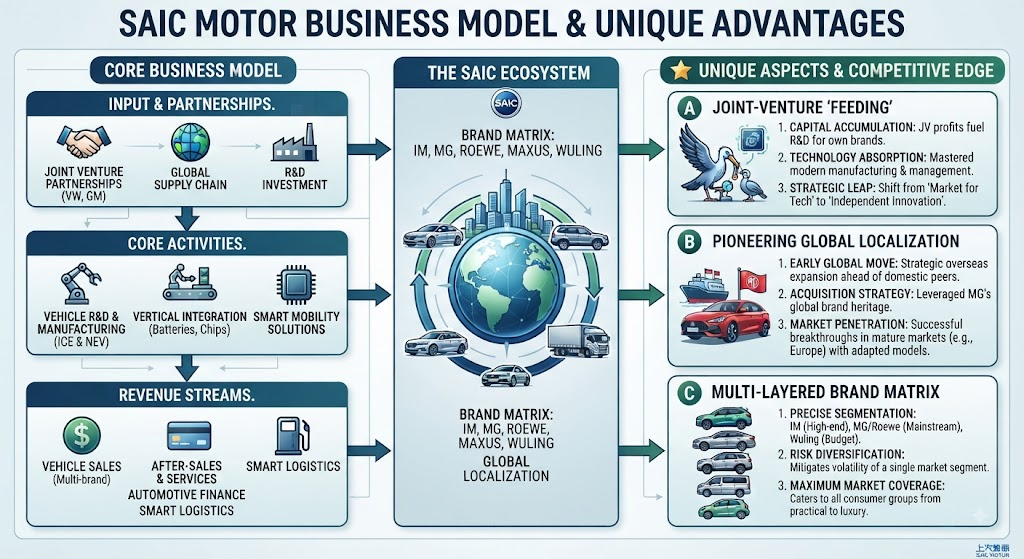
SAIC Motor’s business model is primarily based on the following core revenue-generating pillars:
- Vehicle R&D, Manufacturing, and Sales: Generates revenue by offering a complete lineup of traditional fuel vehicles and new energy vehicles(NEV), meeting diverse consumer needs through a multi-brand matrix of passenger and commercial vehicles(such as Roewe, MG, MAXUS, IM Motors, and Wuling).
- Joint Ventures and Partnerships: Secures steady production volume and profit-sharing revenue through long-term joint ventures with international automotive giants(such as Volkswagen and General Motors), while localizing advanced technology and management expertise.
- Global Layout and Overseas Exports: Drives growth and international revenue by establishing a global sales and service network across more than 170 countries and regions via its core export brands(such as MG).
- Automotive Finance and Mobility Services: Extends the value chain and captures additional profit pools by offering auto financing, smart logistics, and diverse mobility services, transitioning from a pure hardware manufacturer into a comprehensive mobility service operator.
Strategies:
- Joint-Venture “Feeding” and Technology Absorption: Early on, SAIC established joint ventures with international giants like Volkswagen and General Motors to secure massive capital and mature manufacturing management experience. It successfully converted these resources into the foundation for building its own brands and supply chains, achieving a leap from “trading market for technology” to independent innovation.
- Pioneering Global Localization: Unlike many Chinese automakers that focus primarily on the domestic market early on, SAIC made early overseas moves and skillfully acquired and leveraged historical brand assets like the UK’s MG. Combined with China’s robust supply chain advantages, this has made SAIC one of the few Chinese automakers capable of achieving large-scale breakthroughs in mature markets like Europe.
- Multi-Tiered Brand Matrix: From the affordable and practical Wuling, mainstream mass-market Roewe and MG, to the high-end intelligent EV brand IM Motors, SAIC utilizes a highly tiered brand matrix to precisely segment different consumer groups and mitigate operational risks associated with single-brand volatility.
Source:
- https://www.saicmotor.com/
- https://www.saicmotor.com/english/our_business/index.shtml
- https://www.fortune.com/ranking/global500/2025/
- https://www.saicmotor.com/english/investor_relations/index.shtml
Back to SAIC motor