
The history of Safran can be divided into four key stages:
1. Foundation Era (1900s–1940s): Roots of Two Pioneers
Safran’s two core predecessors were established during this period:
- Aerospace Propulsion Roots: In 1905, the Seguin brothers founded Gnome, which later merged into Gnome et Rhône, becoming a major supplier of rotary aircraft engines during World War I.
- Defense & Electronics Roots: In 1925, Marcel Môme founded Sagem, specializing in mechanical engineering before expanding into defense, electronics, and telecommunications.
2. State Ownership & Global Partnership (1945–2004): Rise of Snecma
- Nationalization: Following World War II in 1945, the French government nationalized Gnome et Rhône to form Snecma.
- Strategic Alliance: In 1974, Snecma formed a 50/50 joint venture with GE, creating CFM International. They developed the CFM56 engine, which became the best-selling commercial aircraft engine in history.
3. Merger & Refocusing (2005–2017): Formation of Safran
- The Merger: In 2005, Snecma (propulsion/equipment) and Sagem (defense electronics) merged to officially create Safran.
- Portfolio Streamlining: In 2017, Safran divested its biometrics and identity security business (Morpho) to double down on its core aerospace and defense sectors.
4. Expansion & Sustainable Aviation (2018–Present): Global Leadership
- Major Acquisition: In 2018, Safran acquired Zodiac Aerospace, expanding into cabin interiors, seating, and electrical systems, cementing its rank as the world’s third-largest aerospace supplier.
- Next-Gen Tech: Safran rolled out the LEAP engine family and launched the RISE technology demonstration program, pioneering open-rotor designs to support the industry’s net-zero carbon targets.
Safran’s business model and growth strategy are outlined below:
Business Model(How the Company Makes Money)
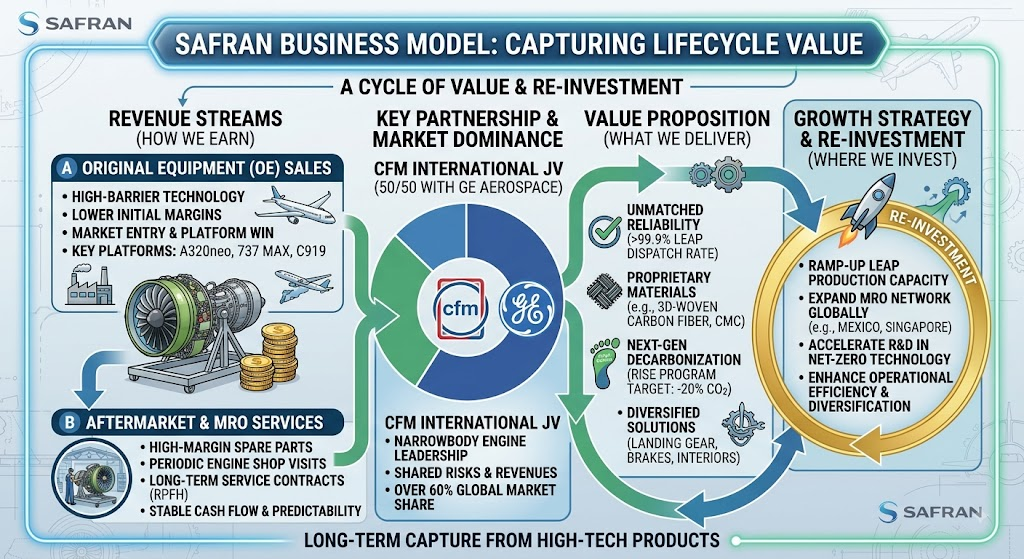
Safran’s core business model is built on capturing long-term lifecycle revenue from high-barrier technology products. The main profit drivers include:
- “Razor & Blade” Revenue Model
- Original Equipment(OE) Sales: New engines(e.g., LEAP) and systems are sold to airframers like Airbus and Boeing at relatively modest margins to establish market footprint.
- High-Margin Aftermarket & MRO: Commercial aircraft remain in service for 20 to 30 years. Safran generates its highest margins through aftermarket spare parts, engine shop visits, and long-term service contracts(Power-by-the-Hour) across decades of operational use.
- Joint Venture Profit Sharing
- Through CFM International(a 50/50 joint venture with GE Aerospace), Safran captures half of the revenue and profits from the global narrowbody commercial aircraft engine market.
- Diversified Product Lines & Defense Contracts
- Aerospace Equipment & Interiors: Landing gear, braking systems, and cabin seats offer steady, recurring aftermarket replacement demand.
- Defense & Space: Long-term government and military procurement contracts provide resilient baseline revenue.
Growth Strategy
Safran’s growth strategy centers on operational ramp-up, aftermarket monetization, and next-generation decarbonization technology:
- Production Ramp-up & Aftermarket Capture
- Stabilizing supply chains to accelerate LEAP engine deliveries while expanding maintenance network coverage to convert its massive installed base(both CFM56 and LEAP) into recurring, high-margin service revenue.
- Decarbonization & Next-Gen Propulsion(RISE Program)
- Advancing the CFM RISE(Revolutionary Innovation for Sustainable Engines) program to develop an Open Fan architecture targeting a 20% reduction in fuel consumption and carbon emissions compared to current engines.
- Engineering compatibility for 100% Sustainable Aviation Fuel(SAF) and pioneering hybrid-electric technology.
- Portfolio Optimization & Operational Efficiency
- Enhancing overall return on invested capital by continually streamlining operations, improving profit margins in newly integrated divisions(e.g., former Zodiac Aerospace interiors and seats), and making selective acquisitions in key electrical and defense capabilities.
Source:
- https://umbrex.com/resources/company-profiles/safran-sa-2/
- https://sifterfund.com/en/the-beauty-of-safrans-business-model-lies-in-its-predictability/
- https://pestel-analysis.com/blogs/growth-strategy/safran-group
- https://www.safran-group.com/pressroom/ge-aviation-and-safran-launch-advanced-technology-demonstration-program-sustainable-engines-extend-2021-06-14-0
- https://www.cfmaeroengines.com/rise
Back to Safran