
Market Position and Market Share
Ryanair Holdings plc stands as the largest airline group in Europe by scheduled passenger volume and daily flight frequencies.
- European Ranking: Ranked #1 in Europe by scheduled passenger traffic, surpassing legacy airline alliances and low-cost competitors including Lufthansa Group, International Airlines Group (IAG), and easyJet.
- Passenger Volume:In fiscal year 2025 (FY25, ended March 31, 2025), Ryanair carried 200.2 million passengers, a 9% increase year-over-year from 183.7 million in FY24.This milestone made Ryanair the first European airline to exceed 200 million guests in a single year.
- Market Share: Ryanair commands approximately 15% to 16% of the total intra-European commercial aviation capacity. Across individual European nations, it holds dominant positions: #1 in Italy (exceeding 35% domestic and international short-haul share), #1 in Spain by passengers carried, #1 in Poland, and the leading low-cost carrier in both Ireland and the United Kingdom.
- Operational Scale: The carrier operates more than 3,000 daily flights across a network of over 230 airports and 90 bases, serving upwards of 5,400 route pairs with an average fleet-wide load factor of 94%.
Supply Chain Analysis and Key Suppliers
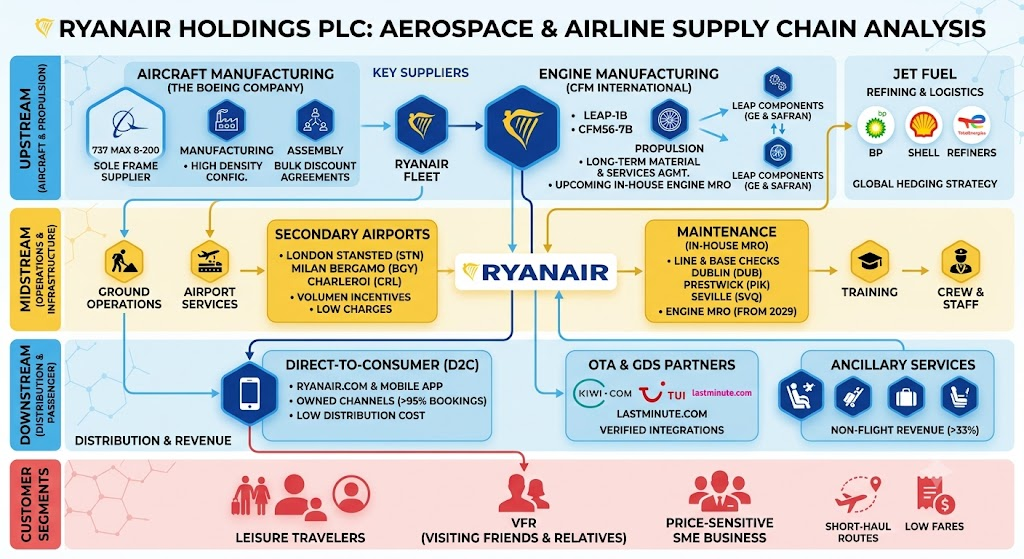
Ryanair’s supply chain is built on extreme standardisation, operational vertical integration, and aggressive cost minimization across upstream, midstream, and downstream segments.
- Upstream Supply Chain (Aircraft OEMs, Propulsion, and Aviation Fuel):
- Airframe Manufacturing: The Boeing Company is Ryanair’s primary airframe supplier. The airline adheres to a single-type fleet architecture dominated by the Boeing 737 Next Generation (-800) and the 737 MAX series (principally the customized 197-seat 737-8200 “Gamechanger”). It holds firm commitments and options for up to 300 Boeing 737 MAX 10 aircraft. While this gives Ryanair immense bulk-purchasing discounts, it exposes the carrier to upstream assembly delays and delivery bottlenecks at Boeing’s Renton facility.
- Turbofan Engines: CFM International (the 50/50 joint venture between GE Aerospace and Safran Aircraft Engines) is the sole propulsion supplier, powering Ryanair’s fleet with CFM56-7B and LEAP-1B engines. In 2026, Ryanair executed a landmark multi-billion-dollar long-term material and services agreement with CFM to support its expanding fleet of roughly 2,000 engines, including initial parts provisioning to launch Ryanair’s two proprietary engine maintenance shops from 2029.
- Jet Fuel Refining and Logistics: Major energy refiners (including BP, Shell, and TotalEnergies) supply Jet A-1 fuel across European airports. Ryanair actively hedges jet fuel exposures through financial forward contracts (hedging approximately 70% to 80% of forward requirements), insulating the business from short-term crude volatility.
- Midstream Supply Chain (Airport Infrastructure and Ground Operations):
- Secondary and Regional Airport Operators: Ryanair bypasses high-cost slot-constrained primary hubs in favor of secondary and regional facilities (such as London Stansted, Milan Bergamo, Brussels Charleroi, and Frankfurt-Hahn). It negotiates long-term, volume-incentivized ground handling and passenger service charges, often receiving municipal subsidies and turnaround priority.
- Maintenance, Repair, and Overhaul (MRO): Unlike carriers that outsource line and base checks to third-party providers, Ryanair performs heavy maintenance via its own internal MRO facilities in Dublin, Prestwick, Kaunas, Seville, and Wroclaw. Its roadmap to bring engine MRO in-house by 2029 reduces reliance on independent overhaul providers and cuts engine turnaround time.
- Downstream Supply Chain (Distribution, Ancillaries, and End-Passengers):
- Distribution Channels: More than 95% of bookings occur directly via Ryanair.com and its proprietary mobile app. The company actively enforces a direct-to-consumer (D2C) model, minimizing third-party Global Distribution System (GDS) transaction fees (such as Amadeus and Sabre) and compelling Online Travel Agencies (OTAs) to enter formal licensing and verification agreements.
- Ancillary Monetization: Downstream monetization relies heavily on unbundled services, including priority boarding, seat selection, cabin baggage, and onboard retail. Non-flight ancillary revenues account for roughly 33% to 35% of total group revenues, generating over €4.5 billion annually.
- End-Market Segments: Primarily leisure travelers, visiting-friends-and-relatives (VFR) traffic, and price-sensitive small-and-medium enterprise (SME) business travelers across Western, Central, and Eastern Europe.
Competitor Analysis: Technical and Financial Comparison
Ryanair competes primarily against pure-play ultra-low-cost carriers (Wizz Air), hybrid low-cost operators (easyJet), and legacy network groups (Lufthansa Group and International Airlines Group/IAG).
- Technical and Operational Comparison:
- Fleet Architecture: Ryanair operates a unified Boeing 737 fleet. The 737 MAX 8-200 features high-density 197-seat layouts (+4% seats over the 737-800) with 16% lower fuel burn. In contrast, easyJet and Wizz Air operate Airbus A320/A321 families. Wizz Air’s reliance on Pratt & Whitney PW1100G-JM geared turbofan engines forced dozens of its A321neo aircraft into mandatory ground inspections, causing substantial operational disruption. Ryanair avoided this entirely through CFM LEAP-1B propulsion.
- Turnaround Speed and Utilization: Ryanair targets a strict 25-minute gate turnaround by enforcing non-bridge outdoor boarding (front and rear built-in airstairs) and simplified cabin layouts (non-reclining seats, no seatback pockets). Wizz Air achieves similar high aircraft utilization (10+ hours daily), whereas easyJet averages 30 to 35-minute turnarounds due to higher exposure to congested primary airports (e.g., London Gatwick, Paris CDG).
- Point-to-Point vs Hub-and-Spoke: Legacy network carriers like Lufthansa and British Airways (IAG) maintain complex hub-and-spoke models requiring connecting passenger banks, baggage transfer infrastructure, and mixed twin-aisle/single-aisle fleets. Ryanair operates pure point-to-point routes, driving ground handling simplicity and minimizing transfer liability costs.
- Financial Metrics Comparison:
- Cost per Available Seat Kilometer (CASK ex-fuel): Ryanair maintains the lowest unit cost base in the European aviation industry. Its ex-fuel CASK stands at approximately €0.024 to €0.026. This metric is roughly 10% to 15% lower than Wizz Air’s stage-length-adjusted cost, and 50% to 80% lower than easyJet and legacy network carriers.
- Revenue and Profitability: In FY25, Ryanair generated €13.95 billion in revenue and a profit after tax (PAT) of €1.61 billion, yielding a net operating margin of ~11.5%. By comparison, easyJet’s operating margins historically track in the 6% to 7% range, while legacy groups like Lufthansa average 4% to 6%. IAG remains competitive with Ryanair in operating margin (13% to 14% in strong travel years) but relies on premium-class transatlantic routes rather than short-haul cost efficiency.
- Balance Sheet and Capital Structure: Over 90% of Ryanair’s Boeing fleet is owned outright rather than leased, shielding the company from surging aircraft lease rates and currency volatility. Ryanair maintains an investment-grade BBB+ balance sheet with substantial gross cash reserves (over €3 billion), whereas Wizz Air carries significant leverage driven by sale-and-leaseback liabilities.
Information Sources
- https://www.londonstockexchange.com/news-article/0RYA/full-year-fy25-ryanair-holdings-plc-earnings/17041757
- https://www.sec.gov/Archives/edgar/data/1038683/000155837025007966/tmb-20250331x20f.htm
- https://www.cfmaeroengines.com/press-articles/ryanair-and-cfm-strengthen-landmark-partnership-with-long-term-services-agreement
- https://www.americanmachinist.com/news/news/55356744/airline-engine-builder-ink-long-term-mro-agreement-cfm-international
- https://www.eurocontrol.int/sites/default/files/2025-01/eurocontrol-european-aviation-overview-20250123-2024-review.pdf
- https://www.oag.com/ryanair-performance-stats
- https://www.routesonline.com/suppliers/10554/capa-centre-for-aviation/news/299664910/european-airline-margin-rankings-2024-pegasus-and-iag-at-the-top-outlook-for-2025-favourable/
- https://www.gridpoint.consulting/blog/a-performance-comparison-of-the-european-lccs
Back to Ryanair