
Corporate History
Formation and Consolidation Phase (2002–2010)
Renesas Technology was initially established in 2003 as a joint venture merging the semiconductor divisions of Hitachi and Mitsubishi Electric. In April 2010, the company merged with NEC Electronics to create Renesas Electronics Corporation, aimed at establishing a Japanese national champion in microcontrollers and logic ICs capable of competing against global chipmakers.
Crisis, Restructuring, and INCJ Bailout (2011–2016)
Following the devastating 2011 Great East Japan Earthquake, which paralyzed its flagship Naka fab and disrupted global automotive supply chains, Renesas faced severe insolvency risks. In 2013, the state-backed Innovation Network Corporation of Japan (INCJ) along with key automotive clients injected approximately ¥138 billion, initiating aggressive structural restructuring, closure of unprofitable domestic front-end wafer lines, workforce downsizing, and a transition to a “fab-lite” manufacturing model.
Global M&A and Portfolio Expansion (2017–2023)
Under CEO Hidetoshi Shibata, Renesas pivoted from domestic restructuring to aggressive global expansion to acquire mixed-signal and power capabilities:
- Intersil (2017, ~$3.2 billion): Strengthened power management and precision analog portfolios.
- Integrated Device Technology (IDT, 2019, ~$6.7 billion): Added RF, optical interconnects, and timing devices.
- Dialog Semiconductor (2021, ~$5.9 billion): Brought low-power connectivity (BLE) and power management ICs.
- Celeno & Panthronics (2021–2023): Expanded Wi-Fi and NFC connectivity portfolios.
System-Level and Software Integration (2024–Present)
In 2024, Renesas completed the landmark acquisition of printed circuit board (PCB) design software leader Altium for approximately A$9.1 billion (around ¥2 trillion). This transition expanded Renesas from a pure-play silicon vendor into an integrated electronics design ecosystem and cloud collaboration platform provider.
Business Model and Strategic Monetization
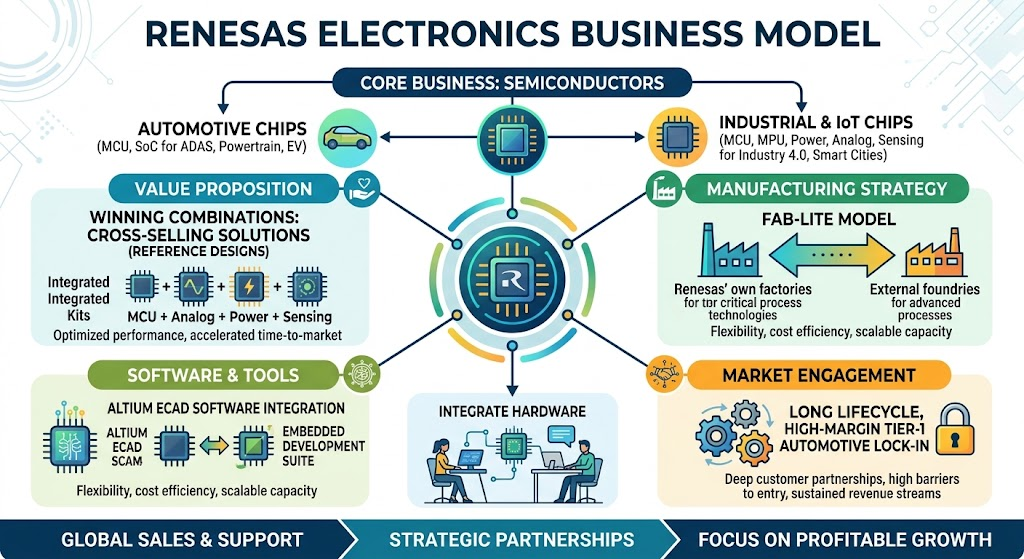
Renesas operates primarily through two core operating business segments: Automotive, and Industrial/Infrastructure/IoT (IIoT). Rather than functioning merely as a component supplier, Renesas monetizes through architectural lock-in, recurring device volume, and software tooling.
1. Revenue Breakdown and Margin Structure
In recent fiscal performance, Renesas generates annual revenues in the range of ¥1.3 trillion to ¥1.45 trillion (delivering ¥1,318.5 billion in FY2025 and ¥1,348.5 billion in FY2024 on a non-GAAP basis). The Automotive segment accounts for over 50% of total group revenues, driven by automotive MCUs and SoC product families. The company maintains a strong gross margin of 56%–58% and a non-GAAP operating margin around 29%–31%, generating substantial operating cash flows.
2. The “Winning Combinations” Cross-Selling Engine
A core commercial lever is Renesas’ “Winning Combinations”—pre-integrated, tested reference designs combining high-margin processing cores (MCUs/MPUs/SoCs) with complementary analog, power, and connectivity components acquired from Intersil, IDT, and Dialog. By packaging microcontrollers alongside PMICs, sensors, and clock generators on a single reference board, Renesas locks customers into purchasing the complete silicon bill of materials (BOM), increasing revenue per design-win while significantly shortening client time-to-market.
3. Long Product Life Cycles and Deep Auto Lock-In
Renesas operates on long automotive design-in cycles (3–5 years from design win to start-of-production), followed by 7–15 years of steady production runs. Once an automaker or Tier-1 supplier (such as Denso, Continental, or Bosch) qualifies a Renesas MCU/SoC for functional safety (ISO 26262 ASIL-D), switching costs are prohibitively high, creating reliable multi-year cash flow streams.
4. Software and Platform Monetization (Altium Synergy)
Following the Altium acquisition, Renesas is monetizing electronics computer-aided design (ECAD) software and cloud subscription tiers (Altium 365 / Renesas 365). This enables engineers globally to design schematics in the cloud, where Renesas silicon components are embedded as native default components, converting software usage into downstream chip orders.
5. Fab-Lite Capital Efficiency
Renesas balances internal production with outsourced manufacturing. It produces specialized, high-reliability analog and mature-node automotive MCUs (40nm and above) at internal fabs like Naka and Saijo, while outsourcing leading-edge digital logic (7nm, 5nm, and 3nm automotive SoCs) to external foundries like TSMC. This minimizes capital expenditure intensity relative to pure IDMs.
Sources for Business Model Information
- https://www.renesas.com/en/document/rep/financial-report-2024
- https://www.renesas.com/document/ppt/2025-2q-presentation-material
- https://www.renesas.com/en/document/ppt/2024-full-year-presentation-material
- https://www.investing.com/news/transcripts/earnings-call-transcript-renesas-electronics-q4-2025-shows-ai-growth-potential-93CH-4486435
AI Strategy, Investments, and Partnerships
Renesas focuses on Edge AI, Automotive Autonomous Driving/Cockpit (ADAS/SDV), and AI Data Center Power & Timing Infrastructure:
1. Embedded Edge AI Silicon Architecture
Renesas differentiates by integrating proprietary hardware accelerators directly into edge MPUs and MCUs:
- DRP-AI (Dynamically Reconfigurable Processor): Renesas developed the DRP-AI MAC engine (featured in the RZ/V2H and RZ/G series), delivering power-efficient TOPS performance for computer vision, robotics, and industrial automation without requiring active cooling fans.
- Arm Cortex-M85 with Helium: Renesas was the first to launch commercial MCUs (such as the RA8 series) leveraging the Cortex-M85 core and Helium vector processing, delivering a 4x boost in neural network inference for voice, vibration, and predictive maintenance.
2. Software and Tooling Ecosystem (Reality AI and Irida Labs)
To eliminate barrier-to-entry friction for embedded developers, Renesas acquired Reality AI (edge machine learning algorithms for sensor and anomaly detection) and completed the acquisition of Irida Labs to bolster vision AI software capabilities. Furthermore, the acquisition of Pictorus introduced low-code/visual embedded modeling tools. These toolchains allow non-data scientists to deploy trained neural networks (TensorFlow Lite, ONNX) onto Renesas microcontrollers seamlessly.
3. Automotive AI & SDV: The R-Car Platform
For software-defined vehicles (SDVs), Renesas introduced the 4th and 5th Generation R-Car system-on-chip families. Designed on advanced 3nm process nodes in partnership with TSMC, the R-Car platform consolidates multi-domain workloads—autonomous driving perception, digital cockpit, and central gateway—into a unified chip capable of handling heavy deep neural networks (DNN). Toyota, along with other Tier-1 suppliers, selected Renesas’ R-Car V4H ADAS SoC for mass-market vehicles (such as the Toyota RAV4 platform).
4. AI Data Center Infrastructure: Power & High-Speed Memory
Renesas is a major supplier of power delivery and timing silicon for AI server architectures (supporting Nvidia and AMD GPU clusters):
- Server Memory Interface: Renesas holds dominant market share in DDR5 Registered Clock Drivers (RCD), Power Management ICs (PMICs), and thermal sensors for AI server memory, advancing Gen 3 MRDIMM chipsets to speeds exceeding 16,000 MT/s.
- High-Current Power Modules & GaN: Renesas develops multiphase digital controllers and smart power stages (SPS) handling 1,000A+ power envelopes for modern AI training accelerators, alongside 800V DC architectures and 650V-class GaN (Gallium Nitride) switches for next-generation data center power efficiency.
5. Strategic Partnerships and Investments
- Foundry Partners: Longstanding volume manufacturing partnerships with TSMC for advanced node manufacturing (including 28nm eFlash MCUs and 3nm/5nm automotive SoCs).
- Silicon IP Ecosystem: Strategic partnerships with Arm for next-generation Cortex-M/A cores and RISC-V International, where Renesas has designed its own in-house 32-bit RISC-V CPU cores for specialized AI and motor control tasks.
- R&D Capital Allocation: Renesas regularly channels 14%–16% of total revenue into R&D (exceeding ¥180 billion to ¥200 billion annually), focusing heavily on edge intelligence, automotive zone controllers, and wide-bandgap (SiC/GaN) power semiconductors.
back to Renesas