
History
Founding and Expansion (1960–1987)
Founded in 1960 by Hiromasa Ezoe as “Daigaku Shimbun Koukokusha” (University Newspaper Advertising Agency), the company initially specialized in college recruiting advertisements before rebranding as Japan Recruitment Center in 1963 and later shortening its name to Recruit in 1984. During Japan’s high-growth era, the company expanded rapidly from employment print media into housing magazines (Housing Information), travel services, and classifieds, creating a powerful domestic print distribution engine.
The Recruit Scandal and Restructuring (1988–2000s)
In 1988, Recruit became the center of the “Recruit Scandal,” one of Japan’s most prominent post-war political corruption and insider trading cases. The incident forced founder Hiromasa Ezoe to resign and led to the resignation of Prime Minister Noboru Takeshita and his cabinet. Saddled with heavy real estate and equity-related debt, Recruit ceded substantial shareholding control to retail giant Daiei in the early 1990s. Following financial distress at Daiei, Recruit successfully repaid its debt ahead of schedule and regained corporate independence in 2000.
Digital Pivot, Global M&A, and Public Listing (2010–Present)
Recruit aggressively transitioned from print media to internet portals, culminating in its landmark acquisition of US-based Indeed in 2012. Recruit completed its initial public offering (IPO) on the Tokyo Stock Exchange in October 2014. The group bolstered its global tech footprint by acquiring employer review community Glassdoor in 2018 for approximately $1.2 billion and multiple international staffing agencies (e.g., Chandler Macleod, Start People). Under CEO Hisayuki “Deko” Idekoba, Recruit restructured into three autonomous Strategic Business Units (SBUs): HR Technology, Matching & Solutions (now Marketing Matching Technologies), and Staffing.
Business Model and Strategy
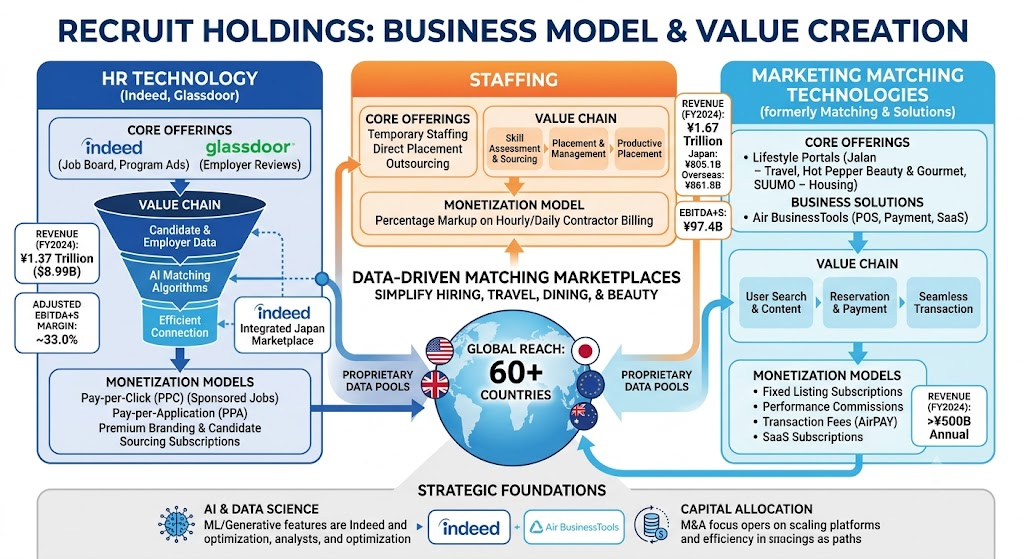
Recruit Holdings operates through three primary reporting segments, monetizing matchmaking friction between individuals and enterprise clients:
- HR Technology: Operating Indeed and Glassdoor, this segment delivers programmatic recruitment solutions. Revenue is generated primarily via auction-based pay-per-click (PPC) and pay-per-application models (“Sponsored Jobs”), as well as subscription services for hiring analytics, premium branding, and CV database sourcing. In FY2024 (ended March 31, 2025), HR Technology generated ¥1.37 trillion ($8.99 billion) in revenue, accounting for roughly 38.6% of group consolidated revenue, with an adjusted EBITDA+S of ¥452.8 billion (an operating margin of ~33.0%).
- Staffing: Providing temporary staffing, direct placement, and outsourcing across Japan, Europe, the US, and Australia. Monetization occurs via a markup percentage applied to hourly/daily contractor billing rates. In FY2024, the Staffing segment recorded ¥1.67 trillion in revenue (Japan: ¥805.1 billion; Overseas: ¥861.8 billion) with an EBITDA+S of ¥97.4 billion.
- Marketing Matching Technologies (formerly Matching & Solutions): Comprising Japan-focused lifestyle booking engines (Jalan, Hot Pepper Beauty, Hot Pepper Gourmet, SUUMO) and the Air BusinessTools SaaS suite for small-and-medium businesses (POS, payment settlement, reservation management). Revenue comes from fixed listing subscriptions, performance-based booking commissions, transaction processing fees (AirPAY), and SaaS subscriptions. The segment generated over ¥500 billion in annual revenue.
Strategic Roadmap:
Recruit’s growth strategy centers on its “Simplify Hiring” thesis. By integrating Indeed’s machine learning infrastructure into Japan’s domestic market via “Indeed PLUS”—a shared distribution network connecting external Japanese job boards directly to Indeed’s matching engine—the company seeks to compress hiring cycle times and capture enterprise programmatic advertising spend.
Sources for Business Model Information
- https://recruit-holdings.com/en/ir/library/upload/recruit_202503q4_earnings_en/
- https://recruit-holdings.com/files/ir/library/upload/Recruit_202603Q1_earnings_en.pdf
- https://recruit-holdings.com/en/about/business/
- https://www.staffingindustry.com/news/global-daily-news/recruit-q1-revenue-slips-25-hr-technology-and-staffing-down
AI Strategy, Budget, and Partnerships
Recruit Holdings treats artificial intelligence as the architectural foundation of its programmatic hiring marketplace rather than an ancillary feature. Its core AI strategy revolves around end-to-end automation of the hiring pipeline, moving from traditional keyword matching toward predictive matching, automated candidate sourcing, and generative outreach.
Product Implementations and Efficiency Metrics:
- Sourcing Assistant & AI Candidate Pitching: Integrated directly into Indeed, AI parsing engines match open job requirements against a database exceeding 610 million candidate profiles across Indeed and Glassdoor. The platform automatically drafts tailored candidate outreach messages and handles automated candidate engagement workflows.
- Engineering Productivity: Within the HR Technology division, internal automation has reached substantial scale, with over 33% of new HR Tech codebase being AI-generated via LLM assisted programming tools.
- Dynamic Pricing Algorithms: Indeed deploys automated bidding and dynamic budgeting systems that optimize job post pricing based on real-time candidate supply and demand curves, geographic talent scarcity, and historical conversion metrics.
Capital Allocation and R&D Budget:
Recruit integrates its AI and data science expenditures into its broader technology development and capital allocation budget. Across the group, annualized R&D, digital system enhancements, and software capitalization consistently exceed ¥100 billion. Within HR Technology, the company earmarks significant cash flow to data center infrastructure, machine learning pipelines, and cloud computing architectures to support millions of real-time search queries daily.
Partnerships and Ecosystem Collaboration:
- Cloud Infrastructure Providers: Recruit works across Amazon Web Services (AWS) and Google Cloud Platform (GCP) to host massive petabyte-scale data lakes, train deep neural networks for semantic skill matching, and run localized inference engines.
- Indeed PLUS Open Ecosystem: In Japan, Recruit partnered with competing independent job listing platforms and niche portals to federate job postings through Indeed’s centralized matching algorithm, transforming Indeed into an underlying AI-driven infrastructure rail for the entire domestic employment sector.
back to Recruit Holdings