
Company History
State Monopoly Foundation (1862–1990s)
Founded in 1862 following the unification of Italy, Poste Italiane operated as a state-run administration under the Ministry of Posts and Telecommunications. It acted as the sole domestic provider of postal communication, telegrams, and postal savings accounts (libretti postali), functioning as a bureaucratic public body with persistent operational deficits and heavy staffing.
Corporatization and Postal Banking Reform (1998–2014)
In 1998, under the leadership of Corrado Passera, the institution transformed into a joint-stock company (S.p.A.), separating operational management from direct ministry administration. It established BancoPosta to formalize financial services and launched Poste Vita (insurance) and PostePay (prepaid digital payments). This shifted revenue reliance toward financial intermediation, making the postal network self-sustaining and profitable.
IPO and Commercial Diversification (2015–2023)
In October 2015, the Italian Ministry of Economy and Finance floated roughly 35% of Poste Italiane on the Borsa Italiana. CEO Matteo Del Fante initiated systematic multi-year strategic plans (“Deliver 2022” and “2024 Sustain & Innovate”), accelerating parcel automation, absorbing e-commerce volume spikes, and expanding into retail energy and telecom packages.
The Phygital Platform Era (2024–Present)
The company launched its 2024–2028 strategic plan (“The Connecting Platform”) alongside the state-backed Polis Project. This initiative repurposed regional post offices into one-stop digital administrative hubs for public identity documents, social security, and remote municipal services while integrating omnichannel logistics and AI-driven distribution networks.
Business Model and Strategy
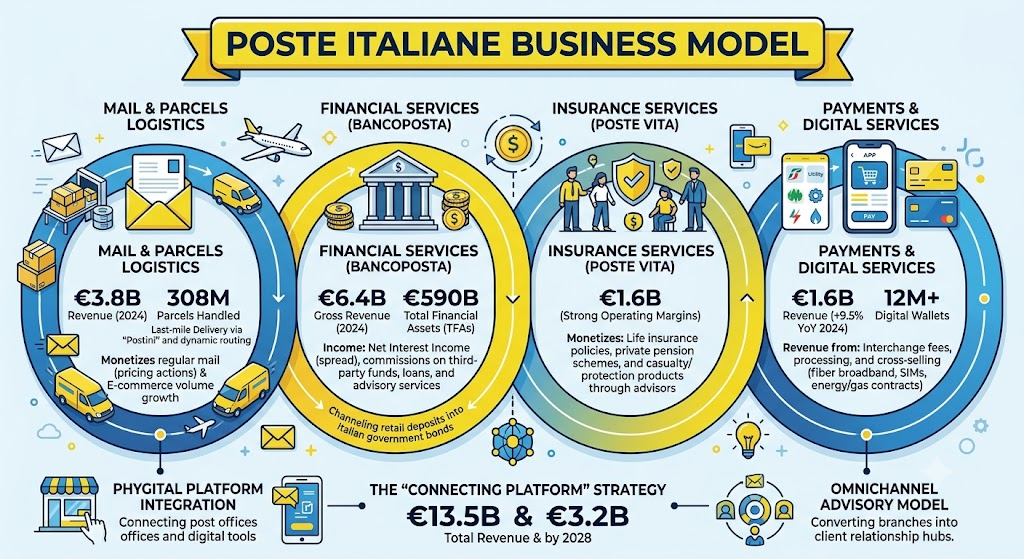
Poste Italiane generates revenue through an omnichannel “phygital” (physical plus digital) platform model across four core operating divisions:
- Mail, Parcels & Distribution: Generates revenue from business and retail postage, direct marketing, and e-commerce package delivery. In 2024, the segment achieved €3.8 billion in external revenue. Traditional letter mail yields higher tariffs via repricing actions to offset volume drop-offs, while logistics revenue grew 13.2% year-over-year behind 308 million parcels handled, leveraging 39%+ parcel last-mile delivery via traditional postal carriers (“postini”).
- Financial Services (BancoPosta): Generated €6.4 billion in gross revenues in 2024. BancoPosta is not a conventional credit-lending bank; it takes customer deposits and channels them into Italian government bonds, earning an asset spread through net interest income (NII), alongside distribution commissions from third-party mutual funds, loans, and treasury management. Total Financial Assets (TFAs) held by clients reached €590 billion in 2024.
- Insurance Services (Poste Vita): Generated €1.6 billion in external revenues with strong net operating margins. It monetizes retail life insurance policies, private pension schemes, and casualty/protection products distributed through post office advisors.
- Postepay & Payments Ecosystem: Reached €1.6 billion in external revenues (+9.5% year-over-year in 2024). Poste Italiane monetizes interchange and processing fees across its base of over 12 million digital wallets and 30+ million payment cards, while cross-selling fiber broadband, SIM plans, and electricity/gas contracts.
The group’s overarching 2024–2028 strategy targets €13.5 billion in total revenues and €3.2 billion in operating profit (EBIT) by 2028 by transitioning branches from transaction handling counters into advisory and commercial relationship hubs.
Sources of Business Model Information
- https://www.posteitaliane.it/en/investors/group-strategy
- https://www.posteitaliane.it/en/press-release/press-release-strategic-plan-2024
- https://resultcenter2024.posteitaliane.it/en
- https://tgposte.poste.it/en/2025/02/21/revenues-from-mail-and-parcels/
AI Strategy, Investments, and Partnerships
Poste Italiane treats artificial intelligence as an operational and customer-interfacing layer embedded across its €5.0 billion 2024–2028 total capital expenditure plan. Annual investments dedicated to hybrid cloud transformation, IT platform development, and logistics automation account for approximately €1.1 billion to €1.3 billion per year.
Strategic Cloud and Generative AI Alliances
The company relies on a multi-year alliance with Microsoft Italy, utilizing Microsoft Azure infrastructure and Azure OpenAI services. Poste Italiane has introduced Microsoft 365 Copilot and conversational AI tooling to internal administrative staff, automating compliance documentation, internal search, and customer service escalation workflows.
Predictive Logistics and Fleet Dispatch
To support daily parcel sorting exceeding 1 million units, Poste Italiane deploys machine-learning dynamic routing algorithms. These models forecast neighborhood drop density, calculate dynamic delivery windows for electric delivery fleets, and optimize automated sorting hub logistics, cutting fuel consumption and transit mileage.
The SuperApp and Recommendation Engines
Under the 2024–2028 plan, Poste Italiane is consolidating its disparate banking, tracking, energy, and telecom applications into an AI-powered SuperApp. The app leverages personalization and recommendation engines to assess a customer’s spending, savings, and utility usage, generating automated financial product recommendations, bill-splitting prompts, and dynamic cross-selling cues across 35 million registered platform users.
Back to Poste Italiane