
Postal Savings Bank of China (601658.SS) released its 2026 first-quarter report on April 29, 2026. The following is a summary of its key performance metrics:
2026 First Quarter Financial Summary
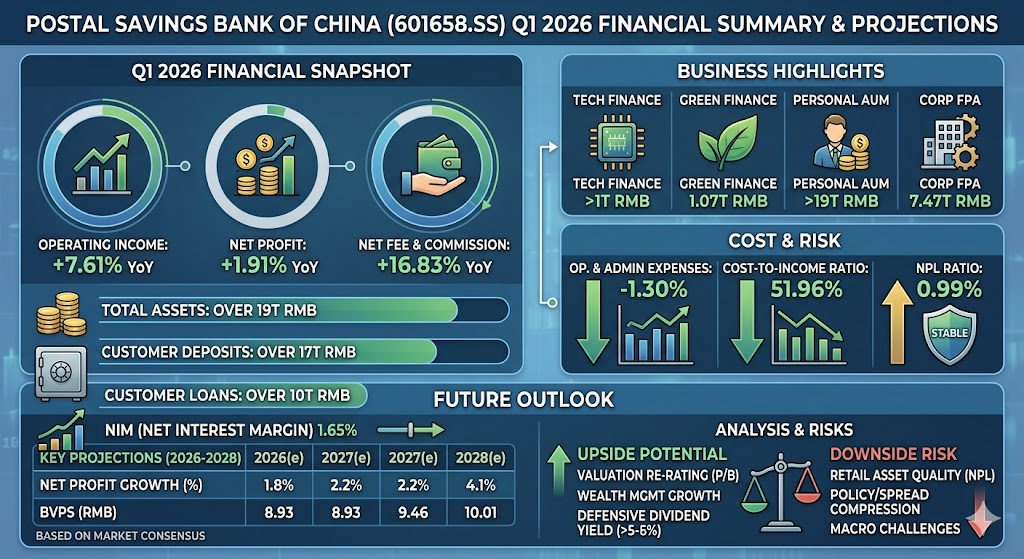
- Operating Income: 96.16B RMB, a year-over-year increase of 7.61%.
- Net Profit Attributable to Shareholders: 25.85B RMB, a year-over-year increase of 1.91%.
- Net Interest Margin: 1.65%.
- Net Interest Income: Year-over-year increase of 7.32%.
- Net Fee and Commission Income: Year-over-year increase of 16.83%.
Assets and Liabilities
- Total Assets: Exceeded 19T RMB.
- Total Customer Deposits: Exceeded 17T RMB.
- Total Customer Loans: Exceeded 10T RMB.
- Loan-to-Deposit Ratio: Increased by 0.26 percentage points.
- Cost of Deposits: Decreased by 16 basis points year-over-year to 0.99%.
Business Highlights and Risk Management
- Technology Finance: Balance of technology loans exceeded 1T RMB, serving over 110,000 technology-based enterprises.
- Green Finance: Balance of green loans reached 1.07T RMB, an increase of 6.75% from the end of the previous year.
- Retail and Corporate Business: Personal customer Assets Under Management (AUM) exceeded 19T RMB, an increase of 4.33% from the end of the previous year; Total Financing for corporate customers (FPA) reached 7.47T RMB, an increase of 10% from the end of the previous year.
- Cost Control: Operating and administrative expenses were 49.97B RMB, a year-over-year decrease of 1.30%; the cost-to-income ratio was 51.96%, a year-over-year decrease of 4.69 percentage points.
- Asset Quality: The non-performing loan (NPL) ratio was 0.99%, indicating a stable and controllable risk profile.
Based on the 2026 first-quarter report and relevant market research, the business operations and outlook for the Postal Savings Bank of China (601658.SS) are summarized as follows:
Key Changes in 2026 Q1
- Growth in Both Revenue and Profit: Operating income increased by 7.61% YoY, and net profit grew by 1.91% YoY. This represents a significant acceleration in growth compared to the full year of 2025, with net interest income growth turning positive.
- Stabilization of Net Interest Margin (NIM): The NIM for 26Q1 was 1.65%, down only 1 basis point from the end of 2025, marking a significant narrowing of the decline compared to the same period last year. This was primarily driven by the substantial optimization of interest-bearing liability costs (deposit cost decreased by 16 basis points to 0.99%).
- Strong Intermediate Business: Net fee and commission income grew by 16.83% YoY, hitting a three-year high, mainly due to the recovery in wealth management, insurance brokerage, and asset management businesses.
- Cost Structure Optimization: Operating and administrative expenses decreased by 1.30% YoY, and the cost-to-income ratio fell to 51.96%, primarily due to the proactive reduction in savings agency fee rates.
- Asset Quality Pressure: The non-performing loan (NPL) ratio was 0.99%, up 4 basis points from the beginning of the year. Attention-rated loans and overdue rates also showed a slight increase, indicating persistent risk exposure in the retail business. Credit impairment losses surged by 65.22% YoY, reflecting the bank’s proactive increase in provision coverage.
Outlook for the Next Quarter and the Year Ahead
- Operational Outlook: Analysts generally expect the bank’s net interest income to maintain strong growth. As the net interest margin reaches a cyclical bottom, pressure for further significant declines is expected to be limited.
- Business Strategy: The company will continue to promote the dual-driver approach of corporate and retail business, particularly in technology finance and green finance. With its wholly-owned subsidiary, Postgroup Financial Asset Investment Co., Ltd., now in operation, the bank is expected to further enhance its comprehensive financial service capabilities.
- Risk Control: Market views suggest that despite short-term pressure on asset quality, the Postal Savings Bank’s reliance on its extensive branch network and low liability costs ensures a safety margin for long-term financial stability. Fitch Ratings expects the NPL ratio will not spike significantly in 2026 or 2027, even in the face of macroeconomic challenges.
EPS Forecast for the Coming Year
According to recent brokerage reports, market forecasts for the bank’s earnings growth from 2026 to 2028 have been revised upward, as follows:
| Year | Net Profit Growth Forecast | BVPS Forecast (RMB) |
| 2026 | 1.8% | 8.93 |
| 2027 | 2.2% | 9.46 |
| 2028 | 4.1% | 10.01 |
Note: The EPS forecasts above represent consolidated institutional assessments. The actual basic EPS for 26Q1 was 0.20 RMB, a decline of 16.67% YoY, primarily affected by increased provision requirements and adjustments to share capital structure. Investors should continue to monitor the trend of earnings recovery in subsequent quarters.
The following is a professional analysis of the stock’s potential performance:
Upside Potential
The upward momentum for Postal Savings Bank is primarily driven by its unique retail banking business model:
- Valuation Re-rating: Bank stocks are generally trading at low price-to-book (P/B) ratios. If China’s macroeconomic policies further gain traction and stimulate real economic demand, Postal Savings Bank’s strong liability-side cost advantage (due to its high deposit ratio) will give it better net interest margin (NIM) elasticity than its peers. This would directly boost net profit expectations.
- Wealth Management Growth: The bank is accelerating its transformation, and the rapid growth in individual customer Assets Under Management (AUM) has provided room for sustained non-interest income. If capital market performance stabilizes, its distribution and asset management businesses will become the second growth curve for profits.
- Dividend Attractiveness: As a typical dividend stock, if its dividend yield can be maintained above 5% to 6%, it will possess a very strong defensive appeal to institutional investors seeking stable returns in a low-interest-rate environment, providing a solid floor for the stock price.
Downside Risk
Downside risks are mainly concentrated on macroeconomic conditions and asset quality volatility:
- Retail Business NPL Risk: Postal Savings Bank has a large scale of retail credit. If consumer spending is weak or the real estate market recovery falls short of expectations, the non-performing loan (NPL) ratio for personal loans could see a structural rise. This would directly lead to an increase in provision requirements, thereby eroding profits.
- Policy and Regulatory Environment: As a large state-owned bank, it frequently takes on policy mandates to promote the real economy (such as technology finance and green finance). During the process of “yielding profits” to support these sectors, the net interest spread may be further compressed, affecting short-term net profit margins.
- Market Liquidity and Index Weighting: As a constituent of indices like the CSI 300, its share price is often driven by broader market liquidity. If foreign capital flows or market risk-aversion sentiment intensifies, large bank stocks often become targets for profit-taking, leading to short-term pullbacks.
Source:
- https://www.chinapost.com.cn/xhtml1/report/2605/1851-1.htm
- http://finance.people.com.cn/BIG5/n1/2026/0430/c1004-40711639.html
- https://www.aastocks.com/tc/stocks/news/glh-news/GLH2426626L/1
- http://stock.finance.sina.com.cn/stock/go.php/vReport_Show/kind/lastest/rptid/831668465267/index.phtml?cref=cj
- https://news.futunn.com/en/post/73354456/postal-savings-bank-of-china-601658-revenue-exceeds-expectations-new
- https://www.fitchratings.com/research/banks/postal-savings-bank-of-china-co-ltd-18-05-2026
Back to Postal Savings Bank of China page