
Market Position and Market Share
Koninklijke Philips N.V.(Philips) holds a dominant position as a global leader in health technology, specializing in diagnostic imaging, image-guided therapy, patient monitoring, and personal health products. The company ranked among the top global medical technology firms by total healthcare revenue.
- Diagnostic Imaging and Image-Guided Therapy: Philips holds a top three global position alongside GE HealthCare and Siemens Healthineers, collectively commanding over 70% of the worldwide diagnostic imaging market. In the image-guided therapy segment (including interventional X-ray systems and catheters), Philips maintains a market share of approximately 30% to 35%, competing directly for the leading position globally.
- Patient Monitoring: Philips is a primary leader in acute care patient monitoring, holding an estimated global market share of 30% to 40% in bedside and telemetry monitoring systems, widely integrated into hospital intensive care units (ICUs).
- Personal Health: Within personal care, Philips holds the world’s #1 position in electric male grooming(shavers) with an estimated market share exceeding 40%, and a top two position in oral healthcare(Sonicare) alongside Procter & Gamble(Oral-B).
Supply Chain Analysis and Key Suppliers
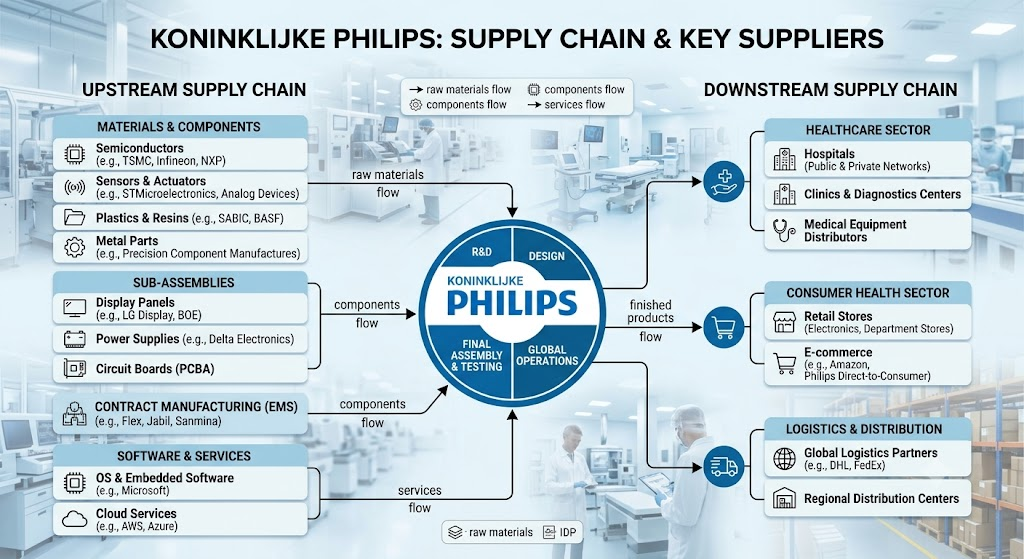
Philips operates an integrated global supply chain categorized across medical device manufacturing, sub-assembly electronics, precision components, software integration, and logistics.
- Upstream Supply Chain (Tier 1 & Tier 2 Suppliers):
- Semiconductors and Microelectronics: Philips relies on specialized semiconductor fabricators and distributors for medical-grade microcontrollers, ASICs, and sensors. Key suppliers include Texas Instruments, Analog Devices, and STMicroelectronics for analog signal processing, and TSMC (via fabless partners) for advanced processor nodes used in high-speed imaging algorithms.
- Precision Optics and X-Ray Components: Advanced imaging systems rely on specialized optical and radiation hardware. Key component partners include Varex Imaging (X-ray tubes and flat-panel detectors) and Dunlee (a Philips brand serving both internal and OEM markets for CT tubes and components).
- Display Technologies: For high-resolution medical displays used in image-guided surgical suites and diagnostic workstations, Philips sources high-grade panel assemblies from Barco and LG Display.
- Contract Manufacturing and Electronics Assembly: While critical IP is manufactured in-house, Philips outsources non-core assembly and printed circuit board assemblies (PCBAs) to major Electronic Manufacturing Services (EMS) providers such as Sanmina, Celestica, and Jabil.
- Downstream Supply Chain (Distribution and Integration):
- Healthcare Providers: The direct downstream channel consists of public and private hospital networks, outpatient surgery centers, and diagnostic clinics. Products are integrated via enterprise software platforms (e.g., Picture Archiving and Communication Systems / PACS) linking directly to hospital Health Information Systems (HIS).
- Retail and E-Commerce Channels: Personal health devices flow through direct-to-consumer (D2C) channels, mass-market retailers (e.g., Walmart, Target), and e-commerce platforms (e.g., Amazon) supported by regional third-party logistics (3PL) providers like DHL and DB Schenker.
Competitor Analysis
Philips competes primarily against GE HealthCare, Siemens Healthineers, and Mindray across its core medtech segments.
- Technological Comparison:
- Philips vs. Siemens Healthineers: Siemens holds a technological edge in heavy diagnostic equipment, particularly in high-field Magnetic Resonance Imaging (MRI) and Computed Tomography (CT) hardware innovation. Philips focuses its technological differentiation on workflow integration, AI-driven image processing (SmartSpeed MRI acceleration), and helium-free MRI magnet technology (BlueSeal magnets), which significantly reduces operational installation costs for hospitals.
- Philips vs. GE HealthCare: GE HealthCare excels in molecular imaging and ultrasound technologies. Philips counters with deep integration in image-guided therapy (Azurion platform) and connected care ecosystems, offering superior interoperability across patient monitoring devices and telemetry networks.
- Philips vs. Mindray: Mindray competes aggressively on cost structure and rapid hardware iteration in patient monitoring and ultrasound. Philips maintains an edge in high-acuity ICU software systems, enterprise clinical algorithms, and regulatory-grade data security.
- Financial Comparison:
- Profitability and Margins: Siemens Healthineers historically achieves higher and more stable Adjusted EBIT margins (typically 14%–17%) compared to Philips, driven by strong performance in its Varian radiation oncology and Diagnostics divisions. Philips’ operational profitability (Adjusted EBITA margin target of 11%–13%) experienced significant margin pressure due to historical recall costs associated with its Respironics Sleep & Respiratory Care division, though core Diagnostic & Treatment margins remain resilient.
- Revenue Mix and Resilience: GE HealthCare and Siemens Healthineers derive a higher proportion of recurring revenue from long-term service contracts and diagnostic consumables. Philips balances capital equipment sales with a consumer-facing Personal Health division, which provides higher gross margins but exposes the firm to consumer discretionary spending cycles.
- R&D Expenditure: Philips allocates approximately 9% to 10% of its annual sales to Research and Development, closely matching GE HealthCare and Siemens Healthineers in absolute percentage, but with a heavier strategic pivot toward software, informatics, and healthcare AI software tools.
- https://www.philips.com/a-w/about/investor.html
- https://www.philips.com/a-w/about/news/archive/standard/news/press/2024/philips-reports-fourth-quarter-and-full-year-results-2023.html
- https://www.siemens-healthineers.com/investor-relations
- https://investor.gehealthcare.com/
- https://www.vareximaging.com/
Back to Philips