
Corporate History
Foundation and Industrial Expansion(1891–1939) Founded in 1891 by Gerard Philips and his father Frederik in Eindhoven, Netherlands, the company initially manufactured carbon-filament lamps.It expanded rapidly into radio technology, medical X-ray tubes, and electric shavers, establishing itself as a global household name early in the 20th century.
Post-War Diversification and Consumer Electronics Dominance(1940–1990s) Philips pioneered iconic consumer electronics, co-inventing the Compact Cassette in 1963 and co-developing the Compact Disc(CD)with Sony in 1982.During this era, the company operated as a vast, highly conglomerate structure spanning lighting, consumer products, microchips, and medical systems.
Strategic Focus and Divestments(2000–2015) Recognizing that intense Asian competition lowered margins in consumer electronics, Philips initiated a massive strategic transformation.It spun off its semiconductor division(which became NXP Semiconductors)and gradually divested its television, audio, and lighting businesses(Signify).
Pure-Play Health Technology Shift(2016–Present) Rebranded as Koninklijke Philips N.V., the company committed fully to medtech.However, the period from 2021 onward has been defined by the global Respironics recall, management overhauls, and structural cost-reduction programs aimed at restoring balance-sheet health and public trust.
Business Model and Growth Strategy
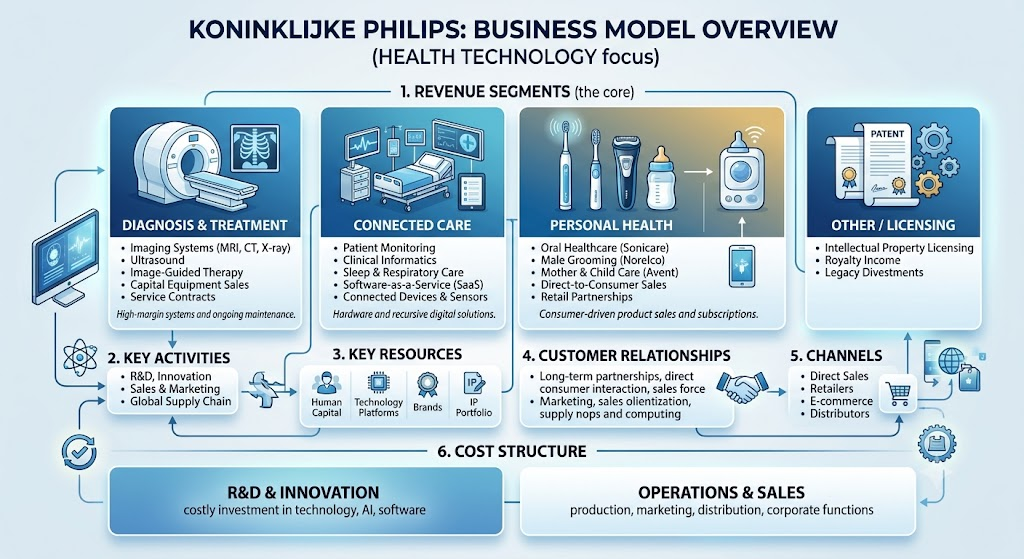
Philips generates revenue by selling high-margin capital medical equipment, recurring software licenses, consumables, personal health products, and multi-year hospital service contracts.Its operations are divided into three principal revenue-generating segments:
- Diagnosis&Treatment: Delivers magnetic resonance imaging(MRI), computed tomography(CT), diagnostic ultrasound, and image-guided therapy systems to hospitals and outpatient clinics.This segment drives significant capital equipment sales alongside long-term maintenance contracts.
- Connected Care: Focuses on patient monitoring solutions, clinical informatics, and hospital workflow automation software.Revenue streams blend upfront hardware installations with recurring software maintenance fees.
- Personal Health: Sells consumer-facing health devices directly to end customers and retail partners, including Sonicare electric toothbrushes, Norelco electric shavers, and mother&child care products.
From a financial perspective, Philips recorded group sales of approximately €18.2 billion in FY2023, reflecting a operational recovery with a comparable sales growth of 6%.Its Adjusted EBITA margin reached 10.6%(around €1.9 billion), up from 5.9% in FY2022.The company’s growth strategy prioritizes operational productivity—targeting €1.4 billion in cumulative cost savings through 2025—and shifting revenue composition toward higher-margin recurring software and subscription-based service agreements.
Information Sources
- https://www.results.philips.com/
- https://www.philips.com/a-w/about/investors.html
- https://www.annualreport.philips.com/
Artificial Intelligence Strategy, Budget, and Partnerships
Philips positions artificial intelligence as a core driver to alleviate clinical labor shortages and optimize diagnostics.Rather than creating standalone consumer AI applications, Philips embeds proprietary and co-developed AI models into its existing hardware and enterprise clinical software platforms.
Operational Budget and R&D Allocation Philips consistently allocates approximately 9% to 10% of its annual revenues to research and development, representing an annual R&D investment of roughly €1.7 billion to €1.9 billion.Over 50% of its total R&D workforce is dedicated to software engineering and data science, with a heavy concentration on medical AI development.
Key AI Applications and Innovations
- Philips SmartSpeed: An AI-driven MRI reconstruction software that increases scan speeds by up to 3 times while improving image resolution, significantly increasing hospital patient throughput.
- Ultrasound Flow Visualization: Uses AI algorithms to automatically detect anatomical structures and streamline echocardiogram readings.
- Enterprise Informatics: Integrates predictive analytics within intensive care units(ICU)to anticipate patient deterioration hours before clinical events occur.
Strategic Partnerships Philips actively collaborates with leading technology providers and academic institutions to accelerate AI deployment:
- Amazon Web Services(AWS): Cloud partnership designed to host Philips HealthSuite System, scaling enterprise clinical AI workloads across global hospital networks.
- SyntheticMR: Co-development of quantitative MRI software that uses machine learning to automatically segment brain tissues for neurological evaluations.
- Academic Health Systems: Long-term research partnerships with institutions like Mayo Clinic and Leiden University Medical Center to validate AI algorithms on multi-center clinical datasets.
Back to Philips