
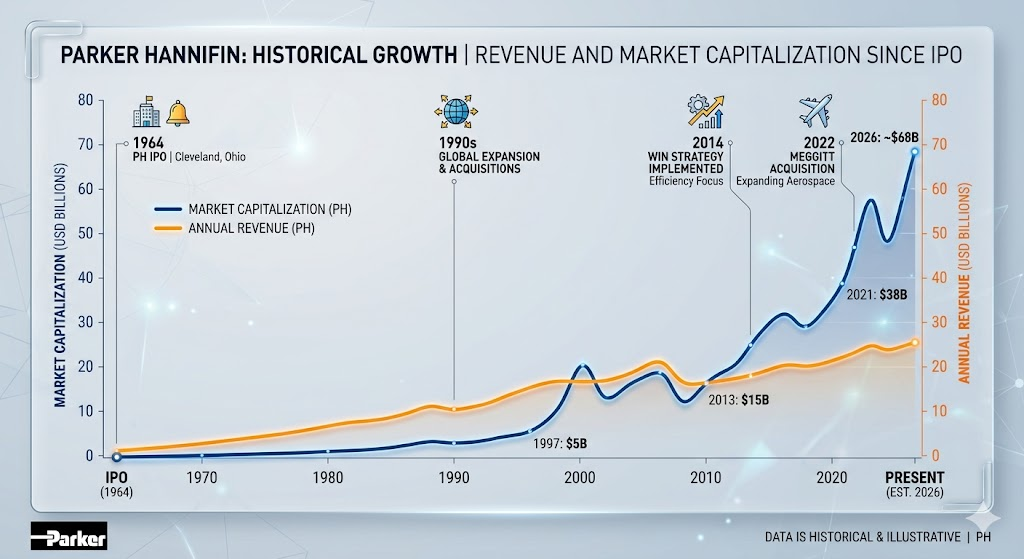
The history of Parker Hannifin can be categorized into the following key phases:
Founding and Early Development (1917–1930s)
In 1917, Arthur Parker founded the Parker Appliance Company in Cleveland, Ohio, initially focusing on developing pneumatic braking systems for trucks and buses. In 1924, he partnered with Carl Hannifin to formally establish the company. During this period, the firm established its foundational expertise in fluid connectors and pneumatic technologies.
Diversification and Aerospace Expansion (1940s–1960s)
During World War II, Parker’s components were widely utilized in military aircraft, significantly advancing its engineering capabilities. Following the war, the company aggressively expanded into commercial aviation and civil industrial markets through strategic acquisitions. This era marked the transition from a supplier of fluid controls to a diversified systems engineering corporation.
Globalization and Technological Depth (1970s–1990s)
The company initiated a major global expansion, leveraging acquisitions in hydraulics, filtration, and sealing technologies to build its comprehensive Motion and Control technology platform. During this phase, Parker successfully applied its core competencies to a wider range of industrial automation sectors and established an extensive global distribution network.
Transformation and Value Creation (2000s–Present)
Entering the 21st century, Parker implemented the Win Strategy, focusing on enhancing operational efficiency and profit margins. Beyond deepening its presence in the aerospace and climate control sectors, the company has actively invested in IoT and digital solutions. In recent years, major acquisitions, such as the purchase of Meggitt, have further solidified its dominant position in the high-end precision engineering and defense markets.
Parker Hannifin is a market leader in motion and control technologies, facing competition across its diversified industrial, aerospace, and automation business units. Below is a competitive analysis:
Major Competitor Landscape
- Diversified Industrial & Fluid Power
- Eaton (ETN): A primary rival with significant overlap in hydraulics, pneumatics, and power management systems. Eaton is increasingly focused on electrification and digital infrastructure.
- Bosch Rexroth: A subsidiary of the Bosch Group, it stands as one of Parker’s strongest global competitors in mobile hydraulics, pneumatics, and factory automation.
- Danfoss: Focuses on mobile hydraulics, power electronics, and climate solutions, competing directly with Parker in pumps, valves, and HVAC control components.
- Gates Industrial (GTES): A major supplier of industrial hoses and power transmission belts, competing in the fluid connector market.
- Aerospace & Defense Systems
- Industrial Automation & Electronic Control
- Rockwell Automation (ROK): A key competitor in the industrial controller (PLC) and automation software space.
- Emerson Electric (EMR), ABB, Schneider Electric: These industrial giants compete with Parker in sensors, integrated automation systems, and broader industrial software solutions.
Competitive Strengths & Strategic Positioning
- Scale and Systems Integration: Parker’s extensive product portfolio—spanning fluid connectors, filtration, sealing, and pneumatics—enables it to offer comprehensive, integrated system solutions. This provides a distinct advantage over competitors focused on narrow niches.
- The Win Strategy: Parker’s long-standing operational excellence program continues to drive margin expansion, cash flow generation, and efficiency. Strategic acquisitions, such as Meggitt and various Filtration Group assets, have successfully shifted the revenue mix toward higher-margin aerospace business and recurring aftermarket revenue.
- Performance: As of FY2026, Parker has demonstrated robust resilience against cyclical downturns. Through disciplined pricing and rigorous cost management, the company consistently maintains adjusted EBITDA margins above 27%.
- Growth Drivers: Current growth is heavily bolstered by strong demand in the aerospace sector (both OEM and aftermarket), while the industrial segment provides a stable base following periods of inventory destocking, supporting record backlog levels.
Risks and Challenges
- Integration Complexity: While M&A is a core growth engine, the integration of large-scale acquisitions (like Filtration Group) carries significant execution risk. Maintaining margin targets and growth velocity during post-merger integration is critical.
- Aerospace Cyclicality: Recent revenue performance has been heavily reliant on the strength of the aerospace market. Any unexpected slowdown or delays in major aerospace programs could pressure future top-line growth.
Source:
Back to Parker Hannifin page