
Corporate History
The evolution of Panasonic spans over a century and can be categorized into four primary developmental phases:
- Foundation and Post-War Industrial Expansion (1918–1970s): Founded in 1918 by Konosuke Matsushita as Matsushita Electric Housewares Manufacturing Works, the company began with duplex lamp sockets and bicycle lamps. Post-World War II, it expanded rapidly across Japan and overseas under brand names National and Panasonic, mass-producing radios, televisions, and household appliances.
- Global Consumer Electronics Leadership and Acquisitions (1980s–2000s): The firm dominated consumer electronics, VHS video tech, and cathode-ray tube displays. In 1990, it acquired MCA Inc. (Universal Studios) for $6.1 billion, later divesting it. In 2008, the company officially rebranded globally from Matsushita Electric Industrial Co., Ltd. to Panasonic Corporation, followed by the acquisition of Sanyo Electric in 2009–2010 to secure battery and solar assets.
- Structural Reforms and the B2B Pivot (2010s–2021): Facing massive losses in plasma TVs and smartphone hardware, Panasonic initiated drastic portfolio restructuring under former CEO Kazuhiro Tsuga. It exited unprofitable television panels and consumer mobile phones to pivot heavily toward automotive electronics, industrial components, and lithium-ion battery production for electric vehicles, cemented by its Gigafactory partnership with Tesla.
- Holding Company Transition and Software Integration (2022–Present): In April 2022, the company reorganized into a holding company structure, Panasonic Holdings Corporation, granting operational autonomy to subsidiaries (such as Panasonic Energy, Panasonic Connect, Panasonic Industry, and Lifestyle). The group completed the acquisition of supply chain AI software specialist Blue Yonder for $7.1 billion, while carving out and divesting non-core entities, including Panasonic Automotive Systems.
Business Model and Strategic Monetization
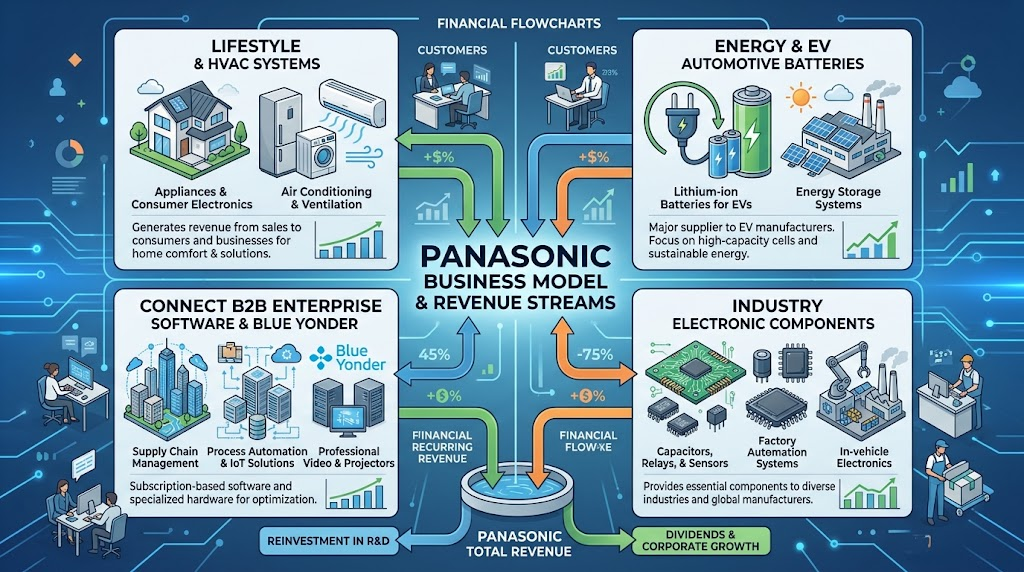
Panasonic operates across five main business segments, generating revenue through hardware manufacturing, system integration, high-margin electronic components, and recurring enterprise software subscriptions:
- Lifestyle (Appliances and HVAC): Generates approximately ¥3.58 trillion in revenue (FY2025). Monetization occurs via sales of consumer appliances, lighting, and commercial heating, ventilation, and air conditioning (HVAC) systems. Profitability is driven by energy-efficient heat pumps in Europe and premium electrical construction materials in Japan and Asia.
- Energy (EV and Industrial Batteries): Panasonic Energy monetizes high-density cylindrical lithium-ion battery cells (primarily 2170 and 4680 formats) supplied to electric vehicle OEMs. Operating profit in this unit has been substantially augmented by US Inflation Reduction Act (IRA) Section 45X production tax credits, which provided over ¥100 billion to ¥180 billion in annual financial credits.
- Connect (B2B Solutions and Software): Generates around ¥1.33 trillion in sales. The core profit engine is transitioning from transactional hardware (rugged Toughbook PCs, commercial projectors, avionics) to SaaS-based recurring revenue via Blue Yonder. Blue Yonder contributes over $1.2 billion in annual revenues with SaaS ARR exceeding $575 million and software recurring revenue ratios above 65%.
- Industry (Electronic Components and Materials): Sells specialized capacitors, relays, sensors, and electronic materials to industrial automation, data center power delivery, and automotive equipment manufacturers. Monetization relies on proprietary high-capacitance conductive polymer capacitors and semiconductor packaging materials.
- Capital Discipline and Portfolio Strategy: The group has pivoted to a strict Return on Invested Capital (ROIC) framework. To divest lower-margin manufacturing units, Panasonic sold a majority stake in Panasonic Automotive Systems (PAS) to Apollo Global Management in 2024 to reinvest capital into software and next-generation battery lines.
Business Model Information Sources
- https://news.panasonic.com/uploads/tmg_block_page_image/file/32667/en250509-4-1.pdf
- https://holdings.panasonic/global/corporate/investors/pdf/2023_full/financial_results_e.pdf
- https://holdings.panasonic/global/corporate/investors/pdf/2023_full/financial_results_note_e.pdf
- https://the-shashi.com/en/tse/6752/financials/
- https://holdings.panasonic/global/corporate/investors/pdf/E_Blue_Yonder_Briefing_EN_master.pdf
Artificial Intelligence Strategy, Budget, and Partnerships
Panasonic approaches AI through two distinct vectors: commercializing industrial AI software for global enterprise supply chains and deploying AI internally across design and smart factory workflows:
- Enterprise AI and the Autonomous Supply Chain: The centerpiece of Panasonic’s commercial AI strategy is Blue Yonder. Following the $7.1 billion buyout, Panasonic committed an additional $200 million dedicated investment budget specifically for Blue Yonder’s transformation into an AI and cloud-native SaaS platform. In 2024, Blue Yonder completed the acquisition of One Network Enterprises for approximately $839 million, creating an AI-driven multi-enterprise supply chain execution network that coordinates predictive logistics and automated inventory replenishment across real-time freight ecosystems.
- Key Strategic AI Partnerships:
- Snowflake: Blue Yonder integrated its supply chain platform natively with Snowflake Data Cloud to provide clean, unified telemetry for training large-scale predictive machine learning algorithms.
- Microsoft Azure and OpenAI: Panasonic established group-wide enterprise generative AI platforms (Panasonic Connect AI) deployed across tens of thousands of employees in Japan, utilizing Microsoft Azure OpenAI service under isolated data privacy protocols to automate coding, internal customer support, and administrative paperwork.
- Accenture and IBM: Blue Yonder maintains dedicated go-to-market and integration alliances with IBM and Accenture to implement cognitive warehouse task optimization engines and autonomous supply chain planning software for global enterprise clients.
- Edge AI and Industrial Infrastructure Integration: Within Panasonic Connect and Panasonic Industry, the company integrates computer vision edge AI into retail self-checkout systems, security camera modules, and warehouse logistics automation engines (such as dynamic sorting and automated guided vehicle dispatch). Concurrently, Panasonic Industry supplies specialized capacitor components and power distribution units specifically engineered for high-density generative AI server racks and AI hyperscale data centers.
back to Panasonic