
Company History
Origins and Government Spinoff(1967–1988)
The foundation of NTT DATA originated in 1967 within the Nippon Telegraph and Telephone Public Corporation as its Data Communications Bureau. During this era, it developed Japan’s foundational national networks, including nationwide banking data communication systems and social administrative databases. Following the privatization of NTT in 1985, the data communications division was officially carved out and incorporated as NTT DATA Communications Systems Corporation in May 1988.
Domestic Expansion and Public Listing(1989–2004)
NTT DATA listed on the Tokyo Stock Exchange in 1995. During this decade and a half, the company established a near-monopolistic lock on large-scale public sector, tax, customs, and financial systems across Japan, developing platforms like the Zengin System(the core interbank funds transfer system) and major regional bank processing platforms.
Global M&A and Scale Expansion(2005–2021)
Recognizing domestic market saturation, the firm initiated an aggressive overseas expansion strategy through debt-financed mergers and acquisitions. Key milestones included the acquisition of Cirquent in Europe(2008), Keane and Intelligroup in the United States(2010), Everis in Spain/Latin America(2013), and Dell Systems(Dell’s IT services division) for over $3 billion in 2016. These moves transformed NTT DATA from an insular Japanese SIer into a global top-10 IT service vendor.
Reorganization and Full-Stack Integration(2022–Present)
In October 2022, NTT DATA and NTT Inc. combined their overseas operations into a unified entity, culminating in the formal transition to a holding structure as NTT DATA Group Corporation in July 2023. By merging NTT Ltd.’s network, data center, and campus infrastructure capabilities with NTT DATA’s software and digital transformation consulting, the firm formed a full-stack digital services provider generating over ¥4.3 trillion in annual revenue.
Business Model and Strategic Growth
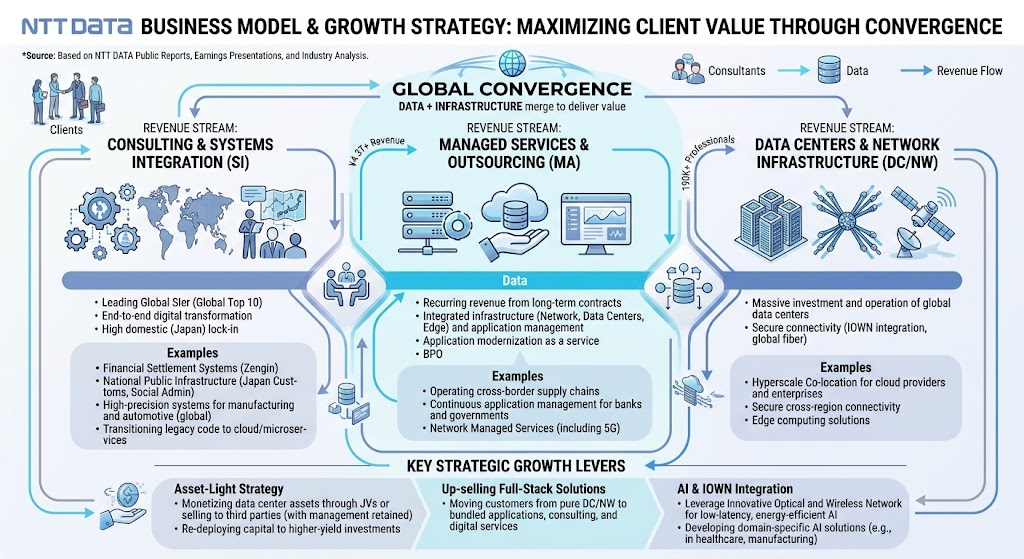
NTT DATA generates revenue primarily through long-term systems integration(SI), IT outsourcing/managed services, business process outsourcing(BPO), enterprise cloud migration, and data center co-location services. The monetization model is anchored by three primary mechanisms:
- Fixed-Price and Time-and-Materials SI Contracting: In its domestic public and financial sectors, NTT DATA captures multi-year implementation and digital renewal contracts with low churn, leveraging high customer switching costs.
- Recurring Managed Services and Maintenance Contracts: Post-deployment, the company locks clients into long-term infrastructure operation, application maintenance, and cybersecurity service-level agreements(SLAs).
- Data Center and Infrastructure Capacity Monetization: NTT DATA operates hyperscale data center facilities globally, generating recurrent recurring co-location and connectivity lease revenue.
Financially, the group recorded consolidated net sales of approximately ¥4.37 trillion in fiscal year 2023, expanding toward a medium-term revenue target of ¥4.7 trillion. Consolidated operating profit has stabilized near ¥310 billion, yielding a group operating margin around 7.1%.
A sharp divergence exists within its segment economics:
- Japan Business(Public & Enterprise/Financial): Yields high, dependable operating margins between 9% and 11%, driven by monopolistic pricing power in domestic clearing and government administration.
- Overseas Business(NTT DATA, Inc.): Represents more than half of gross revenue following the NTT Ltd. consolidation but has operated with compressed operating margins ranging between 3% and 5% due to ongoing restructuring expenses and higher talent costs in North America and EMEA.
To counter margin compression, NTT DATA’s corporate strategy centers on two initiatives:
- Balance Sheet Optimization via Capital Asset Transfer: Facing substantial capital expenditures exceeding ¥400 billion annually in global data center capacity, the group has executed real estate monetization structures—including transferring data center assets into specialized REITs and third-party capital vehicles—to de-lever its balance sheet while retaining management fees.
- High-Margin Full-Stack Solutions: Up-selling bundled cloud-network-consulting architectures to multinational corporations, transitioning away from commoditized legacy infrastructure management.
Business Model Reference Sources
- https://www.nttdata.com/global/en/-/media/nttdataglobal/1_files/investors/financial-results/2023/fy2023_pre_4q_note.pdf
- https://www.nttdata.com/global/en/-/media/nttdataglobal/1_files/investors/financial-results/2023/fy2023_qa_4q.pdf
- https://www.nttdata.com/global/en/-/media/nttdataglobal/1_files/investors/financial-results/2024/fy2024_fs_4q.pdf
- https://www.hfsresearch.com/research/onentt-global-footprint-consolidation/
Artificial Intelligence Strategy, Budget, and Strategic Alliances
Core AI Strategy and Proprietary LLM Deployment
NTT DATA’s AI roadmap rests on a dual strategy: integrating major foundation models from global cloud providers while commercializing NTT Group’s proprietary small language model(SLM), tsuzumi. Developed by NTT Laboratories, tsuzumi features parameter sizes ranging from 0.6 billion to 7 billion parameters. Unlike massive generic models, tsuzumi focuses on high-precision Japanese natural language understanding, domain-specific enterprise fine-tuning, and ultra-low computing overhead, enabling on-premise execution on single GPUs or CPUs to comply with stringent Japanese data sovereignty and privacy mandates.
Capital Allocation and Strategic R&D Commitments
NTT DATA benefits from the broader NTT Group’s annual research and development expenditure, which exceeds $3.6 billion(approximately ¥500 billion). The group directs capital toward generative AI frameworks, automated code migration, and the Innovative Optical and Wireless Network(IOWN) architecture. IOWN is an end-to-end photonics-based network engineered to slash transmission power consumption by up to 100-fold and reduce latency by 200-fold, addressing the surging energy and bandwidth constraints of generative AI data centers. In data center infrastructure specifically, NTT DATA allocated over ¥413 billion in annual capital expenditure to expand AI-ready facilities worldwide.
Strategic Partnerships and Concrete Deployments
- Microsoft Collaboration: In November 2024, NTT DATA expanded its strategic alliance with Microsoft to integrate the tsuzumi-7B model into Azure AI Studio, providing enterprise clients with co-developed generative AI applications, automated legacy code translation, and enterprise RAG(Retrieval-Augmented Generation) workflows.
- OpenAI Global Partnership: NTT DATA serves as an authorized partner and reseller for ChatGPT Enterprise, deploying OpenAI API integrations and dedicated AI Centers of Excellence(CoE) for Tier-1 financial institutions and manufacturing conglomerates.
- Hyperscaler Alliances(AWS & Google Cloud): Through the NTT DATA GenAI TechHub, the company offers pre-validated architecture blueprints across AWS and Google Cloud, accelerating client AI application deployment times by up to 40%.
- Operational Platforms(LITRON & Syntphony): The group has deployed internal AI platforms, including LITRON(an AI-powered process automation suite) and Syntphony Intelligent Document Processing, reducing manual document verification cycles across banking and insurance operations.
back to NTT Data