
History
The history of NTT can be broken down into three major developmental phases:
- Monopoly Era (1952–1985): Established in 1952 as a government-owned public corporation (Nippon Telegraph and Telephone Public Corporation), the entity held an absolute monopoly over domestic telecommunications infrastructure, rapidly rebuilding and expanding Japan’s post-war telephone networks across the country.
- Privatization and Restructuring (1985–1999): In 1985, NTT was privatized under the Nippon Telegraph and Telephone Corporation Act, though the Japanese government retained a significant ownership stake. In 1999, the company underwent a massive government-mandated restructuring, splitting into a holding company structure that separated into regional carriers (NTT East and NTT West) and a long-distance/international arm to foster market competition.
- Global Expansion and Digital Transformation (2000–Present): Entering the 21st century, NTT aggressively pursued diversification beyond traditional voice telephony through large-scale acquisitions, most notably consolidating NTT DOCOMO into a wholly-owned subsidiary and scaling up global IT services by integrating Dell Services and other entities into NTT DATA, while presently pivoting heavily toward cloud infrastructure, data centers, and AI initiatives.
Business Model and Growth Strategies
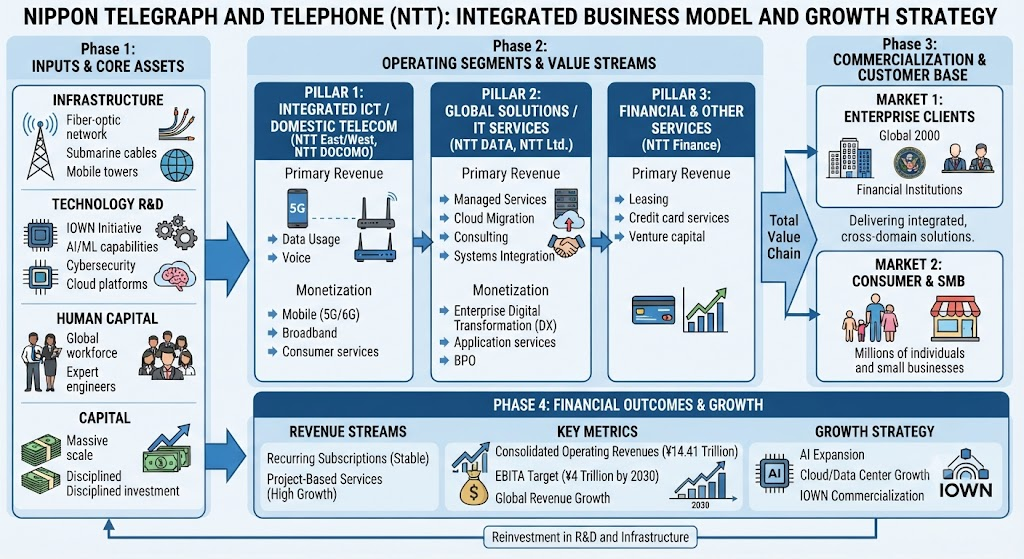
NTT generates revenue by monetizing an integrated ecosystem of telecommunications, mobile communications, global IT services, and enterprise solutions. Rather than relying solely on infrastructure supply chains, the company makes money through recurring subscription fees, data usage charges, enterprise managed services contracts, and digital infrastructure leasing. Mobile subscriptions and consumer broadband services through NTT DOCOMO generate steady, high-frequency recurring cash flows, while the Integrated ICT and Global Solutions segments—anchored by NTT DATA—monetize enterprise digital transformation, cloud migrations, cybersecurity, and data center colocation.
The financial scale of this model is substantial, with the Global Solutions Business acting as a primary top-line driver, contributing significantly to annual revenue growth. NTT leverages the stable cash generation of its domestic utility-like telecom business to fund high-growth digital segments, targeting a consolidated EBITA of 4 trillion Japanese yen ($25.38 billion) by 2030.
Sources
- https://umbrex.com/resources/company-profiles/ntt-inc/
- https://vizologi.com/business-strategy-canvas/nippon-telegraph-telephone-business-model-canvas/
- https://www.lightreading.com/finance/ntt-updates-medium-term-plan-with-ai-data-center-focus
AI Strategy and Development
NTT is executing an aggressive, multi-layered artificial intelligence strategy focused on transforming both its internal operations and its commercial product portfolio. Central to this strategy is the development of next-generation infrastructure, including its proprietary Large Action Model (LAM) designed to analyze time-series behavioral data and power hyper-personalized marketing and enterprise automation. Commercial deployments like NTT DATA AIVista are rolled out to capture enterprise AI consulting and implementation revenue streams.
To support surging AI workload demands, NTT has elevated artificial intelligence and data center expansion to the core of its updated medium-term financial plan. The company is actively deploying its Innovative Optical and Wireless Network (IOWN) architecture—transitioning domestic infrastructure into an AI-native framework (“AIOWN”) designed to optimize GPU, network, and power resource allocation. NTT aims to scale its international data center footprint specifically targeting hyperscaler cloud and AI inference demands, backed by disciplined capital allocation strategies that utilize third-party capital partnerships to fund massive digital infrastructure buildouts while protecting the parent company’s balance sheet.
back to NTT