
Market Position and Market Share
Norsk Hydro ASA is one of the world’s few fully integrated aluminum and renewable energy conglomerates.Founded in Norway, the company commands a dominant presence across upstream mining, refining, primary smelting, downstream extrusion, and scrap recycling.
- Downstream Aluminum Extrusions:Norsk Hydro is the global #1 player in aluminum extrusions, holding the leading market positions across Europe and North America.In Europe, Hydro Extrusions holds approximately a 15% to 20% market share within its core segments, particularly serving the European automotive sector. Annual extrusion shipment volumes reach roughly 1.0 million metric tons.
- Primary Aluminum Smelting: Globally, Norsk Hydro ranks among the top primary aluminum producers outside China (typically within the top 5 ex-China alongside Rio Tinto, UC Rusal, and Alcoa). Its primary aluminum equity production stands at approximately 2.05 to 2.1 million metric tons annually, representing roughly 3% of total global primary aluminum output (a share constrained by China’s dominant 58–60% global production footprint).
- Upstream Bauxite & Alumina:Hydro operates the Paragominas bauxite mine and the Alunorte alumina refinery in Barcarena, Pará, Brazil.Alunorte is the single largest alumina refinery outside China, with a nameplate capacity of roughly 6.3 million metric tons per year, making Hydro a top global supplier of refined alumina.
- Low-Carbon & Circular Aluminum:Hydro leads the industry in certified low-carbon primary aluminum (Hydro REDUXA, certified at $<4.0$ kg $CO_2$ per kg Al) and post-consumer recycled aluminum (Hydro CIRCAL 75R/100R). Following its acquisition of Polish recycler Alumetal, Hydro’s total recycling capacity surpassed 1.3 million metric tons, solidifying its position as Europe’s leading recycler.
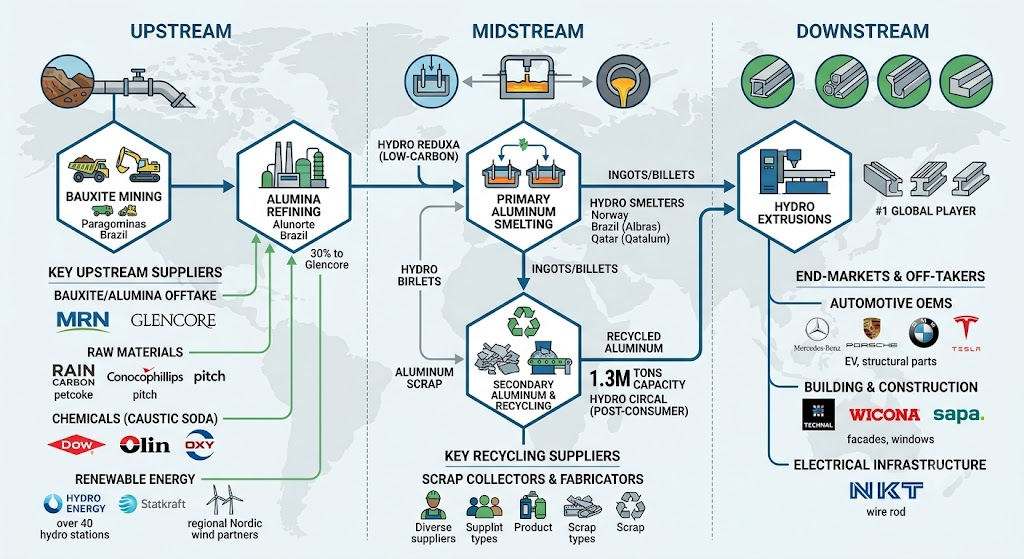
Supply Chain Upstream, Downstream, and Key Suppliers
Hydro’s business architecture is built on vertical integration, designed to insulate operations from commodity volatility, lower freight friction, and secure access to green energy.
- Upstream Operations:
- Bauxite Mining: Primary extraction takes place at the wholly-owned Paragominas mine in Pará, Brazil (producing ~10 million metric tons per year), transported via a 244 km underground slurry pipeline directly to Alunorte. Hydro also holds off-take agreements from Mineração Rio do Norte (MRN).
- Alumina Refining: Handled by Hydro Alunorte in Brazil, converting bauxite via the Bayer process. Hydro monetized a 30% minority interest in Alunorte to Glencore, maintaining operational control while securing long-term offtake liquidity.
- Energy & Power Infrastructure: Aluminum smelting requires intense baseload electricity (~14–15 kWh per kg of primary metal). Upstream captive energy is managed by Hydro Energy, which owns and operates over 40 hydropower stations across Norway (~10 TWh annual captive generation capacity), protecting smelters from volatile European grid spot prices.
- Midstream & Smelting:
- Smelting facilities are primarily situated in Norway (Sunndal, Årdal, Karmøy, Høyanger, and Husnes) leveraging domestic hydro-power, as well as joint ventures such as the Albras smelter in Brazil (with Nippon Amazon Aluminium Co.) and Qatalum in Qatar (50-50 joint venture with QatarEnergy).
- Key Upstream Suppliers:
- Carbon Anodes & Raw Materials: Petroleum coke (petcoke) and coal tar pitch suppliers (e.g., Rain Carbon, ConocoPhillips) provide critical materials for reduction anode baking.
- Chemical Processing: Major chlor-alkali producers (e.g., Dow Chemical, Olin, Occidental Chemical) supply industrial caustic soda (sodium hydroxide) required for the Bayer refining process at Alunorte.
- Renewable Energy Providers: Independent power producers and wind utilities in the Nordics under long-term Corporate Power Purchase Agreements (CPPAs), such as Statkraft and regional Nordic wind asset operators, supplementing Hydro’s internal hydropower generation.
- Secondary Raw Materials: Industrial fabricators and municipal scrap collectors feeding post-consumer and pre-consumer scrap to Hydro’s recycling and casthouse networks.
- Downstream Integration & Off-takers:
- Hydro Extrusions: Over 100 manufacturing and fabrication facilities in ~40 countries transform billets into precision profiles, tubes, and components.
- Key End-Markets & Off-takers:
- Automotive OEMs: Tier 1 suppliers and OEMs including Mercedes-Benz, Porsche, BMW, and Tesla for lightweight EV battery enclosures, crash-management systems, and structural body parts.
- Building & Construction: Architectural facade engineering, high-performance window systems, and structural framing (e.g., Hydro’s Technal, WICONA, and Sapa building systems brands).
- Electrical Infrastructure: Cable producers (e.g., long-term low-carbon wire rod offtake contracts with NKT) for high-voltage transmission networks.
Competitor Analysis: Technical and Financial Benchmarking
Norsk Hydro competes directly against integrated global mining and metals conglomerates, including Rio Tinto (Rio Tinto Aluminium), Alcoa Corporation, UC Rusal, and downstream extrusion converters like Constellium.
- Technical Comparison:
- Decarbonization & Carbon Intensity: Norsk Hydro holds a structural technological edge over coal-dependent competitors (such as Chinese smelters, which average 12–14 kg $CO_2$/kg Al). Smelting powered by Norwegian hydro assets delivers primary metal averaging below 4.0 kg $CO_2$/kg Al (Hydro REDUXA). By comparison, Rio Tinto leverages Canadian hydroelectric smelters and is developing the ELYSIS inert anode technology (aiming to eliminate direct greenhouse gas emissions entirely, producing pure oxygen as a byproduct). Hydro’s proprietary HalZero technology pursues an alternative zero-emission process by converting alumina to aluminum chloride before electrolytic dissociation, isolating chlorine in an internal closed loop.
- Scrap Sorting and Metallurgy: Through its proprietary laser-induced breakdown spectroscopy (LIBS) scrap-sorting technology and its Alumetal acquisition, Hydro processes complex post-consumer scrap without down-cycling, surpassing Alcoa and Rusal in post-consumer circular scrap conversion capabilities.
- Downstream Specialization: Competitors like Alcoa and Rio Tinto remain predominantly upstream commodity extraction and primary metal producers, lacking extensive downstream fabrication networks. Hydro’s captive extrusion network captures high-margin value-add processing premiums ($350–$450/mt above LME cash prices) that upstream-only peers forgo.
- Financial Comparison:
- Revenue & Top-Line Exposure: Hydro generates annual revenue of roughly NOK 190–210 billion (~$18–$20 billion USD), placing it comparable to Alcoa (~$10–$12 billion USD) and Rio Tinto’s aluminum division (~$12–$14 billion USD).
- Margin Stability & Business Cyclicality: Upstream-heavy peers like Alcoa face severe margin volatility driven purely by London Metal Exchange (LME) base metal and Platts alumina index pricing. Hydro’s downstream segment (Extrusions) and trading division (Metal Markets) provide steady cash flows and cost pass-through mechanisms that buffer group EBITDA during low LME price cycles.
- Balance Sheet & Leverage: Hydro maintains a disciplined balance sheet, with net debt typically kept below 1.5x adjusted EBITDA and significant liquidity reserves (NOK 15–22 billion adjusted net debt range depending on dividend and capex cycles). Alcoa operates with lower capital density downstream but experiences wider earnings dispersion during metal price downswings. Rio Tinto possesses superior overall group balance sheet strength derived from iron ore cash flows, but its standalone aluminum division operates at similar cost-curve dynamics to Hydro’s primary assets.
Sources
- https://www.hydro.com/
- https://www.hydro.com/globalassets/06-investors/reports-and-presentations/quarterly-reports/2025/q4r8nt/nhy-investor-presentation-q4-2024.pdf
- https://www.hydro.com/en/global/media/news/2026/hydros-second-quarter-2026-operational-strength-delivering-solid-results/
- https://www.globenewswire.com/news-release/2025/04/29/3069822/0/en/norsk-hydro-strong-upstream-results-navigating-global-trade-uncertainty.html
- https://newsweb.oslobors.no/message/644646
- https://www.aluminummarketupdate.crugroup.com/growth-markets/hydros-primary-aluminum-stability-contrasts-with-softer-extrusion-demand/
- https://umbrex.com/resources/company-profiles/norsk-hydro/
- https://eiti.org/supporters/hydro
Back to Norsk Hydro