
The development history of Nongfu Spring (9633.HK) can be divided into the following four main stages:
Foundation and Brand Establishing (1996–2000)
In 1996, founder Zhong Shanshan established Zhejiang Qiandaohu Yangshengtang Drinking Water Co., Ltd. (the predecessor of Nongfu Spring) in Hangzhou. In 1997, the first packaged drinking water under the “Nongfu Spring” brand was launched. In 2000, the company announced it would cease production of purified water to pivot completely toward natural water, introducing the classic slogan “Nongfu Spring tastes a bit sweet,” which successfully achieved a market breakthrough.
Product Diversification and Nationwide Layout (2001–2010)
The company officially changed its name to Nongfu Spring Co., Ltd. During this period, Nongfu Spring accelerated its search for premium natural water sources, sequentially establishing production bases in water source areas such as Changbai Mountain in Jilin, Danjiangkou in Hubie, and Wanlv Lake in Guangdong. Concurrently, the company initiated a multi-brand strategy to enter the beverage market, successively launching popular products including “Nongfu Orchard” fruit juice, “Scream” functional drinks, and “Water Melting C100.”
Dual-Engine Drive and Sugar-Free Tea Explosion (2011–2019)
During this decade, Nongfu Spring established its “dual-engine” growth model spanning packaged water and non-alcoholic beverages. The company launched the sugar-free tea brand “Oriental Leaf” in 2011 and “Tea π” in 2016, successfully capturing and leading the explosive growth of China’s healthy beverage and sugar-free tea markets. By this time, the company had constructed a modernized supply chain and distribution network covering the entire country.
Hong Kong Listing and Modernized Expansion (2020–Present)
In September 2020, Nongfu Spring was officially listed on the Main Board of the Hong Kong Stock Exchange. Post-listing, the company has continued to deepen its multi-brand strategy, consolidating its leading position in packaged water while increasing R&D innovation in tea beverages (such as flavor profile expansions for Oriental Leaf), fruit juices, and functional products. Despite facing market competition and environmental challenges, the company maintains its leadership in the Chinese soft drink market leveraging its nationwide water source layout and resilient supply chain.
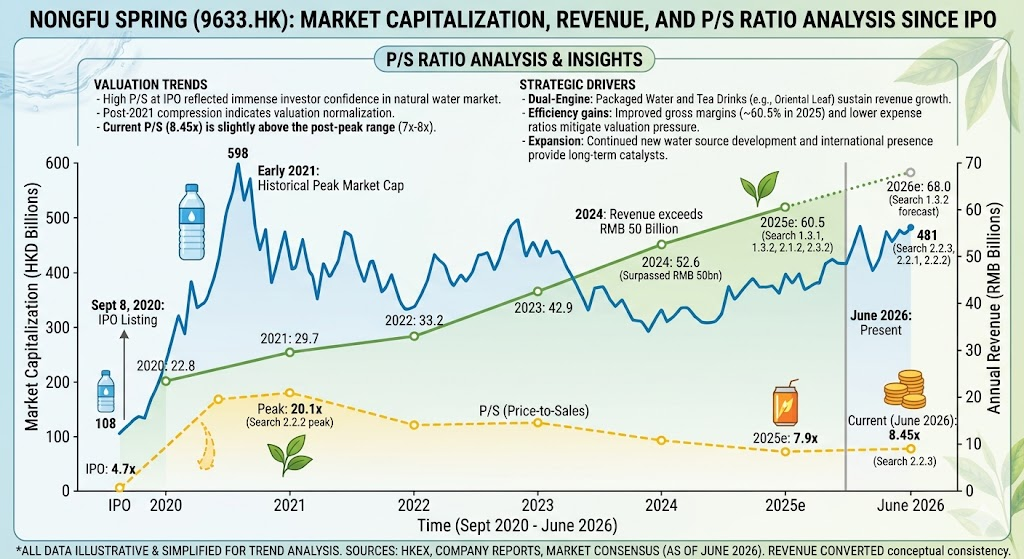
Nongfu Spring (9633.HK) adopts a “dual-engine” growth strategy driven by packaged drinking water and non-alcoholic beverages in the Chinese soft drink market. As the industry enters a stage characterized by health-consciousness and category segmentation, the company faces distinct competitive landscapes and rivals across its core battlegrounds.
The competitive analysis for Nongfu Spring is outlined below:
1. Packaged Drinking Water Market: Oligopoly and Price Wars
In the bottled water sector, Nongfu Spring has long maintained the number one position in retail value market share (approximately 25%-28%), but it faces fierce pincer attacks from traditional giants and regional brands.
- Core Competitors:
- CR Beverage (C’estbon): The leader in the purified water segment (holding nearly 40% share) and the most direct competitor to Nongfu Spring. It focuses heavily on sports marketing and penetration into lower-tier markets.
- Master Kong, Wahaha: Possess extremely strong distribution network penetration in lower-tier markets and low-to-mid-end price tiers. Since 2024, driven by public opinion events and intensified market competition, Wahaha has launched a powerful offensive across offline channels.
- Ganten (Baisui Mountain): Monopolizes the premium tier of natural mineral water (3 RMB and above), posing direct pressure on Nongfu Spring’s high-end water series.
- Competitive Dynamics: In 2024, Nongfu Spring launched its “green bottle purified water” to directly penetrate C’estbon’s core territory, triggering a fierce price war with prices dropping below 1 RMB per bottle to defend its market share and shelf space.
2. Tea Beverage Market: Absolute Dominance of Sugar-Free Tea and Multi-Brand Siege
Ready-to-drink (RTD) tea has been the core engine of profit growth for Nongfu Spring in recent years. Its brands “Oriental Leaf” and “Tea π” have demonstrated exceptionally strong performance.
- Core Competitors:
- Suntory: The pioneer of sugar-free oolong tea in China, which together with Oriental Leaf carved up nearly 80% of the early sugar-free tea market. It possesses strong brand equity in dining and convenience store channels.
- Master Kong, Uni-President: The rulers of traditional (sweetened) tea drinks. In recent years, both have accelerated their shift toward the sugar-free tea track (such as Master Kong’s Pure Tea series and Uni-President’s Chai Li Won), utilizing their nationwide distributor networks to squeeze Nongfu Spring’s shelf space.
- Genki Forest, Guo Zi Shu Le, and other emerging brands: Excel in internet marketing and rapid product iteration, attracting younger demographics through differentiated flavor profiles featuring “0 sugar, 0 fat, 0 calories.”
- Competitive Dynamics: The sugar-free tea segment has shifted from a red-hot dividend period into an era of intense internal competition. The focus of competition has transitioned from early “concept popularization” to “flavor innovation (such as barley tea and green citrus pu’er)” and “value for money (large-format packaging).”
3. Functional Drinks and Fruit Juice Markets: Defense and Breakthrough in Niche Segments
- Functional Drinks (Scream, Victory Vitamin Water): Main rivals are Dongpeng Beverage (Dongpeng Special Drink) and Red Bull. Dongpeng Beverage has maintained high-speed growth exceeding 30% in recent years, heavily eating into the shelf space of energy drinks. Nongfu Spring primarily adopts defensive and differentiated strategies targeting niche segments (such as sports and children) for this category.
- Fruit Juice Beverages (Nongfu Orchard, Water Melting C100, 17.5°): Main competitors include Coca-Cola (Minute Maid), Uni-President (More Juice), and emerging cold-chain juice brands. Nongfu Spring maintains steady growth by leveraging high-purity and health-oriented (high Vitamin C) concepts.
Comprehensive Competitive Advantages and Strategic Challenges
Core Moats
- Water Source Barriers: The company has secured 12 premium natural water sources across China (such as Qiandao Lake and Changbai Mountain) with long-term mining rights or water extraction permits. The transportation radius for natural water is logistically constrained, making asset-heavy water source layouts an exceptionally high barrier to entry.
- Exceptional Profitability: The consolidated gross margin has long sustained a level of nearly 60%, far exceeding the industry average. High margins provide the company with ample financial buffer for price wars, channel subsidies, and new product R&D.
- Distribution Depth: Possesses a distributor network covering millions of retail terminals across China, coupled with fully automated production lines, ensuring extreme supply chain resilience.
Strategic Challenges Faced
- Brand Image and Public Relations Risks: As a mega-brand, the company is highly susceptible to shocks from social media public opinion volatility (for instance, the PR crisis in the first half of 2024 directly led to a decline in packaged water revenue), driving up the cost of brand equity maintenance.
- Raw Material Cost Volatility: The primary packaging material for bottled water and beverages is PET plastic (which is positively correlated with crude oil prices). Geopolitical tensions driving fluctuations in crude oil and commodity prices pose a potential squeeze on the company’s gross margins.
- Intensified Industry Involution: Across both packaged water and sugar-free tea, major competitors are increasing investments in price subsidies and exclusive cooler placements through 2025 and 2026, making the maintenance of double-digit growth increasingly difficult.
Source:
Back to Nongfu Spring page