
History www.nomura-trust.co.jp
Founding and Early Domestic Expansion(1925–1960s) Founded in Osaka in December 1925 by Tokushichi Nomura II, the company spun off from the securities department of Nomura Bank(now part of Resona Bank). It focused initially on the domestic bond market and subsequently led the retail distribution of Japanese public equity and investment trusts during the post-war economic miracle.
Global Push and Bubble-Era Dominance(1970s–1990s) Nomura internationalized rapidly across London, New York, and European financial capitals, underwriting sovereign debt and cross-border securities. During Japan’s asset-bubble zenith in the late 1980s, Nomura briefly became the world’s most profitable financial institution, though it faced substantial restructuring, market slumps, and regulatory scrutiny following the bubble’s collapse.
Lehman Acquisition and Global Volatility(2000s–2010s) In 2001, the group adopted a holding company framework. In 2008, Nomura made a decisive bid for global scale by acquiring Lehman Brothers’ European and Asian franchises. Integrating Lehman proved costly, resulting in prolonged overseas losses, cultural friction, and repeated structural cost-reduction programs over the next decade.
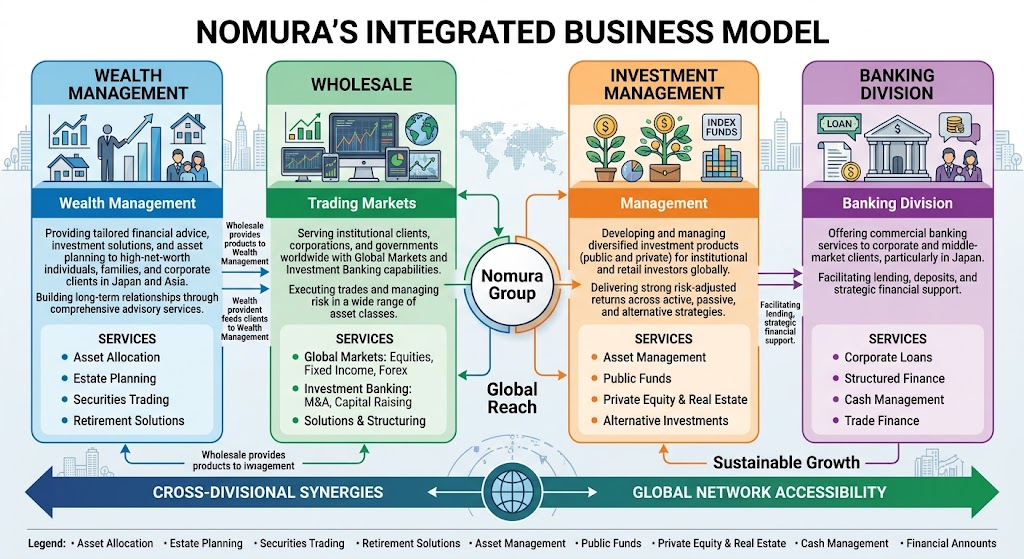
Structural Pivot and Multi-Pillar Strategy(2020s–Present) Following substantial hits in US prime brokerage in 2021, management accelerated structural reforms to pivot away from balance-sheet-heavy wholesale risks. The firm restructured its core into four operating pillars—Wealth Management, Investment Management, Wholesale, and the newly carved-out Banking Division—emphasizing fee-based recurring assets and disciplined capital allocation.
Business Model and Strategy Nomura
Nomura generates revenue across four primary operating divisions rather than functioning as a traditional balance-sheet lender.
1. Wealth Management(Domestic Retail)
Nomura
- How It Makes Money: Historically reliant on flow-based brokerage commissions(trading stocks, retail bonds, and newly launched mutual funds), this segment has systematically transitioned to a recurring fee model. It earns management fees on discretionary investment contracts, advisory fees, and ongoing fund administration fees calculated as a percentage of client recurring revenue assets.
- Scale and Numbers: Wealth Management achieved net revenue of JPY 133.1 billion and pretax income of JPY 61.2 billion in Q4 FY2025/26, with recurring revenue assets expanding past JPY 23.5 trillion toward a multi-year target of JPY 37 trillion.
2. Wholesale(Global Markets & Investment Banking)
Nomura
- How It Makes Money:
- Global Markets: Executes client trades, provides liquidity, and captures bid-ask spreads across fixed income, foreign exchange, commodities, and cash equities.
- Investment Banking: Collects advisory fees on M&A mandates and underwriting fees from initial public offerings(IPOs) and secondary debt and equity issuances.
- Scale and Numbers: The division logged quarterly net revenue of JPY 308.1 billion in Q4 FY2025/26. Strategy emphasizes cross-border Japan-related M&A and capital-efficient financing rather than high-risk uncollateralized lending. Nomura
3. Investment Management
Nomura
- How It Makes Money: Asset management base fees and performance incentives charged on both public market assets(equities, fixed income, ETFs) and high-margin private/alternative assets(private equity, infrastructure, real estate, private credit).
- Scale and Numbers: Net revenue reached JPY 86.2 billion in Q4 FY2025/26. Assets under Management(AuM) expanded to JPY 136.9 trillion, aided by organic inflows and bolt-on acquisitions(such as Macquarie’s US/European public asset management business) targeting a long-term goal of over JPY 150 trillion. Nomura
4. Banking Division
Nomura
- How It Makes Money: Established in April 2025 as an independent operational pillar, it generates net interest income on secured loan portfolios and investment trust balances, supporting deposit-sweep mechanisms across retail brokerage accounts. It logged JPY 14.5 billion in net revenue in Q4 FY2025/26 with a loan balance targeting JPY 2.8 trillion.
Sources Nomura
- https://www.nomuraholdings.com/en/news/nr/nhi20260424a.html
- https://www.nomuraholdings.com/doc/en/investor/library/ar/report/2025_23_46.pdf
- https://plus.nomuraholdings.com/en/latest/20250428-FY202503-4Q-Full-Year-Highlights.html
- https://www.nomura.com/europe/switzerland/resources/upload/NBS-Annual-Report-24-25.pdf
AI Strategy, Partnerships, and Budget
Nomura views artificial intelligence not merely as a back-office automation utility, but as a critical driver for alpha generation, risk surveillance, and mass-affluent wealth personalization.
- Strategic Partnerships and Initiatives:
- OpenAI Partnership: In late 2025, Nomura formalized a strategic collaboration with OpenAI to deploy enterprise-grade generative AI and reasoning-agent infrastructure across its investment management and research platforms. The deployment integrates tools like OpenAI Deep Research into analyst workflows to synthesize complex macro datasets, automate document extraction, and accelerate thematic fundamental analysis. Nomura
- Algorithmic Execution and Alpha Generation: In wholesale markets, Nomura continues expanding proprietary machine-learning execution algorithms within its Instinet trading subsidiary and internal FX/rates market-making platforms to minimize execution slippage and manage real-time inventory risk.
- Front-Office Wealth Advisory Support: Rolling out predictive client analytics and AI-assisted financial planning engines to provide relationship managers with tailored portfolio rebalancing proposals based on client risk tolerance and behavioral patterns.
- Technology Budget and Resource Allocation:
- Group IT and digital transformation operating expenditure averages between JPY 150 billion and JPY 200 billion annually, with approximately 15% to 20% of discretionary software development budgets directed toward advanced data infrastructure, cloud modernization, and generative/predictive AI integrations.
- Investments focus strictly on secure internal private clouds and compliance-compliant sandbox environments to meet Japanese FSA and global regulatory safeguards regarding algorithmic fairness, insider data isolation, and customer privacy.
back to Nomura