
History and Evolution GamesIndustry.biz
- The Early and Toy Era (1889-1970s): Founded by Fusajiro Yamauchi as a manufacturer of handmade hanafuda playing cards, the company expanded into various business ventures through the mid-20th century—including taxi services and love hotels—before pivoting toward electronic toys and arcade games in the 1970s under Hiroshi Yamauchi.
- The Pioneer of Console Gaming (1980s-1990s): Nintendo revolutionized the home entertainment industry with the release of the Nintendo Entertainment System (NES) in 1983 and the Game Boy in 1989, rescuing the video game market from the 1983 crash and establishing dominant first-party game design philosophies.
- The Transitional and Niche Era (2000s-2010s): Following the massive success of the Nintendo DS and Wii, the company suffered a major strategic misstep with the Wii U (2012), which suffered from weak third-party support and poor consumer positioning, leading to substantial financial losses.
- The Modern Hybrid and Ecosystem Era (2017-Present): Nintendo rebounded strongly with the launch of the hybrid Nintendo Switch console in 2017, followed by the rollout of the next-generation Switch 2 hardware ecosystem, expanding digital download revenues and transmedia entertainment investments like feature-length films.
Business Model and Growth Strategy
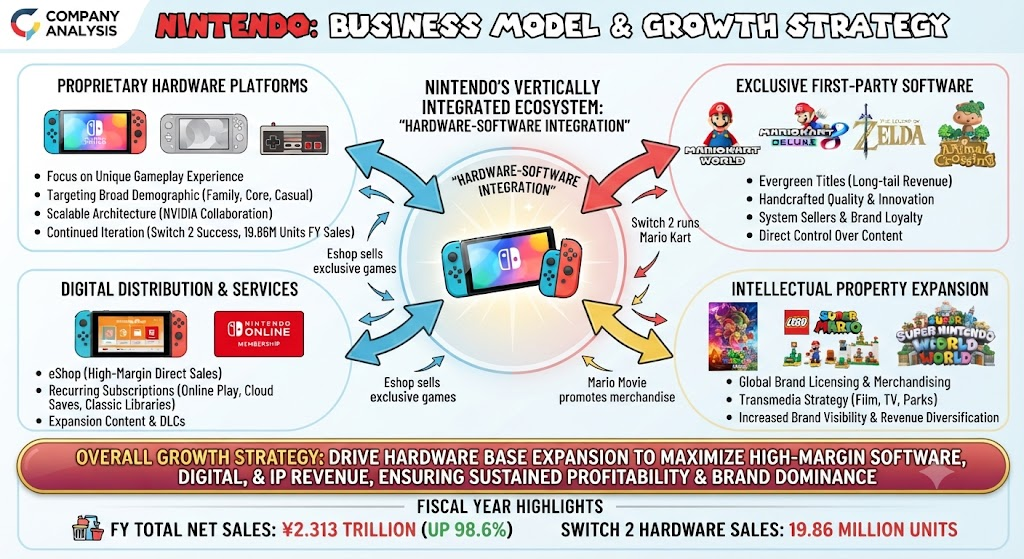
Nintendo operates on a vertically integrated ecosystem model, generating revenue by tightly coupling proprietary hardware sales with exclusive first-party software development. Rather than competing purely on raw hardware processing power, the company leverages unique gameplay mechanics, iconic intellectual properties, and dedicated digital storefronts.
FourWeekMBA
According to Nintendo’s fiscal year financial results, net sales reached 2.313 trillion yen (approximately 14.76 billion dollars), representing a 98.6 percent year-over-year surge driven heavily by the global rollout of the Switch 2, which achieved 19.86 million hardware units sold by March 31, 2026. The company’s primary revenue streams consist of hardware sales, physical and digital software distribution via the Nintendo eShop, recurring subscription fees from Nintendo Switch Online services, and intellectual property licensing, including box-office and merchandise royalties. Digital sales continue to play an expanding structural role, while evergreen software titles such as Mario Kart World and Mario Kart 8 Deluxe generate long-tail cash flows.
Nintendo World Report
References SQ Magazine
- https://wnhub.io/news/finance/item-50786
- https://www.gamesindustry.biz/nintendo-fy-sales-soar-986-to-146bn-following-launch-of-switch-2
- http://www.nintendoworldreport.com/news/75489/nintendo-announces-2025-26-financial-results-and-guidance-for
- https://sqmagazine.co.uk/nintendo-statistics/
Artificial Intelligence Strategy and Implementation
Nintendo maintains a conservative and highly selective approach toward artificial intelligence, prioritizing artistic integrity, proprietary control, and player safety over automated generative pipelines. Unlike many competitors, executive leadership has repeatedly expressed caution regarding generative AI, emphasizing that Nintendo’s core creative value lies in handcrafted game design and unique human-crafted gameplay experiences rather than automated asset generation.
Despite avoiding broad generative AI models for core creative content, Nintendo utilizes machine learning and data analytics internally for quality assurance, automated bug testing, performance optimization across varying hybrid hardware states, and algorithmic telemetry tracking within its digital eShop infrastructure. Financial budgets for AI integration are embedded directly into internal research and development expenditures rather than disclosed as standalone line items. Strategic collaborations focus primarily on hardware silicon partnerships—such as working closely with NVIDIA on custom scalable processor architectures, deep learning super sampling (DLSS) support for the Switch 2 platform, and secure cloud infrastructure management—ensuring that hardware performance optimization remains tightly controlled without relying on external generative software vendors.
back to Nintendo