
NextEra Energy Corporate History
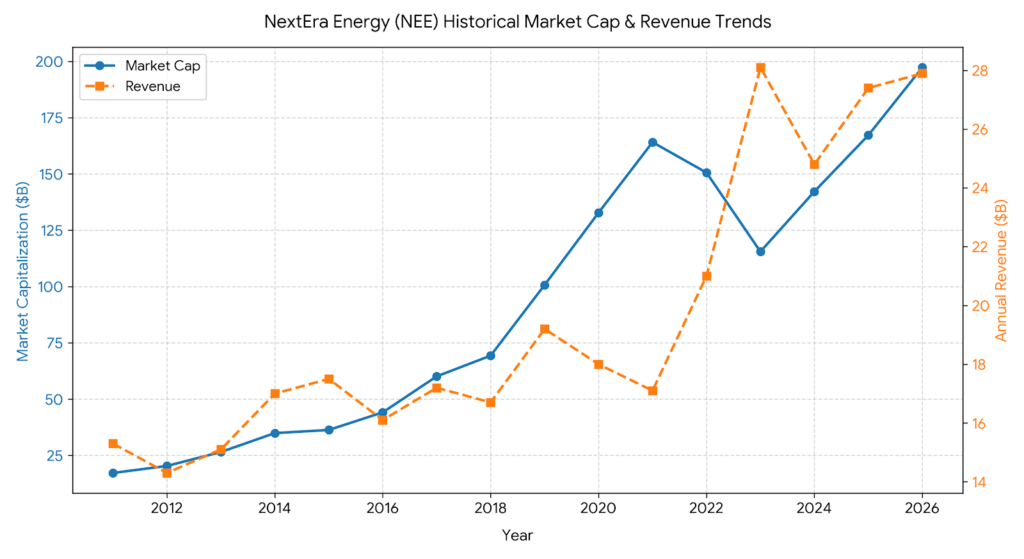
The evolution of NextEra Energy is a remarkable journey from a traditional local utility into a global clean energy titan. Its historical trajectory can be broadly divided into four key eras:
Founding and Regional Grid Consolidation (1925 to 1984)
The company’s roots date back to 1925 with the establishment of Florida Power & Light Company (FPL). In its early days, the company aggregated local ice plants, power stations, and water utilities to build a unified power grid in Florida. Following World War II, fueled by Florida’s massive population and economic boom, FPL aggressively expanded its coal and oil-fired generation capacity, and later introduced nuclear power in the 1970s, establishing itself as the state’s dominant regulated utility.
Corporate Diversification and Geographic Expansion (1984 to 2000)
To pursue growth opportunities beyond the constraints of a regulated market, the company reorganized in 1984 under a new holding company, FPL Group. In 1989, it formed a non-regulated independent power producer subsidiary (which later became NextEra Energy Resources) to expand beyond Florida. During this period, the company began investing in competitive energy projects and acquired its first wind farm in 1998, marking the official beginning of its green transition.
Renewable Energy Leadership and Rebranding (2000 to 2014)
At the turn of the century, FPL Group solidified its long-term strategy centered around renewable energy. Capitalizing on federal tax credits for wind and solar, the company aggressively built out utility-scale green energy projects across North America. In 2010, to better reflect its identity as a forward-looking clean energy pioneer, FPL Group officially rebranded as NextEra Energy. In 2014, the company launched NextEra Energy Partners (NEP), a publicly traded yieldco designed to acquire, manage, and own contracted clean energy projects.
Massive Scaling and Leading the Energy Transition (2014 to Present)
NextEra Energy has continuously fortified its position as the world’s largest producer of wind and solar energy. In 2019, the company completed the acquisition of Gulf Power, expanding its regulated utility footprint in Florida, and subsequently integrated it into FPL. Driven by the recent surge in electricity demand from AI data centers, the company has ramped up investments in battery storage systems (BESS) and green hydrogen technologies. It continues to advance its “Real Zero” blueprint, aimed at completely eliminating carbon emissions from its operations by 2045.
NextEra Energy Competitive Analysis
NextEra Energy (NEE) occupies a highly unique competitive positioning in the market, effectively blending the defensive nature of a regulated utility with the high-growth potential of an independent power producer and renewable energy developer.
Its competitive landscape is shaped by two traditional peer groups and one rapidly evolving frontline market:
1. Regulated Utility Peers
This peer group primarily competes with NextEra’s flagship subsidiary, Florida Power & Light (FPL), regarding regional regulatory policies, grid infrastructure investments, and baseline profitability.
- Duke Energy (DUK)
- Competitive Dynamics: Operating approximately 60 GW of generation capacity, Duke directly competes with FPL in the Florida market, as well as in the Carolinas. Duke’s aggressive expansion into solar and nuclear makes it a primary rival for regional grid modernization and regulatory rate-case outcomes.
- Southern Company (SO)
- Competitive Dynamics: As the dominant energy provider in the southeastern U.S., Southern Company serves roughly 9 million customers. With its newly operational Vogtle nuclear units (adding around 3.2 GW of zero-carbon baseload power), Southern offers a reliable baseload profile that complements and competes against NextEra’s heavy intermittent wind and solar mix.
- Dominion Energy (D)
- Competitive Dynamics: Centered in Virginia, Dominion is aggressively advancing massive offshore wind initiatives, such as the 2.6 GW Coastal Virginia Offshore Wind project. Dominion serves as a key model competitor should NextEra choose to scale up its own offshore wind presence.
- Financial & Structural Comparison:Traditional peers like Dominion and Southern rely more heavily on regulated utility earnings (representing roughly 80% to 90% of their EBITDA mixes) compared to NextEra (around 70% to 75%), which grants them a slightly more defensive profile. However, NextEra counters with a superior balance sheet; its projected FFO leverage sits around 4.3x, comfortably ahead of Southern and Dominion, both of which hover near 5.0x.
2. Global Renewable Energy Developers
This segment goes head-to-head with NextEra Energy Resources (NEER) in bidding for global renewable assets and securing corporate Power Purchase Agreements (PPAs).
- Brookfield Renewable Partners (BEP)
- Competitive Dynamics: One of the world’s largest pure-play renewable asset managers. Armed with globally flexible institutional capital and a low cost of funding, Brookfield routinely challenges NextEra in securing large-scale corporate PPAs and global project portfolios, putting pressure on asset yields.
- AES Corporation (AES) & Fluence
- Competitive Dynamics: A global power infrastructure giant whose joint venture, Fluence, is a market leader in battery energy storage systems (BESS). AES poses a strong commercial and technological threat in the “solar + storage” co-location market, a sector NextEra considers vital to its future growth.
- Oil Majors & International Utilities:Players like Invenergy, Orsted, Enel Green Power, and European oil giants (Shell, TotalEnergies, BP) actively vie for the same project footprints, driving up competitive land lease rates and interconnection auction prices across North America.
3. The New Frontier: AI Data Center Power Demand (24/7 CFE)
The massive power needs of hyperscalers (Amazon, Google, Microsoft, Meta) to fuel AI infrastructure have created a brand-new competitive arena focused on 24/7 Carbon-Free Energy (CFE).
- Nuclear Pure-Plays: Constellation Energy (CEG) & Vistra (VST)
- Competitive Dynamics: This represents NextEra’s most notable emerging competitive headwind. While NextEra remains the undisputed leader in wind and solar execution—planning to add an ambitious 36.5 GW to 46.5 GW of renewables and storage through 2027—hyperscalers are increasingly prioritizing uninterrupted, 24/7 clean baseload power. Constellation, boasting the nation’s largest unregulated nuclear fleet, has captured massive premiums by signing direct colocation contracts with tech giants. While NextEra possesses its own nuclear assets, the pure-play nuclear fleets of CEG and Vistra represent a powerful alternative for AI developers seeking immediate grid reliability.
Competitive Matrix Summary
| Dimension | NextEra Energy (NEE) Advantage | Key Competitive Threats |
| Capital & Scale | Largest market cap in the utility sector; immense purchasing power and supply chain resilience. | Low-cost private capital and infrastructure funds (e.g., Brookfield) squeezing asset returns. |
| Regulated Core | FPL benefits from Florida’s robust population growth and favorable regulatory environment. | Rising grid hardening costs and regional expansion from peers like Duke. |
| AI & Tech Demand | Dominant player in solar + BESS configurations tailored for corporate ESG goals. | Nuclear giants (Constellation) capturing high-premium AI contracts via 24/7 baseload availability. |
Source:
- https://www.nexteraenergy.com
- https://www.fpl.com
- https://www.nexteraenergyresources.com
- https://www.nexteraenergypartners.com
- https://www.macrotrends.net
- https://companiesmarketcap.com
Back to NextEra page