
Corporate History
Early Foundation and Telephony Joint Venture (1899–1945)
NEC was founded in 1899 by Kunihiko Iwadare as a joint venture with Western Electric, making it the first foreign joint venture in modern Japanese history. The company initially manufactured telephone equipment and switchboards, establishing itself as the primary communications equipment supplier for Japan’s Ministry of Communications. During the 1920s and 1930s, NEC expanded into radio broadcasting infrastructure, electron tubes, and defense communication systems.
Post-War Electronics and the “C&C” Era (1950s–1980s)
In the post-World War II period, NEC emerged as a major industrial heavyweight across telecommunications, mainframes, and semiconductors. In 1977, CEO Koji Kobayashi formulated NEC’s corporate philosophy of “C&C” (Computers and Communications), anticipating the convergence of telecommunication networks and computing technologies. During the 1980s, NEC became the world’s largest semiconductor manufacturer by revenue and dominated the Japanese personal computer market with its proprietary PC-9800 architecture.
Market Disruption, Restructuring, and Core Divestitures (1990s–2010s)
The 1990s and 2000s exposed NEC to intense price competition from Taiwanese and South Korean semiconductor foundries, modular personal computers, and mobile equipment manufacturers. This margin collapse prompted a decade-long restructuring:
- Divested its semiconductor foundry operations via the spin-off of Elpida Memory and Renesas Electronics (2010).
- Formed a PC joint venture with Lenovo in 2011, relinquishing majority operating control.
- Discontinued its loss-making smartphone business in 2016.
- Divested Biglobe internet services (2014) and display panel businesses (2020).
Digital Transformation and Mission-Critical Infrastructure (2018–Present)
Starting in 2018, NEC redirected capital toward high-margin recurring enterprise software and public-sector digital identity solutions. It executed targeted overseas acquisitions including Northgate Public Services (UK, 2018, now NEC Software Solutions UK), KMD Holding (Denmark, 2019), and Avaloq Group (Switzerland, 2020) for core banking platforms. In its Mid-term Management Plan 2025 cycle, NEC accelerated consolidation across IT services, rebranded its enterprise digital value creation architecture as “NEC BluStellar”, and deepened its commitment to Japan’s domestic defense and economic security sectors.
Business Model and Growth Strategy
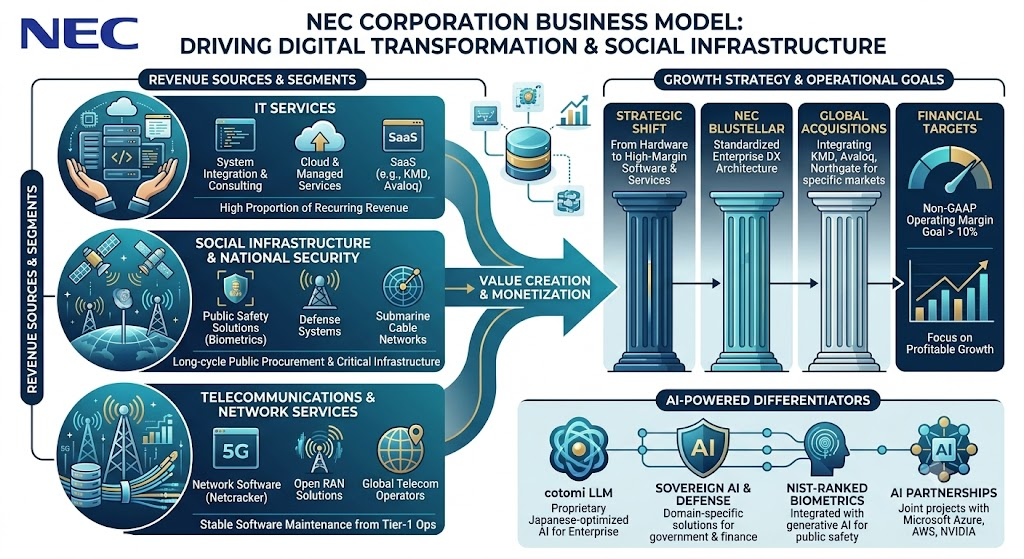
NEC operates primarily as an enterprise IT systems integrator and mission-critical infrastructure provider. Rather than depending on mass hardware distribution, NEC monetizes through long-cycle public procurement, system integration fees, managed service contracts, recurring software licenses, and specialized capital-infrastructure projects.
The company monetizes across three primary segments:
- IT Services (Core Profit Engine):
- Monetization Mechanics: Hybrid revenue model combining upfront systems implementation/consulting fees with high-margin recurring application maintenance, outsourcing, and cloud-managed services for municipal agencies, tax bureaus, healthcare networks, and enterprise clients.
- Global Software Assets: Generates recurring SaaS subscriptions and license maintenance via specialized acquired platforms—Avaloq for wealth management core banking, and KMD for Danish central government payroll and administrative workflows.
- Financial Contribution: In fiscal 2025, IT Services delivered consolidated revenues of ¥1,755.0 billion to ¥1,800.0 billion, generating adjusted operating profits above ¥177.0 billion. Under its value creation architecture “BluStellar”, which standardizes enterprise DX deployment, BluStellar-related revenue reached ¥705 billion with a non-GAAP operating margin of 14.5%.
- Social Infrastructure & National Security:
- Monetization Mechanics: Multi-year, high-barrier defense contracts and infrastructure installations. NEC provides radar, satellite ground terminals, cybersecurity systems, and aerospace defense hardware to the Japan Ministry of Defense. It is also one of the three dominant global suppliers of transoceanic optical submarine cable networks (competing with SubCom and ASN).
- Financial Contribution: Delivers approximately ¥1,062.2 billion to ¥1,085.0 billion in revenue, with adjusted operating profit around ¥73.8 billion to ¥95.0 billion. The ongoing expansion of Japan’s national defense budget (projected domestically to reach ¥43.5 trillion over the mid-term framework) serves as an earnings tailwind for NEC’s command-and-control communication deployments.
- Telecommunications & Network Services:
- Monetization Mechanics: Telecom core network software, OSS/BSS platforms (operated primarily through its Netcracker Technology subsidiary), and Open RAN radio unit deployments. Netcracker generates stable, high-margin software maintenance from global tier-1 telecom operators, offsetting lower margins incurred in customized wireless base station hardware.
Strategic Pivot:
NEC’s growth strategy centers on shifting its non-GAAP operating margins from historical levels (~6%) to double digits (achieving 10.8% adjusted operating margin and ¥386.8 billion in adjusted operating profit in its 2025 plan review). The company achieves this by raising the proportion of recurring IT revenue, retiring low-margin sub-contracting hardware deployments, making its system integration subsidiary NEC Networks & System Integration (NESIC) a wholly owned entity, and redeploying free cash flow toward defense and sovereign cloud environments.
Business Model Information Sources
- https://group.nec/assets/global/en/about/ir/library/annual/pdf/2025/ar2025-e.pdf
- https://seekingalpha.com/article/4906099-nec-corporation-necpy-discusses-progress-and-strategic-priorities-in-midterm-management-plan
- https://www.nec.com/en/press/202307/images/1902-01-01.pdf
- https://umbrex.com/resources/company-profiles/nec-corp/
AI Development Strategy, Budget, and Partnerships
NEC’s artificial intelligence strategy focuses on Sovereign, Enterprise-Grade Generative AI designed for regulated industries, defense, and high-confidentiality Japanese enterprise environments where external public cloud models pose data governance concerns.
Core Proprietary Architecture: cotomi
- In 2023, NEC released its proprietary large language model (LLM), cotomi, engineered specifically for high-speed Japanese text comprehension and domain-specific knowledge integration.
- Performance Enhancements: NEC expanded cotomi’s context window to 128K tokens (exceeding 200,000 Japanese characters) and integrated Model Context Protocol (MCP) standards to establish autonomous agent capabilities. These agents interpret complex business instructions, execute task planning, access external APIs, and run multi-step administrative workflows.
Infrastructure and R&D Capital Allocation
- NEC allocates roughly ¥110 billion to ¥120 billion annually toward overall corporate research, development, and digital transformation initiatives.
- Domestic Supercomputing Power: To train cotomi and proprietary computer vision models, NEC constructed a dedicated corporate AI supercomputer in Japan equipped with thousands of high-performance NVIDIA GPUs. This infrastructure provides domestic data sovereignty, enabling financial institutions and central government bodies to leverage generative AI within domestic borders.
Commercial Applications and Case Studies
- Healthcare and Pharmaceuticals: NEC partnered with institutions such as the National Cancer Center Japan to deploy AI algorithms for colorectal polyp identification during endoscopic examinations and genomic medicine analysis.
- Public Safety and Biometrics: NEC’s facial recognition algorithm (ranked repeatedly among the top performers in NIST evaluation tests) is combined with multimodal generative AI for automated video analysis in border security, airport automated gates (Star Alliance Biometrics), and disaster-response monitoring.
- Financial & Enterprise DX: NEC deployed internal cotomi instances across its 100,000+ employee base, reporting routine internal engineering software productivity improvements above 30%, and launched commercial domain-tailored LLM offerings for banks and legal review desks.
Strategic Alliances and Ecosystem Integration
- Box: NEC became the first Japanese domestic independent software vendor (ISV) partner to join Box’s MCP server program, integrating cotomi with Box’s intelligent enterprise content management repository to automate enterprise knowledge retrieval.
- Microsoft & AWS: While advancing cotomi, NEC operates a pragmatic hybrid ecosystem approach, maintaining multi-year enterprise transformation alliances with Microsoft Azure and Amazon Web Services to deploy hybrid cloud environments and OpenAI models for enterprise customers demanding global architectures alongside domestic sovereign stacks.
- NVIDIA: Collaborates on edge-computing AI frameworks and accelerated computing infrastructure for smart city vision analytics and Open RAN telecom intelligent controller (RIC) software.
back to NEC