
History of Murata Manufacturing
- Foundation and Early Years (1944 to 1950s): Founded in October 1944 by Akira Murata in Kyoto, the company started as a small workshop manufacturing titanate ceramic components for electronic applications, shifting its focus toward ceramic capacitors as post-war Japanese electronics began to expand.
- Global Expansion and Technological Scaling (1960s to 1990s): Murata established its first international sales and manufacturing subsidiaries in the United States and Europe during the 1960s and 1970s, scaling its proprietary material science capabilities to mass-produce piezoelectric components, ceramic filters, and sensors.
- Diversification and Strategic Acquisitions (2000s to Present): The company aggressively expanded its product perimeter through major transactions, including the acquisition of Peregrine Semiconductor in 2014 for radio-frequency dominance, Sony’s battery business in 2017 to target energy devices, and Resonant Inc. in 2022 to advance high-frequency filter technologies.
Business Model and Growth Strategy
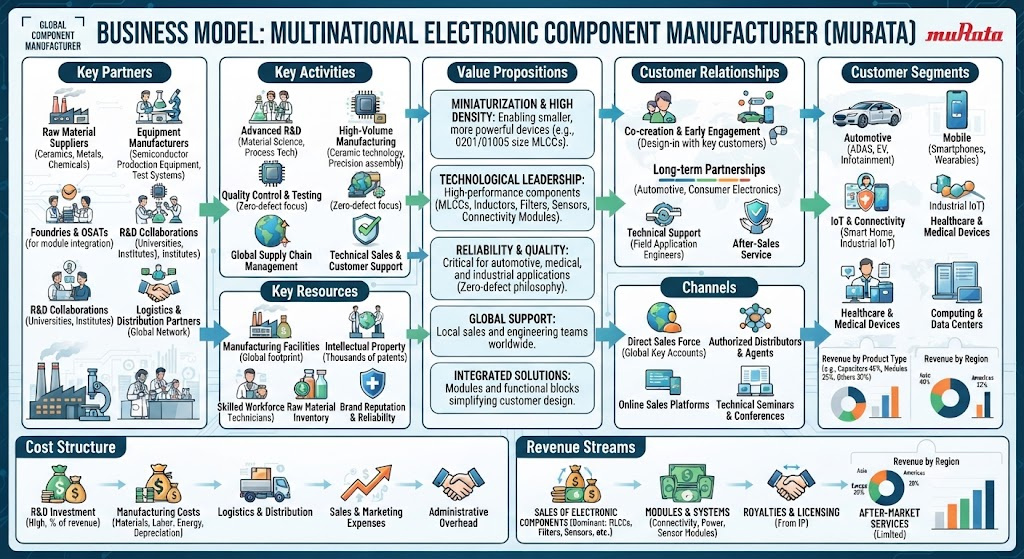
Murata generates revenue not through recurring subscriptions, but via high-volume, repeat-driven sales of proprietary electronic components integrated into customer device platforms. Its core commercial strength relies on a “design-in” business model, where Murata collaborates directly with global device manufacturers during the early R&D phase to embed its specialized components into next-generation hardware. This creates high switching costs and deep customer lock-in.
The company achieves robust operating leverage because its manufacturing lines involve substantial upfront capital expenditures and advanced material science know-how. Once factory utilization crosses break-even thresholds—driven by intense demand cycles such as the recent surge in AI server deployments—incremental revenue translates into high marginal profitability. For instance, Murata reported a record book-to-bill ratio of 1.24x, signaling heavy forward order momentum, and subsequently raised its operating profit forecast for the fiscal year ending March 2027 to ¥430 billion on projected net sales approaching ¥2 trillion.
Sources
- https://umbrex.com/resources/company-profiles/murata-manufacturing-co-ltd/
- https://finance.biggo.com/news/5de180ed-5c94-4221-86d9-d7ab7b1ac588
- https://www.gurufocus.com/news/8994438/murata-manufacturing-raises-profit-forecast-amid-strong-ai-component-demand
AI Development Strategy and Investments
Murata’s AI strategy centers on capitalizing on the exponential surge in electronic component density required by generative AI data centers, AI servers, and high-performance computing infrastructure. An advanced AI server utilizes thousands of specialized multilayer ceramic capacitors (MLCCs) and high-performance inductors—often scaling up to 10,000 units per server—to manage severe power fluctuations, noise suppression, and thermal dissipation.
To support this demand, Murata is channeling capital expenditure into expanding high-capacitance, miniaturized MLCC production lines and high-frequency connectivity modules optimized for AI data infrastructure. Driven directly by this AI hardware boom, Murata upgraded its consolidated financial outlook, projecting an operating profit of ¥430 billion, backed by an operating profit margin target exceeding 18% under its medium-term business framework. The company collaborates closely with global hyperscalers, tier-one server original design manufacturers, and semiconductor logic providers to co-design power delivery networks that can withstand the intense voltage loads demanded by next-generation artificial intelligence accelerators.
back to Murata Manufacturing