
Market Position and Market Share
Mowi ASA is the world’s largest producer of Atlantic salmon by both harvest volume and operational revenue.
- Global Ranking:Ranked #1 globally in salmon farming and total aquaculture market capitalization.
- Global Market Share:Controls approximately 20% of the global farmed Atlantic salmon market.
- Volume Metrics:Achieved an annual harvest volume of 501,530 gutted weight tonnes(GWT) in 2024 and reached 559,000 tonnes in 2025.
- Financial Scale:Generated annual operational revenues exceeding €5.7 billion, supported by farming operations across Norway, Scotland, Chile, Canada, Ireland, the Faroe Islands, and Iceland.
Upstream and Downstream Supply Chain Analysis and Key Suppliers
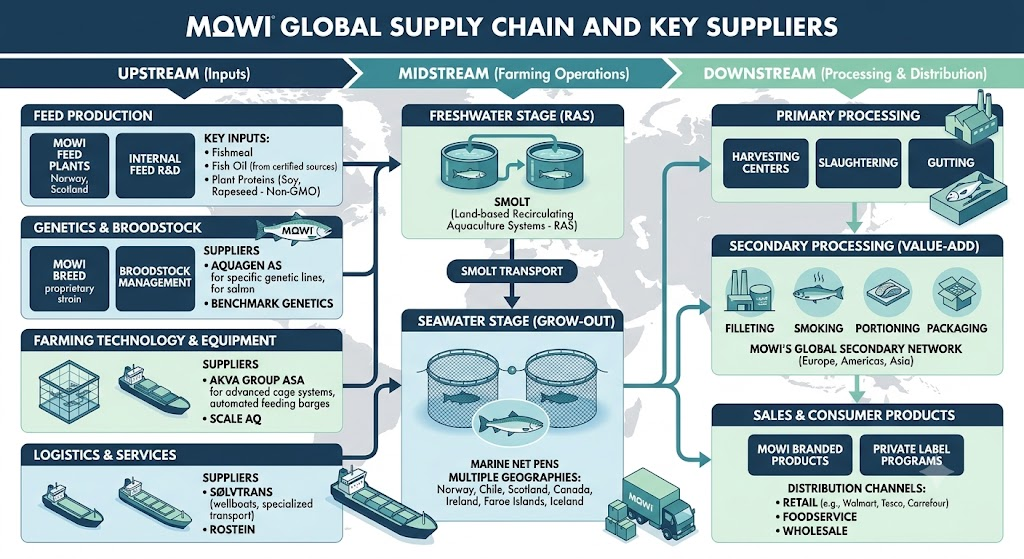
Mowi operates a fully integrated “feed-to-fork” aquaculture model across three core divisions: Feed, Farming, and Sales/Consumer Products.
- Upstream(Feed, Genetics, and Equipment):
- Feed Production: Unlike most peers that outsource feed entirely, Mowi runs an internal feed division with production facilities in Norway and Scotland, making its European farming operations largely self-sufficient in fish feed.
- Feed Ingredients: Mowi procures marine raw materials(fishmeal and fish oil) alongside plant proteins(non-GMO soy, rapeseed) from certified suppliers such as Cargill, BioMar, and specialized South American marine ingredient processors.
- Genetics and Broodstock: Mowi controls its proprietary genetic strain(the Mowi breed) originated from the Norwegian rivers Vosso and Årøy. It supplements internal breeding with external specialized genetics suppliers, primarily AquaGen AS and Benchmark Genetics.
- Farming Hardware and Systems: For cage systems, nets, automated feeding barges, and monitoring systems, key external suppliers include AKVA group ASA and Scale AQ. Wellboat transport and delousing vessels are contracted through shipping specialists such as Sølvtrans and Rostein.
- Midstream(Farming and Biological Lifecycle):
- Smolt and Post-smolt: Rearing occurs in freshwater land-based Recirculating Aquaculture Systems(RAS) before marine transfer. Mowi has heavily scaled its post-smolt strategy, growing juveniles to larger sizes on land to minimize open-sea exposure and biological hazards.
- Seawater Grow-Out: Fish spend 12 to 18 months in coastal seawater pens across seven distinct farming geographies until reaching harvest weight(4–5 kg).
- Downstream(Processing, Value-Added Products, and Distribution):
- Primary and Secondary Processing: Mowi owns an extensive secondary processing network across Europe, the Americas, and Asia, filleting, portioning, and smoking raw material.
- Distribution and Branding: Sells under the consumer-facing brand “MOWI” as well as private-label programs directly to retail giants(e.g., Sainsbury’s, Walmart, Costco, Carrefour) and foodservice networks worldwide.
Competitor Analysis
Mowi competes primarily against three listed North Atlantic salmon farming powerhouses: SalMar, Leroy Seafood Group, and Bakkafrost.
- Technical and Operational Comparison:
- Scale vs. Specialization: Mowi possesses unparalleled geographic diversification across multiple jurisdictions(Norway, UK, Chile, Canada), which insulates the business from regional biological crises but exposes it to varying local cost structures. SalMar focuses primarily on Norway and leverages world-class automated harvesting centers(e.g., InnovaMar) and offshore farming technology(Ocean Farm 1).
- Smolt Strategy: Bakkafrost leads the industry in large post-smolt production(averaging ~500g smolt before sea transfer), drastically reducing marine mortality and sea lice exposure.Mowi has invested over €600 million into expanding post-smolt capacity to reach 50% post-smolt share across key operations.
- Feed Integration: Mowi and Bakkafrost are the only major producers with proprietary feed plants, shielding them from third-party tolling margins. In contrast, SalMar and Leroy rely on long-term supply contracts with commercial feed giants(BioMar, Skretting, Cargill).
- Financial Comparison:
- EBIT Margins per Kilogram: SalMar consistently achieves the lowest unit production costs in the industry, frequently generating higher operational EBIT per kg in central and northern Norway compared to Mowi’s global average. Mowi’s Scottish and Canadian operations historically face higher biological costs and lower margins than its flagship Norwegian farming sites.
- Downstream Revenue Cushion: Mowi’s downstream Consumer Products arm acts as a counter-cyclical financial hedge. When global spot salmon prices drop, processing margins widen, allowing Mowi to sustain consolidated earnings and dividend distributions more effectively than pure-play farming peers.
Information Sources
- https://mowi.com/about-us/
- https://mowi.com/news/mowi-annual-report-2024/
- https://mowi.com/wp-content/uploads/2025/03/Mowi-Integrated-Annual-Report-2024-1.pdf
- https://mowi.com/wp-content/uploads/2025/05/Mowi-Annual-Report-2025.pdf
- https://www.mispeces.com/en/news/Mowis-global-results-show-a-salmon-farming-sector-growing-at-two-different-speeds/
- https://www.seafoodsource.com/news/business-finance/mowi-akva-set-up-global-frame-agreement
- https://ensun.io/search/aquaculture/norway
- https://www.bonafide-ltd.com/en/blog/margin-kings-bakkafrost-vs-salmar
- https://simplywall.st/stocks/no/food-beverage-tobacco/ob-salm/salmar-shares/news/mowi-stock-and-european-seafood-shares-worth-a-closer-look
Back to Mowi