
Corporate History by Era
Alpine Utilitarian Origins(1952–2002)
- 1952: René Ramillon and André Vincent founded Moncler in Monestier-de-Clermont near Grenoble, France, initially manufacturing quilted sleeping bags, tents, and functional hooded capes for mountain workers.
- 1954: French mountaineer Lionel Terray collaborated with Moncler to engineer the first down jackets designed to withstand extreme high-altitude expeditions, outfitting the Italian expedition to K2.
- 1968: Moncler became the official supplier to the French national alpine skiing team during the Grenoble Winter Olympics, introducing lighter, more ergonomic jackets and the rooster logo.
- 1980s–1990s: The brand gained urban street appeal via the Italian “Paninaro” youth subculture, yet subsequently suffered from fragmented licensing, inconsistent design direction, and near bankruptcy in the late 1990s.
Remo Ruffini Takeover and Luxury Repositioning(2003–2017)
- 2003: Italian entrepreneur Remo Ruffini acquired Moncler, terminated low-end licenses, shifted production to high-grade European factories, and re-anchored the brand at the intersection of alpine heritage and runway luxury.
- 2006–2009: Moncler launched the haute-couture Gamme Rouge line in Paris and Gamme Bleu in Milan, validating its presence on top-tier international runways.
- 2013: Moncler listed on the Borsa Italiana(Milan Stock Exchange) at a valuation of approximately €2.5 billion, attracting major institutional capital.
Digital Transformation and Brand Aggregation(2018–Present)
- 2018: Discontinued traditional bi-annual fashion shows to launch the Moncler Genius initiative, a rolling collaboration platform partnering with designers like Pierpaolo Piccioli, Rick Owens, and Pharrell Williams.
- 2021: Moncler completed the acquisition of Italian high-end technical sportswear brand Stone Island for €1.15 billion in cash and shares, establishing a dual-brand luxury sportswear conglomerate.
- 2024–2025: LVMH acquired a 10% stake in Double R, Remo Ruffini’s investment vehicle controlling Moncler S.p.A., providing strategic support and long-term shareholder stability.
Business Model and Strategic Monetization
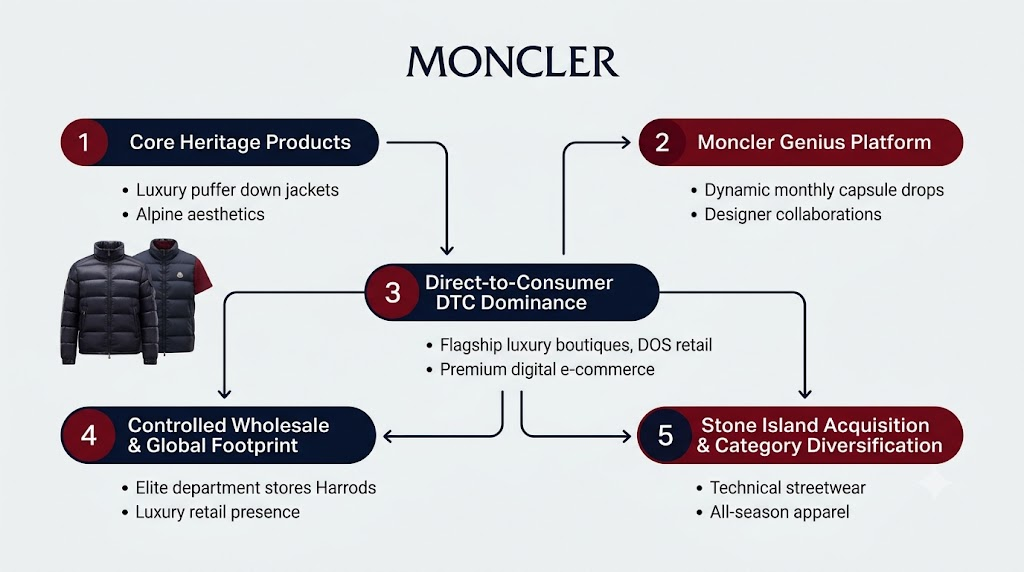
Moncler operates a classic high-margin luxury model characterized by strict direct-to-consumer(DTC) distribution control, prestige pricing architecture, and rapid drops to sustain pricing power and avoid markdown obsolescence.
Revenue Generation and Channel Economics
- Direct-to-Consumer(DTC) Dominance: Over 80% of Moncler brand consolidated revenue stems from its directly operated stores(DOS) and proprietary e-commerce platforms. Controlling the final point of sale enables gross margins exceeding 77% and operating(EBIT) margins between 28% and 30%.
- Wholesale Discipline: The wholesale channel contributes less than 20% of sales and serves strictly as brand positioning in elite multi-brand boutiques and luxury department stores(e.g., Harrods, Saks Fifth Avenue) rather than volume clearing.
- Geographic Balance: Asia(principally Greater China, Japan, and South Korea) generates approximately 45% to 50% of group revenue, EMEA accounts for roughly 35%, and the Americas represent 15% to 18%.
Moncler Genius Drop Strategy
- Instead of locking capital into six-month runway cycles, Moncler divides collections into continuous monthly capsules(“drops”).
- These drops serve two financial functions: they act as top-of-funnel marketing campaigns generating organic social impressions, and they drive repeat footfall to DTC stores where consumers often purchase higher-margin core classic down jackets(e.g., the Maya jacket).
Stone Island Integration and Category Expansion
- The acquisition of Stone Island allows the group to diversify revenue streams into year-round technical menswear, casual apparel, and accessories, mitigating Moncler’s winter seasonality.
- Moncler maintains strict supply and production controls via centralized facilities in Romania and specialized suppliers in Italy, maximizing manufacturing yield while preventing overstock.
Sources for Business Model Information
- https://www.monclergroup.com/en/investor-relations/results-and-reports
- https://www.monclergroup.com/wp-content/uploads/2024/02/Moncler-FY-2023-Financial-Results-Press-Release.pdf
- https://www.borsaitaliana.it/borsa/azioni/scheda/IT0004965148.html?lang=en
- https://www.lvmh.com/en/press-releases/lvmh-invests-in-double-r-to-support-remo-ruffini-in-his-development-of-moncler
Artificial Intelligence Strategy, Investments, and Partnerships
Moncler has integrated artificial intelligence directly into its supply chain, omnichannel clienteling, and digital co-creation initiatives to protect gross margins and elevate lifetime customer value.
Supply Chain Optimization and Predictive Allocation
- Demand Forecasting: Moncler deploys predictive AI algorithms within its ERP and logistics network to dynamically forecast regional replenishment needs across direct retail boutiques. This minimizes inter-store transfers, reduces markdowns, and maintains full-price sell-through rates above 80%.
- Allocation and Inventory Visibility: Using RFID tracking integrated with machine learning models, store associates and central fulfillment centers achieve real-time unit visibility, reducing supply chain friction during peak winter delivery cycles.
Clienteling and Omnichannel Personalization
- AI-Assisted CRM: Store associates use proprietary clienteling tablets powered by customer lifetime value(CLV) and purchase propensity algorithms. The software flags specific customer affinities(such as past Moncler Genius purchases or alpine ski gear) to trigger personalized follow-ups.
- Conversational AI: On proprietary e-commerce channels, Moncler integrates natural language processing engines to power sizing recommendations and product discovery, reducing return rates across high-ticket outerwear.
Generative AI and Immersive Brand Collaborations
- Moncler Genius Immersive Concepts: Moncler partnered with digital design houses and creative agencies to use generative AI for virtual lookbooks, digital avatars, and campaign rendering during large-scale events such as London Fashion Week’s “The Art of Genius.”
- Enterprise Technology Partnerships: The company works closely with enterprise solution providers including Salesforce(Einstein AI for retail customer journeys and personalized segmentation) and Google Cloud(data lake analytics and demand pattern identification across global markets).
- Budget and Capital Expenditure: While Moncler does not break out standalone AI line items, IT and digital infrastructure investments consistently comprise a significant portion of the group’s annual capital expenditures(CapEx averages €130 million to €160 million annually, with roughly 15% to 20% dedicated to digital, omnichannel, and operational technology enhancements).
Back to Moncler